Editorials
8 Films to Die For: Revisiting the Original ‘After Dark Horrorfest’


The After Dark Horrorfest was a game-changer back when it premiered in 2006. Not only was this film festival devoted to the horror genre, it was accessible. Founder Courtney Solomon (An American Haunting) chose the best possible venue for this “ultimate celebration of horror”: the big screen. So from November 17 to 21, these hand-picked titles were shown at select theaters across the U.S.
There have been four “sequels” to the After Dark Horrorfest since then, but for many horror hounds like myself, the original one is a bit more meaningful. It was an exciting time for discovery, developing one’s own taste, and for learning what the genre had to offer in the non-mainstream sector.
So in honor of this momentous film fest, we look back at the first “8 Films to Die For”.
The Abandoned (Nacho Cerdà)

Pictured: Anastasia Hille in The Abandoned.
That February following the first After Dark Horrorfest, Nacho Cerdà‘s The Abandoned was re-released in theaters for a wider rollout. This Spanish-U.K.-Bulgarian co-production was the only movie from the 2006 collection to receive such an honor. And after watching this spectral, time-based story, it’s easy to see why The Abandoned was singled out. Anastasia Hille (The Hole) plays Marie, a woman visiting some inherited property in Russia. That is when she, along with a long-lost brother named Nicolai (Karel Roden, Hellboy), discovers her dark and forgotten origins.
Digging up the past is a frequently, not to mention ill-advised activity in horror. The Abandoned demonstrates that opinion with both force and style. It’s the kind of movie where the viewer is just as clueless as the characters, who are quite literally being haunted by themselves, yet the lack of explanations only makes their supernatural ordeal more intriguing. And if there is anything about The Abandoned that is properly disappointing, it’s Cerdà not going on to direct more horror movies.
Dark Ride (Craig Singer)

Pictured: The killer gives someone a splitting headache in Dark Ride.
The only bona fide slasher in the mix is Craig Singer‘s bloody ode to old-school body-count movies. Dark Ride is by the numbers in most regards, but that’s also part of its appeal. It does nothing but get back to basics. And while the conventional, no-frills slasher was struggling to stay afloat in the mainstream, indie offerings such as this kept the subgenre alive until the next major resurgence.
Dark Ride operates on the same premise as Tobe Hooper’s The Funhouse; both movies have young people crashing overnight at a closed horror attraction, only to then be picked off by a crazed killer. Unlike Hooper’s underrated slasher though, this one plays more with its environment. That is primarily because Dark Ride‘s production values and set design are what make it pop. After all, this movie’s cast of potential victims is not designed to be likable; Jamie Lynn-Sigler‘s character and the other fodder are intentionally irritating so that their over-the-top deaths are more satisfying for audiences.
The Gravedancers (Mike Mendez)

Pictured: Josie Maran is visited by her character’s supernatural tormentor in The Gravedancers.
Combine parts of The Evil Dead with The Frighteners and Poltergeist, and you have a good idea of what the The Gravedancers is all about. After showing his comedic chops in The Convent, Mike Mendez followed with this semi-serious ghost story. There is still a funny bone jutting out here, however, the movie is ultimately more straightforward than silly. Mendez directs with so much energy that this movie’s wilder effects and moments are exhilarating as opposed to ridiculous.
Estranged friends (Dominic Purcell, Josie Maran, Marcus Thomas) come together to mourn a shared loss, but after dancing on graves as part of their grieving process, they accidentally summon three spirits. And not just any spirits either; the trio is now haunted by an axe murderer, a firebug, and a rapist. The main characters’ only hope, of course, is a pair of paranormal experts (Tchéky Karyo, Megahn Perry).
The Hamiltons (The Butcher Brothers)

Pictured Joseph McKelheer and Mackenzie Firgens, as Wendell and Darlene, get cozy in The Hamiltons.
This offbeat vampire story could be classified as “mumblegore,” what with the characters talking more than feeding and killing. That’s not to say the titular family doesn’t prey; they don’t spare any drop of blood coming their way. It’s just that their hunting habits seem more suited for a Jack Ketchum novel. The characters’ sense of brutality goes undetected by society, for the most part.
While The Butcher Brothers‘ The Hamiltons may look and seem amateurish, at least when compared to its peers, it’s really the most unconventional and envelope-pushing movie from the first After Dark Horrorfest. It will catch viewers off guard at least once. For more from this fang family, check out the sequel, The Thompsons.
Penny Dreadful (Richard Brandes)

Pictured: Rachel Miner in Penny Dreadful.
Richard Brandes‘ Penny Dreadful is a routinely overlooked example of movies that have both a high concept and a limited setting. Rachel Miner (In Their Skin) is the eponymous Penny whose extreme aversion to cars, in response to trauma, is ruining her life. And when a therapist (Mimi Rogers, Ginger Snaps) forces Penny on a road trip to confront that problem head on, they cross paths with a dangerous hitchhiker.
For a movie that takes place largely inside a car, Penny Dreadful manages to keep your attention and excite. Miner’s performance as a distraught and easily rattled amaxophobe is convincing. It’s a bit too convenient how the story managed to weaponize the main character’s fear — the thing Penny feared the most is now her only means of safety — however, the execution is solid.
Reincarnation (Takashi Shimizu)

Pictured: A creepy doll from Reincarnation.
The other movie here to receive a separate showing on the big screen was this forgotten piece of “J-Horror” from The Grudge director Takashi Shimizu. That’s only because Reincarnation (originally Rinne) was released in its home country of Japan months before the first After Dark Horrorfest. When it came time to watch this tale of a haunted hotel with the other Horrorfest entries though, many viewers didn’t give the movie a fair chance. In fact, it’s said that some audience members left their screening, on account of the subtitles.
For those who did stay the whole time or sought out Reincarnation on their own, they were in for a treat. Admittedly more slow burning than thrilling, Shimizu’s neglected movie is an exemplar of contemporary psychological horror, Japanese or otherwise.
Unrest (Jason Todd Ipson)

Pictured: Corri English’s character, a med student, gets to know her cadaver in Unrest.
Rather than delving into the potential, reality-based horrors of med school, Jason Todd Ipson‘s Unrest depicts a more typical threat. Here a first-year pathology student (Corri English) and her lab partners come to find that their medical cadaver is cursed, and anyone who comes in contact with the body is doomed to die.
While Unrest approaches generic territory, its conventionality doesn’t make it unwatchable. There’s enough here to keep your interest, including a charming lead, the startling use of actual cadavers — not for the main one, mind you — and a dread-inducing soundtrack made more distinct by its use of a recurring “tribal” beat.
Wicked Little Things (J. S. Cardone)

Pictured: Lori Heuring, Scout Taylor-Compton and Chloë Grace Moretz in Wicked Little Things.
The final entry here is, like Unrest, a bit average. However, many would agree that “undead miner kids attacking folks up in the mountains” is an irresistible elevator pitch. The follow-through is sometimes patchy, but oh does J. S. Cardone (The Slayer) deliver the goods when it comes to creepy zombie children taking their revenge.
Wicked Little Things (also known as Zombies in other regions) doesn’t come up often, if at all, in conversations about killer kid horror. Maybe that should change because this movie is well shot and surprisingly atmospheric.
So, of these 8 Films to Die For, which one is your favorite?



Despite what the higher-ups at Marvel would have you believe, Stan Lee’s original vision for Spider-Man was very different from the friendly neighborhood wall-crawler that fans ultimately got.
It was comics maestro Steve Ditko that turned him into the lovable web-head that we all know and love, though even that first draft of the character wasn’t exactly meant to be a child-friendly mascot. Ditko envisioned an uncanny arachnid-human hybrid whose freakish poses and dark costume would strike terror into the hearts of criminals, with the inclusion of web-shooters possibly having been a suggestion by Ditko’s roommate at the time, renowned fetish artist and bondage enthusiast Eric Stanton.
These more adult-oriented origins may have changed over the years, but one could argue that Spidey never completely lost his darker side. In fact, we’d eventually see several grim storylines that explored the horrific consequences of Spider-Man’s radioactive blood. While having his irradiated body fluids give Mary Jane cancer is likely the most terrifying of these yarns (track down Spider-Man: Reign if you’re up for a depressing read that was at one point set to be adapted to film by Michael Jackson), one of the most memorable horror-adjacent moments in these comics has to be the acceleration of Peter Parker’s mutation and the eventual introduction of Man-Spider – a storyline that appears to have been one of the main inspirations behind the upcoming Spider-Man: Brand New Day.
I sincerely doubt that Marvel Studios is really going to give their toy-selling juggernaut a Cronenbergian rebrand, but the most recent trailer for Brand New Day suggests that the creative team is pulling from some surprisingly spooky source material in this latest superhero sequel. Specifically, the trailer makes it seem like the film is set to be a loose adaptation of the Neogenic Nightmare arc from Spider-Man: The Animated Series, commonly known as the best exploration of Spidey’s radioactive dark side that also features the most iconic version of Man-Spider.
If you’re wondering what these influences could mean for the upcoming film, I’d like to invite you to join me as we look back on some of the animated series’ most horror-tinged episodes.

A fourteen-episode story arc that made up the show’s second season, Neogenic Nightmare began airing in September of 1995. At this point, the series had already earned a reputation as the definitive version of Spider-Man despite dealing with absurd levels of censorship and executive meddling. It’s widely known at this point that this incarnation of Spidey was prohibited from ever punching his villains, and the studio even insisted that realistic guns should be replaced with futuristic laser weapons in order to avoid enraging concerned parents.
And that’s not even mentioning bizarre demands like setting up Hobgoblin as the original Goblin villain simply because the folks responsible for the toy-line had already prepared the character’s merchandise before scripts were even written.
At the end of the day. the show’s success mostly came down to John Semper’s excellent writing, with the (mostly) faithful recreation of the Spider-Man’s core principals and a handful of iconic storylines (coupled with an excellent cast behind the scenes) elevating a what was intended to be a kid’s show promoting ToyBiz products.
Naturally, the rampant cartoon censorship of the 90s couldn’t keep Semper from wanting to explore darker themes from his own favorite Spider-Man comics, and that’s how his team came up with a season-long re-imagining of iconic arcs like the Six-Arm Saga, The Mutant Agenda and even the first appearance of the Sinister Six. These stories would be enhanced with additional “dark” characters like Blade, The Punisher and even Morbius (though the latter had to exchange his vampiric blood-drinking for bizarre plasma-absorbing powers in order to conform to network guidelines).
If you haven’t yet seen it, the complete Neogenic Nightmare arc follows Spider-Man as he discovers that his mutation is progressing beyond his initial superpowers and threatening to turn him into a more monstrous hybrid. After developing extra arms, Spidey goes so far as to request help from both the X-Men and several other super-heroes as he becomes embroiled in a criminal conspiracy involving a team-up between some of his most iconic villains. The arc eventually introduces us to the show’s version of Man-Spider, which is depicted here as the monstrous final stage of the process which began when Peter was first bitten by that radioactive spider.

Personally, I think this werewolf-like addition to Spidey’s genetic curse is the best incarnation of Man-Spider that we’ve ever seen. This is because the six-armed body horror of it all adds even more weight to Peter’s decision to keep helping others regardless of what his powers may cost him, with the creature’s final rampage even giving the supporting cast a chance to help Spider-Man for a change. While I don’t hate the Morbius movie as much as some other comic fans, it’s a shame that Sony relegated that story to a solo film instead of later incorporating it into the Man-Spider saga like Neogenic Nightmare did.
Season two of the animated series ended up being an even bigger hit than the first, with fans loving the show’s take on an expanded Marvel Universe (which even included the ’90s X-Men cast) as well as the darker take on a more monstrous Spider-Man. That’s why it makes sense that the MCU’s return to street-level comic adventures would harken back to this particular storyline – especially since it appears that the Disney wishes to use the upcoming film as an opportunity to shine a light on other Marvel characters just like Semper did back in the day.
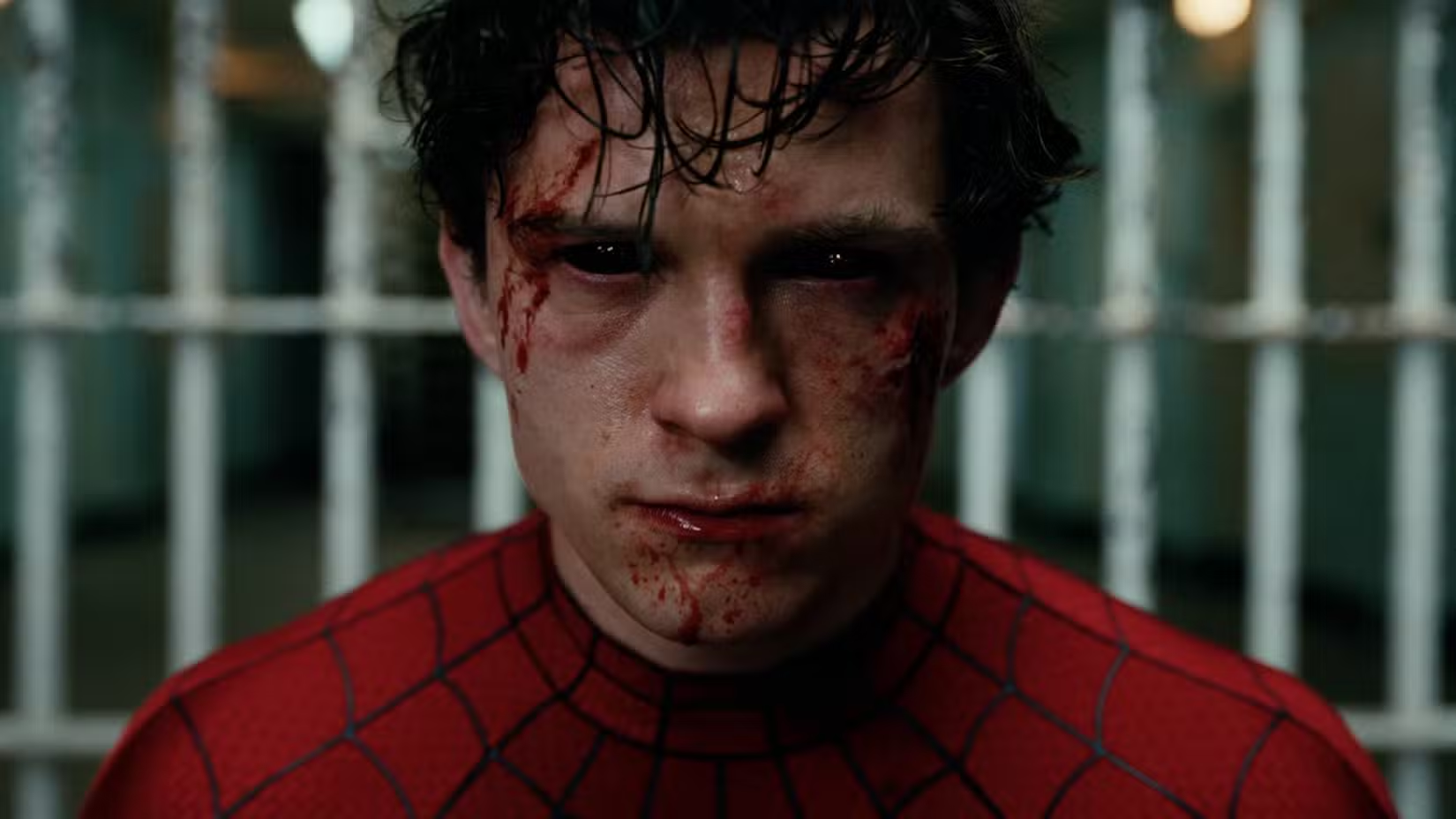
From what we can see in the trailer, Tom Holland’s Spider-Man appears to be going through his own additional transformations, including creepy fully black eyes and organic web-shooter, as well as the cocoon-building behavior previously seen in Marvel’s The Other arc in the comics. As I mentioned before, I doubt that the MCU will allow this particular cash cow to fully transform into a nightmarish spider freak that can scare away children, but there’s always a chance that the studio could surprise us with more horror elements. I’d also love to see the story explore Spidey’s mutation and use that as an excuse to formally introduce X-Men’s mutants into the MCU, especially since Sadie Sink is rumored to be playing Jean Grey in the flick.
However, even if Brand New Day doesn’t adapt as much of the Neogenic Nightmare as the promotional material has suggested, I’d argue that this particular season of Spider-Man: The Animated Series is still worth revisiting simply because it’s a great example of artists being able to work past network limitations in order to tell complex stories that approach full-on body-horror.
You must be logged in to post a comment.