Editorials
Five Freaky Horror Short Films to Scare You
The tragedy of the short film is that, while it’s a necessary step in a filmmaker’s journey towards producing bigger projects (with these movies often requiring just as much effort as a feature), no one really tunes into the Oscars just to find out who won “best live-action short”.
You’d be hard-pressed to find a single theater that still screens short-form media outside of the festival scene, and as someone who’s made a fair number of short films in the past, I can guarantee you that this isn’t a very lucrative endeavor.
Yet, at least where genre movies are concerned, some of the very best filmmaking in the industry is currently happening within the short film circuit. In fact, I’d argue that many horror shorts are actually superior to their feature-length cousins, often precisely because of their more concise structure and budgetary limitations. In honor of these short-form frights, we’ve decided to highlight five freaky horror shorts that are worth a watch!
Like our previous articles recommending horror shorts, this list is purely based on personal opinion, but every film here stands out either because of its narrative prowess, overall visual style, or the presence of good old-fashioned scares. That being said, don’t forget to comment below with your own favorite horror shorts if you think we missed a particularly memorable one.
With that out of the way, onto the list!
5. My house walk-through (2016)

Liminal Horror only really took off in 2019 with the rise of the Backrooms phenomenon, but I’d argue that the genre’s seeds had already been planted years in advance at that point. A great example of this is PiroPito’s underrated found footage oddity, My house walk-through, a bizarre Japanese “home video” where an unseen man gives us a looping tour of his increasingly disturbing home.
PiroPito (also known as Nana825763) was already something of a horror icon after the release of Username: 666 back in 2008, but My house walk-through is a narratively dense nightmare that far surpasses the director’s previous work. That’s why this memorable short is still worth revisiting a decade later, not only as the grandfather of an entire genre but also as a legitimately fascinating piece of minimalist horror filmmaking in its own right.
4. Heck (2020)

Kyle Edward Ball may have made a name for himself with Skinamarink, but it’s his 2020 short Heck that first introduced the world to the filmmaker’s peculiar talent for liminal frights, lo-fi aesthetics, and surreal storytelling. And if you ask me, the 28-minute-long short is a superior product to its feature-length cousin precisely because of its streamlined structure.
While both movies are obviously meant to be enjoyed as eerie mood pieces, Heck feels narratively denser, making it more enjoyable for folks like myself who like their grainy nightmare fuel served with a healthy dose of freaky storytelling.
3. The Kid and the Camera (2022)

Analogue Horror sometimes gets a bad rap because of certain creators who attempt to emulate aging technology that they’re far too young to fully understand, but I don’t think it’s fair to judge a whole genre based on a handful of awkward examples. After all, projects like The Kid and the Camera prove that there are still unexpected thrills to be had when exploring the darker side of nostalgia.
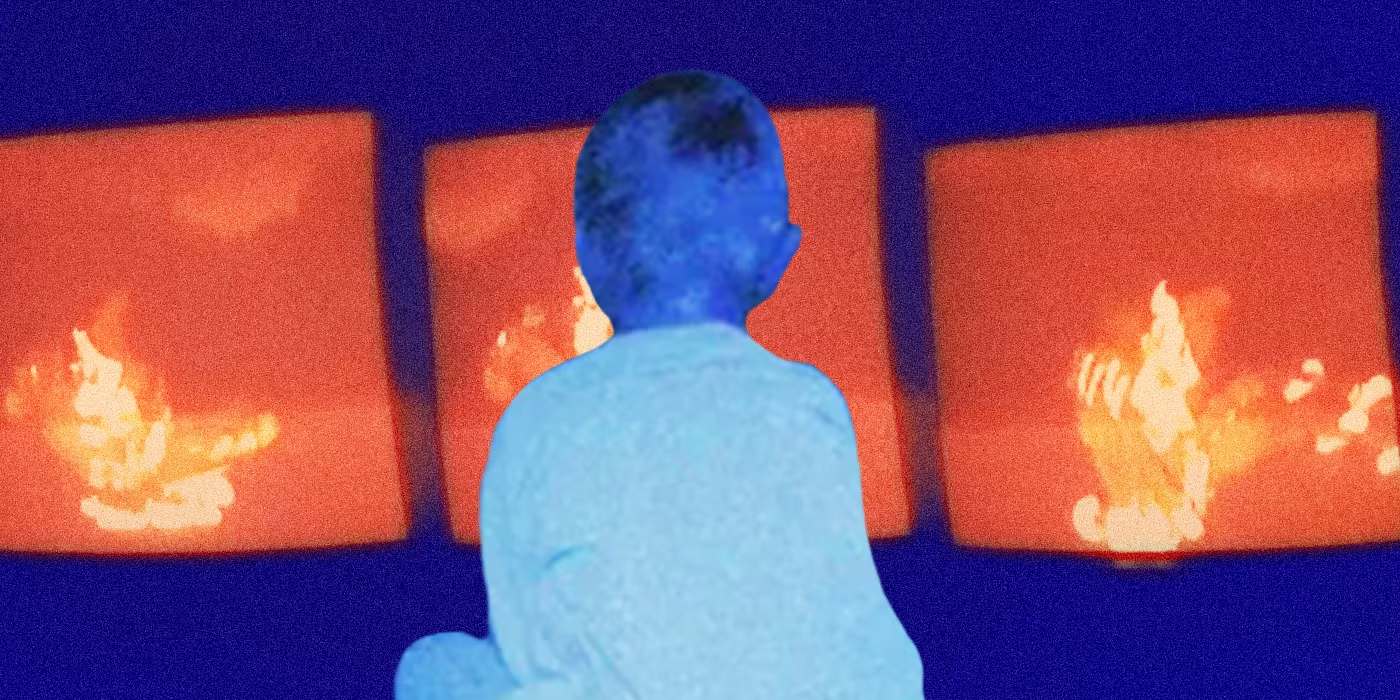
Not only is Braiden Ortiz’s short an exceedingly authentic recreation of children’s programming from the 90s, but it’s also the only real successor to classic Creepypastas like the iconic Candle Cove, and that’s why it makes it onto the list.
2. La Última Campanada (2026)

Not only is Braiden Ortiz’s short an exceedingly authentic recreation of children’s programming from the 90s, but it’s also the only real successor to classic Creepypastas like the iconic Candle Cove, and that’s why it makes it onto the list. Animated horror is tough to get right. While some filmmakers think that sinking a ton of money into tinkering with the art style is all it takes to set up a spooky atmosphere, the fact remains that a good scary movie needs a good script, expensive animation or not. That’s why La Última Campanada (The Last Bell in English) is such a good time, as this indie production from Spain manages to translate all the gothic thrills of a traditional folk legend into a short yet satisfying experience.
The textures and animation may not be as smooth as something rendered by Pixar, but the subtle craftsmanship on display here more than makes up for that. From simulated split diopter shots to a narrative directly lifted from oral tradition, there’s a lot to love about this clever reinvention of the vourdalak myth.
(La Última Campanada is currently still screening at festivals, but it’ll be released online soon!)
1. Desdêmona (2025)

Cronenberg meets Kafka in this moody exploration of non-binary identity and insectoid body horror!
Desdêmona is likely the strangest movie on this list, with the filmmakers combining surreal visuals, meta storytelling (the main character even builds prosthetic props for horror movies!), and hand-crafted effects work in order to tell a unique story about a lonely individual undergoing an unexpected transformation.
That’s why I’d recommend this atmospheric Brazilian gem to all the weirdos out there – so long as you can handle the bug-themed imagery.
Books
The 10 Best Horror Books of 2026 (So Far)
There’s a lot of reading left to do in 2026, between the glut of summer releases and the approach of fall, when horror titles get a special push from publishers, but this has already been an incredible year for horror literature.
Some of the biggest names in the genre have turned in outstanding work, rising stars have made their mark, and we’re only halfway through the year.
To celebrate the midway point of 2026, with plenty of horror books still to come, we’re taking a look back at the best horror books we’ve read this year so far, listed alphabetically by author.
If you missed any of these books earlier in the year, consider this your reminder to catch up.
Japanese Gothic by Kylie Lee Baker

A student running from a crime he may or may not have committed escapes to his father’s country home in Japan, only to find himself haunted by strange apparitions, while in the past, a young samurai tries to find salvation for her family and finds a door to the future instead. Kylie Lee Baker’s Japanese Gothic begins with this dialogue between past and present, and then blossoms into so much more, a cross-time ghost story about old wounds and what it really takes to finally heal them. I got so happily lost in this one that I would have read at least 200 more pages.
Persona by Aoife Josie Clements

In this tale of shut-ins, sex workers, artists, and the horrors they both summon and recoil from, Aoife Josie Clements weaves something that feels less like a story to be experienced and more like a psychic wound to be endured, and I mean that in the most complimentary way possible. Evocative in its prose and nightmarish in its imagery, Persona is a story of the masks we wear, and the understanding that not all of our masks are particularly pretty or even easy to breathe through. It’s a dense, literary, unnervingly vicious book, and while it’s already attracted an audience, it deserves a much bigger one.
Dead First by Johnny Compton

Johnny Compton’s latest novel opens with a throwing down of the gauntlet, a sequence that made me instantly think “How on Earth is he going to top this?” It’s a story that begins with a billionaire hiring a private investigator to determine why, despite trying in many brutal ways, he cannot die. That premise, and the scene which sets it all off, is so alluring and delightfully gruesome that you almost can’t believe it’s the way a book begins, and then Compton just keeps going, delivering a supernatural mystery that I could not put down.
Make Me Better by Sarah Gailey

A woman grieving for the life she wanted visits a mysterious island renowned for the healing salt its residents harvest and sell, seeking renewal and relief. What she finds instead is a strange cult with a twisted history with surprising resonance in her own life, and a people who are more than willing to grant the relief she wants, for a price. Laced with beautiful prose and moments of profound realization alongside folk and even cosmic horror, this is vintage Sarah Gailey.
Partially Devoured by Daniel Kraus

If you love horror film history and analysis, Partially Devoured is an essential. Written by Pulitzer Prize-winner Daniel Kraus, the book is a deep dive into his favorite movie of all time, George A. Romero‘s Night of the Living Dead, complete with exhaustive research into the making of the film and passages of deeply moving memoir woven in. If you’ve ever wanted to know what the eerie music that opens the film is called while also bursting into tears at how horror movies can save your life, this is a must-read.
Wretch by Eric LaRocca

Our reigning King of Extreme Horror, Eric LaRocca weaves books of uncommon beauty out of the most nightmarish parts of humanity, and Wretch is no exception. The story of a grieving man who longs for relief and searches for it amid a strange support group that might be a cult, Wretch is a brutal journey into the darkest part of us all, and explores what salvation we might find when we get to the rotten core of the world and peel back its layers. LaRocca’s on a tear of great work right now that few other genre writers can match.
Headlights by CJ Leede

A mystery, a serial killer horror show, a tribute to Stephen King‘s The Shining. All of these things describe CJ Leede’s Headlights, and yet they don’t begin to cover the full breadth of horror awaiting you in this novel. The story of a former FBI agent drawn back into the cold case that haunts him most, it’s a shocker brimming over with vivid moments that’ll live behind your eyes. CJ Leede has now published three novels, and they’re all bangers, so it’s time to get on board if you haven’t already.
It Came From Neverland by Cynthia Pelayo

Cynthia Pelayo has been one of our finest genre writers for years now, but It Came From Neverland is my favorite thing she’s written, and it’s not even close. A dark take on Peter Pan from the perspective of an adult Wendy Darling living in World War I-era London, Pelayo’s book works as both a satisfying horror narrative and a rich exploration of what it really means to never grow up. The horror never loses its potency, but it’s the search for the meaning behind the Peter Pan phenomenon in our own lives, and what we can do about it, that sticks with me most.
Filth Eaters by Ito Romo

Ito Romo’s Filth Eaters is a slim volume, one you can read in just a couple of hours if you’ve got the inclination, but it has the feel of a generation-spanning epic. The story of a breed of vampires born in Central America, the European vampires who encounter them, and the offspring they eventually produced, it spans centuries and packs loads of juicy lore into its pages while never losing its grip on character and narrative drive. I would read hundreds more pages of this world, but I’ll settle for this uncommonly grand-scale novella for now.
Dead But Dreaming of Electric Sheep by Paul Tremblay

A former pro gamer gets a job at a tech company to pilot a brain-dead human body across the country, and so Paul Tremblay’s sci-fi-horror juggernaut begins. Indebted to Philip K. Dick, the primal snarl of Harlan Ellison, and the quirky comedy of The Big Lebowski, and yet wholly original, this is a towering and ambitious novel by one of horror’s most respected voices. What starts as a high-concept tech thriller soon becomes a startling meditation on the value of stories, who gets to tell them, and what happens when we cede too much control to machines we don’t understand. It’s a stunner.
You must be logged in to post a comment.