


While art-house horror isn’t exactly the most popular sub-genre in the film world, a variety of silver screen gems have resulted from directors feeling that traditional genre limitations are more of a guideline than concrete rules. Films like David Lynch’s Eraserhead, or even Michael Haneke’s Funny Games may be considered too ‘dense’ or ‘complicated’ by some moviegoers, but still had a substantial impact in horror. This is why, after recently having the pleasure of reviewing Kyle Broom’s surreal feature film debut, Tabloid Vivant, I jumped at the chance to interview the first-time director about his influences and filmmaking process.
My review of Tabloid Vivant is available here.
Bloody Disgusting: First of all, we appreciate you accepting our request. I immensely enjoyed Tabloid Vivant, and it’s good to know that art films are evolving with the times.
Kyle Broom: Thank you so much for asking me and for your review of the film. It’s so gratifying to hear that you enjoyed it. You said the term ‘art film’ – that’s a pretty dirty word these days around much of the film world, even on the festival circuit, so I’m well aware of how far out on a limb I am. You kind of need to be willing to go with the movie and take the kind of ride it’s offering; I wasn’t at all sure how many people would be up for it. So the positive reaction so far has been really exciting.
BD: Do you think that the film could have been funded without help from Kickstarter, or the internet in general? It’s such a peculiar story and visual style, hard to imagine something like this getting made before the digital age.
KB: While most of the budget was raised outside of Kickstarter, the campaign definitely got us over the finish line. You are right that it would have been difficult to get this project funded through the ordinary channels, because, as you say, it’s such a peculiar story and style, and also because I was a director who hadn’t yet made a feature. It’s just always much more difficult to get something off the ground when there aren’t known markers attached that are similar to previous, successful projects. And it’s kind of hard to come up with a good example of a film that is similar to Tabloid Vivant.
You’re right about the digital age and the internet. There are direct ways that the film is trying to talk about the internet — the way Max’s research leads him to Sara’s obsession with the Black Dahlia, for example — but the way digital tech and the internet became such a huge part of the post-production process was something I didn’t really anticipate. I had never written any code before. About 7 or 8 months of the post-production was me using the internet to teach myself how to teach my computer how to make Max’s paintings. At one point, I was going to credit the internet as a collaborator, but Alex talked me down from that.
BD: How did you first envision Klinkau’s painting? There must be an interesting story behind that.
KB: Well, there certainly is a story. Judgements of interest will vary, I think. Haha. This whole painting idea came out of an aesthetics paper I wrote in graduate school. There’s a really interesting way in which tools influence and constrain creative choices. Like musical notation — it kind of tells the composer the range of sounds with which she has to work. I wanted to create something similar with painting where the “score” tells you where on the canvas specific colors have to go, but in a loose enough way that the resulting paintings can all differ from one another visually. That idea transformed into Klinkau’s paintings when I noticed that, as far as the score can tell – all those different looking paintings are the same – they’re all paintings of the same score. That’s when my fixed, analogue paintings got agitated and became Max’s living digital ones.
BD: Though the issue of reality has been disputed in the art world for many years now, recent technology like functional virtual reality and other forms of digital media have made this discussion relevant again. Do you personally think that filmmakers (and artists in general) will one day truly be able to cross the line between representation and reality, or is the line itself just an illusion?
KB: Wow. Thanks so much for this question! I think this line between reality and representation isn’t so much an illusion as a matter of facility and usage. Reality is a just a bunch of representations we are so good at interacting with that we don’t notice they are representations. It’s just that some representations, like a photograph, are so unresponsive and low-bandwidth, that it’s difficult to imagine effectively interacting with it in place of the person it depicts. But what if the picture could move? Make sounds? What if you could talk to the person in the picture and the person could talk back to you? At some point, you could get used to interacting directly with the person instead of using the picture as a “mere” representation. This is basically Skype – no one is tempted to say the person you’re talking to on Skype isn’t real, but you certainly interact with a representation of that person when you’re using Skype to talk to her.
So, if anything, representation versus reality is a matter of how accustomed your brain is to using certain inputs. And this, of course, is something that changes and develops–and something that art can and does very powerfully influence. Picasso famously said about his portrait of Gertrude Stein: “Everybody says that she does not look like it but that does not make any difference, she will.”
BD: What was an average day on set like, any interesting anecdotes? The strange make-up/body paint on Tamzin Brown towards the end of the film must have been a chore to work with.
KB: I guess the first thing that comes to mind is how isolated we were while shooting at the cabin. We were up in the mountains above Azusa, California and for most of the time we were there, we had no telephone, cell or internet service of any kind. A satellite company even came out to try to set up a temporary internet connection and they couldn’t get a signal. So, every night when everyone but Alex and I went home, she would drive down the mountain and sit in the parking lot of Starbucks, to siphon a wifi signal and put out any production fires ahead of the next day’s shoot. Just doing food runs and getting expendables and stuff like that was an ordeal, because someone had to drive forty minutes away from the cabin in order to get a call out.
In another way, though, the lack of cell phones was a real asset during that part of the shoot. There was just this intense focus from cast and crew and I think that was encouraged by how cut off from the rest of the world we were. I also think it contributed to the fact that we enjoyed a rare film-family atmosphere on a project like this where everyone is stretched to capacity, attempting to do as much as possible with what we had available. Sometimes that can end up really backfiring on a production and the crew turns against the project. But I think we dialed this one in just right where everyone was stretching themselves without getting fed up with the pressure and stress of a challenging shoot. We also had a wonderful camaraderie between the actors and the crew, which really helps to make everyone feel like they are all part of creating something together. I have my wonderful leads Jesse Woodrow and Tamzin Brown to thank for that.
Working with the paint makeup wasn’t a chore for me… for Aubrie Davis (our Key Makeup Artist), and Jesse and Tamzin, hmm. I don’t know–it never really came up as a problem that I heard about, but also, I mean if you’re a makeup artist, I’d imagine a project like this is an opportunity to go as wild as you want to be. Doing a big makeup application and keeping it consistent from one day to the next is a challenge. But I think having actors on set looking as strikingly deteriorated as Aubrie made Tamzin and Jesse look kind of heightens everyone’s interest and excitement so everyone is trying to come up with the best ideas they can to bring to the set.
BD: Do you worry that, because of the niche subject matter, general audiences might shy away from Tabloid Vivant?
KB: Yes, it’s been a worry of mine. It’s a weird film that defies neat classification. I guess I have just been telling myself to try to make the most interesting and original film I could. If people like it then that will be great, and if they don’t then I’ll probably become depressed and bitter, but at least I’ll have made something that I can stand behind as truly attempting something original. Honestly, though, I have always been much less concerned with finding an audience that connects with the film than I have with finding a distributor who wants to try something new. I think there is a lot more creativity and openness to trying new things from filmgoers than there is from people who market and sell films. I mean, general nerdiness has bubbled up as a trait to be embraced in the age of the internet, and there’s a high level of technical interest and sophistication on the part of genre fans of various sorts. There’s also been a blurrying of lines between “high” and “low” art. All of these things seem to point up the presence of a significant audience for Tabloid Vivant, because it deals in having fun with nerdiness and spattering the rarefied air of the fine art world with a bit of horror and delirium.
BD: Which specific movies, or other media, influenced your work on the film?
KB: So many. In terms of films, for me, The Shining kind of stands on its own as a singular, perfect work and it influences my thinking about film more than anything else. Antichrist was also a big one for me and, visually, at least, Melancholia. The devastating power of the final shot of Melancholia–that instantly cut a trench in my brain that shows no signs of shallowing five years later. The irrepressible dread that image made me feel.
The story structure allows me to do a few different genre shifts at various points throughout, which of course just creates such an opportunity to play around with all kinds of visual ideas, like the way the beginning sequence looks noir or the first scene at the cabin parodies a romance. Using the rear-screen projection setup and the corvette for the driving scene in the beginning, I was thinking of the hyper-fake, candy red look of Vertigo.
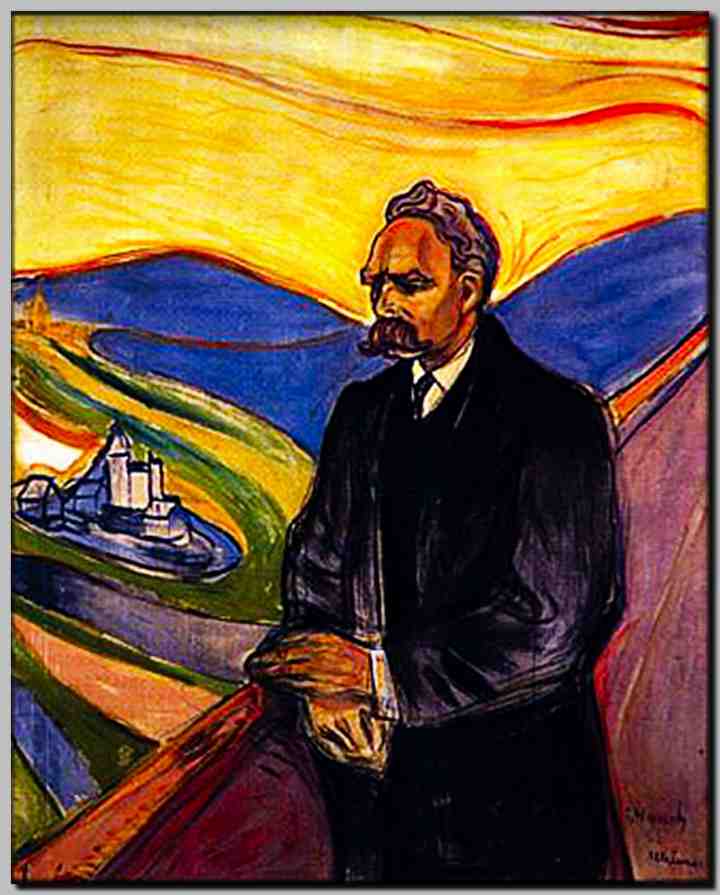
The scene with Lou Salome and Friedrich Nietzsche was based on an actual photograph they made, which is in black and white, and I wanted to emphasize the effect of the photographic medium so I made the backdrop with these bright primary colors. I stole those colors from Edvard Munch’s paintings of Nietzsche, which I had first seen in black and white on the cover of a book. It looks so gloomy and Sturm und Drangish, when I saw the original later it really struck me how much of a mood change that makes in the effect of the piece, so I wanted to try to work that transformation in.

Graffiti and street art were also a big influence that comes through in Sara’s way of thinking and talking about art. There are pieces of street art photographed in the film as well as an animated version of a Space Invader piece; Blu’s stop-motion murals were also an inspiration for Max’s paintings. A strain runs through Sara’s writing about people just seizing their own creative opportunities and connecting directly with their audiences, without the oversight and acceptance of institutional channels. That’s something from street that I’m very inspired by, and I like the idea of applying it to filmmaking, especially now that access to professional tools and techniques doesn’t really require permission from anyone. It’s a ripe time, and there’s a lot more opportunity to push boundaries and do new things than we are currently taking. If you have an idea for a film, and you care about it enough to devote a year or two or to making it – go out and do it!
BD: When and where can viewers expect to see Tabloid Vivant? I hope it gets some form of theatrical release, but modern distribution like VOD seems fitting for an avant-garde picture like this one.
KB: Now that so many reviewers are giving the film such an enthusiastic and thoughtful reaction, it should be much easier for us to get it out to as wide an audience as possible. I’m really very grateful especially for the way that the horror community has embraced us. You know, the relationship between artists and people who think and write about art is a main theme in the movie, so it’s so exciting to see that idea coming so significantly into play in how it’s being seen and received.
Right now, we are still considering our distribution options; we have a few irons in the fire, taking a hard look at what’s going to be best for the picture to get it seen as widely as we can. Thank you for expressing that hope for a theatrical run. That’s something we would be delighted by. As I think I’ve indicated, I’m very much a champion of digital tech and the internet as filmmaking tools – and film distribution tools. Most of my film viewing these days takes place at home on a digital projector. But every single one of my most moving film-viewing experiences has taken place in a theatre and with an audience. For me, at least, sharing the experience with a bunch of strangers assembled in the dark just amplifies my response by orders of magnitude.
Therefore, we will certainly release Tabloid Vivant on VOD and DVD/Blu-ray in the coming months, but we are also working on getting some sort of theatrical run. So, if the trailer, reviews and press materials pique your interest, please follow us on Twitter and Facebook. We will continue to publish news and updates about the release as we settle on our plan.
BD: Thank you very much for your time, and I can’t wait to seoe any future projects you have in store for us.
KB: Thank you so much for your interesting questions and thoughtful review. I’m currently working on a new Horror/Sci-Fi feature script about a woman whose identity gets taken over by her social media use. It’s called Goldilocks.
BD: Ha! I’m excited already!