


Shane Black has made a name for himself by pioneering the buddy/action picture with films like Lethal Weapon and The Last Boy Scout. His newest movie looks to expand his usual duos into a full on ensemble with The Predator. When I visited the set, the emphasis from almost all parties involved was on “character”. It’s true that for an audience to be invested in a picture, focus must be placed on our heros. If we’re not rooting for them, why should we care at all? The core group carries the telling moniker of “The Loonies”. Each member is former military coping in various degrees with PTSD and remorse from their time spent in war.
It’s clear that Black’s intention is to craft an epic thrill ride utilizing various genre motifs in a mash up straight out of the 80’s, but the groundwork for such a piece is built from the characters up. He contrasts his style to other big budget tentpole spectacles that are crammed to the brim with massive stunts:
“Our quest to be a cut above is to make it so we keep changing it up so that it feels more like a thriller and less like just action. Because action to me is not sustainable over two hours. You can like it. You can like the Transporter movies. They’re fun, but at the end you don’t feel like you’ve had an experience with a guy that you want to sit down with. You feel like you’ve watched an action character flex his muscles. Hopefully we give you a bigger canvas, more action, and better characters. That’s a big get. That’s a lot.“

Quint (Boyd Holbrook) – The Leader
Hot off his villainous role in the hit Wolverine pic, Logan, Boyd Holbrook is no stranger to big budget genre pictures. This, however, is a lead role; as Holbrook puts it, he will “carry the movie on his back.” It’s not hard to believe as the actor is pulled from the tent twice for his on set obligations during the fairly short interview. His character, Quint, is the estranged father of Rory (Jacob Tremblay). While not an OG Looney, Quint is thrust into the group and becomes their de facto leader, and he might just be the catalyst for the ensuing alien insanity. In fact, it’s hinted that Quint has a direct connection to the original film (remember that familiar jungle set I mentioned?):
“You find him doing mercenary work. Basically collecting a paycheck. You got something you need done down in Mexico. I’m your guy. So he’s estranged from his wife. He’s detached from his son. Really the heart of the story is about reconnecting and being a father, reconnecting and getting all these looney tune guys who have no direction, to give them some purpose…What is interesting, if I may say – I’ve seen something and maybe there is a familiarity or, I wouldn’t want to say he’s a UFO conspirator but he’s heard of things and seen things [from his time in Mexico]. So that’s the reference to the original. We are keeping some sort of lineage.”
Holbrook doesn’t seem interested in repeating the same types of roles from picture to picture. When opportunity knocked for him to battle against the Predator, he jumped at the chance.
“What attracted me to this, it was a completely new story…for this character, what Shane wanted to do, the higher story, is to give a complete freshness…to give it a heartbeat. Going away from the machismo, ya know, guns and guns…And, I love that film, but I think we’re setting out to do something really different.”
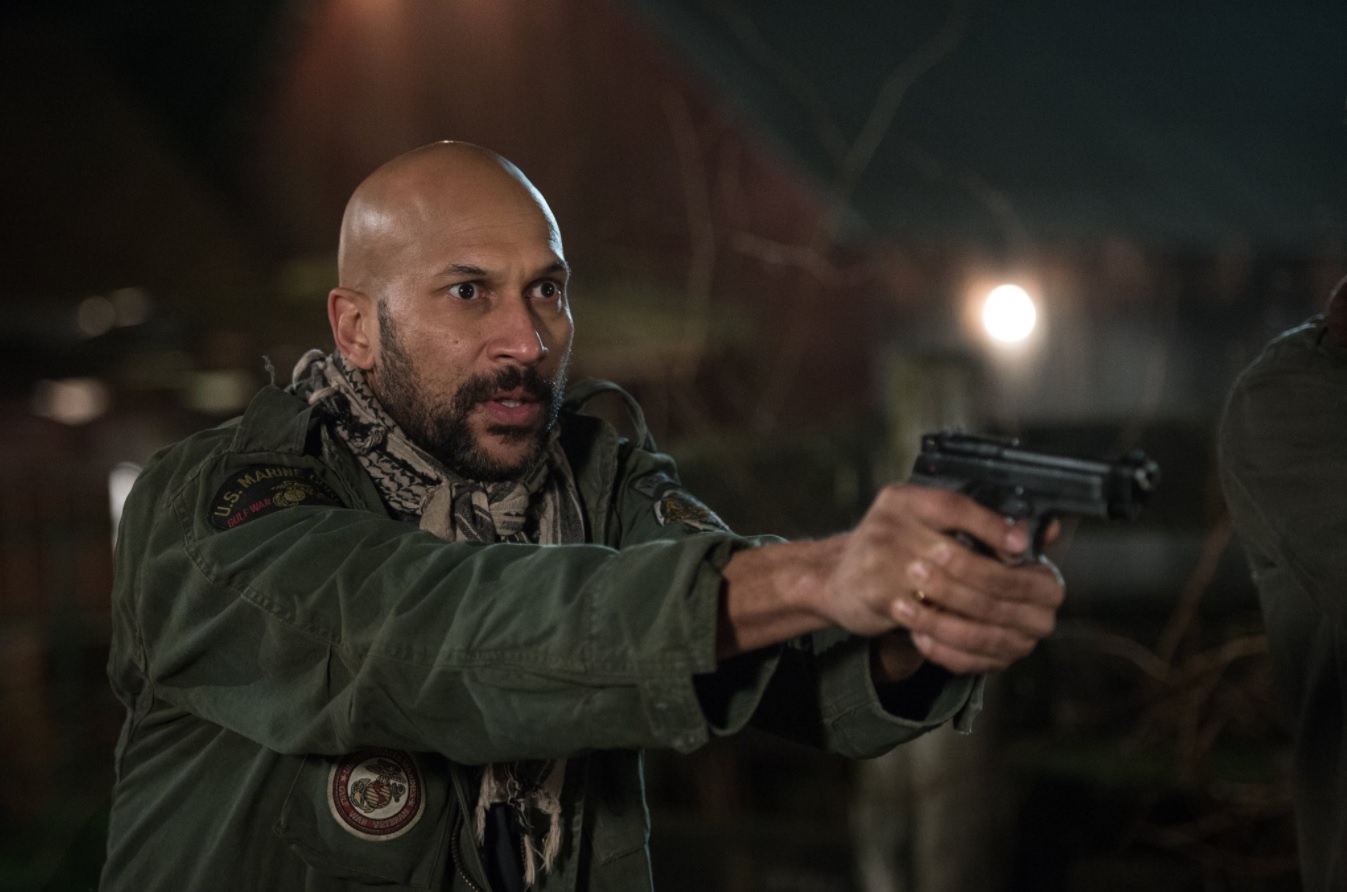
Coyle (Keegan-Michael Key) – The Loud Mouth
When Key stepped into the tent I was instantly taken by his presence; tall, animated, charming (I was man crushing pretty hard). “I’m the big mouth of The Loonies!” It was abundantly clear that Key was as jazzed to be on set as we were, and he was relishing the moment.
“There were certainly things that I’m not allowed to share with you that made my eyes pop out of my head…There’s always a nice, sly, meta quality [to Black’s writing]. This picture contains great referential stuff to not just the original movie, but to Predator 2 and every other movie in the franchise, the Alien vs Predator universe…The way he references the movies is very clever if you’re a huge Predator fan. I’m a HUGE fan of this universe.”
While it seems this bit of backstory might not make it to film, Key explains how his character, Coyle, and the rest of The Loonies wind up getting caught in a battle with extraterrestrial hunters. The gang meets weekly at the local VA for group therapy, and their biggest complaint is the piss poor coffee. Finally, they start a mutiny over the junky java and get themselves detained. On the bus ride to the nuthouse is where it seems the story proper begins:
“Boyd’s character just happens to be thrown on the same bus with them. So, that’s how he becomes our ad hoc leader. [Coyle] has a very jarhead mentality, ‘Well, okay, so there are aliens.’ Brbrbrbrbrbr (mimicking the sound of gunfire)…He’s never fully engaged. He’s always standing a little outside of himself, so he doesn’t have to deal with his own pain. He goes, ‘I guess we’re doing this. I guess these seven foot dreadlock dudes are real.’ He pretends like he takes it with a grain of salt..We’re all a little off. We’re not the dream team.”

Baxley (Thomas Jane) – The Loose Canon
“They’re taking us down to the, ya know, the big hospital where they’re going to lock us up for a few days for observation. That’s when Boyd gets thrown on the bus too with us, cause he’s seen an alien and they want to cover that shit up. So, Boyd and all these lunatics end up going on this adventure.”
Thomas Jane manages to provide the most succinct plot synopsis thus far with his dryly humorous delivery. Jane has gotten to play in a lot of fanboy sand boxes, and The Predator is just another in a long list that includes a Marvel movie, Stephen King adaptation, and his current Syfy series, The Expanse. As Baxley, Jane’s character is the closest with Key’s Coyle. During a friendly fire incident, Coyle made a fatal mistake that led to the death of Baxley’s troupe, ultimately leaving Baxley shell shocked and now suffering from tourettes. “I know that Shane and Keegan came up with a lot of the backstory themselves…We’ve tried to pepper that stuff, weave it into the story.” Speaking of Black and the freedom to play around outside the script:
“He creates a tone that’s very hard to do. It’s serious. The stakes are high. The people are real, yet it’s funny as fuck…He hits a bell inside of me that I really enjoy.”
Nettles (Augusto Augilera) – The Lovable One
Augusto Aguilera might not be a name you know yet, but his character of Nettles is described as the “heart” of the group. Nettles is a role that just might put the young actor on the map. Aguilera is instantly relatable and down to earth as he describes being in the unemployment office just weeks before landing the role. When asked how big a fan he is of the Predator franchise, he tells of how he and his brothers “played” Predator after having seen the original movie:
“I would be, for some reason, I was The Body, Jesse Ventura. We’d run around the house and my poor mother and father would freak out. We’d run around and shoot guns and shoot at them cause they were the alien at the time…We’d get dressed in full costume doing this, because my mom saved all of our costumes from Halloween. We’d be in full camo. We’d paint our faces…So my fandom? Out of ten? Ten.”
The character of Nettles is a bit of an outsider trying to fit in with this group of damaged tough guys. He used to fly helicopters as part of a special forces group known as The Nightstalkers. An injury from a past mission left him with TBI (traumatic brain injury). “So, I’m just a beat behind. Which is easy for me to play,” he says with a sheepish grin. On preparing to tackle the sensitive subject of TBI, Aguilera explains, “You prepare with, just trying to get kind of a sense of humanity. You don’t want to be there doing these things and the people that actually are afflicted with this, you don’t want them to feel like they’ve been spoofed…That would ruin me.”
From playing pretend soldiers as a kid, Aguilera has come full circle to playing pretend as an adult. Thankfully, this time around he got a bit more training before being sent off to faux-warfare:
“They’ve got some special forces guys here and they’ve just been, they’ve like handed us a bunch of guns and blanks, obviously, and they’ve been teaching us to do all this stuff. I’m walking around now in Vancouver thinking I’m like six feet tall. I feel like I’m so cool cause I can shoot a gun. I have no idea if I can hit a target, but I can LOOK pretty cool shooting it.”

Lynch (Alfie Allen) – The Loner
Alfie Allen is very quiet and observant. He sits before us patiently awaiting each question and providing only the few necessary words to relay his intent, nothing more. Unsurprisingly, his character, Lynch, is described as the loner of the group who tries to intimidate those around him with nothing more than a glare. Though, he apparently has one other trick up his sleeve. “He’s got a skill which is, um, sleight of hand. He uses card tricks to sort of fill his alone time, but I guess also, it’s just kind of a nervous tick.”
Allen has a bit more to say when it comes the film itself:
“It’s very real. Rather than it just sort of being ‘Hey, tough guys! This is an alien. We can deal with it!’ We’re all just really dealing with it as humans…I think it’s different from the other Predators…When I was reading the script, it immediately jumped out towards me that this is a whole different ballgame.”

Nebraska (Trevante Rhodes) – The Right Hand Man
“This is awesome. This is obviously a big difference from what I’m used to!”
Very true words, coming from Trevante Rhodes who has gone from the groundbreaking, Oscar nominated indie film, Moonlight, to the newest sci-fi/action epic in a long running franchise. Rhodes has a laid back demeanor, calm and cool as he points out that one of my fellow reporters is “cheesing” from the excitement of being on set. It’s as if this newfound celebrity hasn’t yet caught up to the hot up and comer. In the film, Rhodes takes on the role of Nebraska:
“He’s the man behind the man, in regards to Boyd Holbrook’s character. He’s kind of the guy who helps keep him on track and helps push him and everything. So, he’s kind of the leader behind the leader of this motley crew…Nebraska, he was someone who had his own special forces group, he had his own unit….he made a wrong decision and got everybody killed except for himself…
That’s something he’s still struggling with and why he’s kind of distanced himself from the world. Then he stumbles upon these people that kind of assume that same kind of family…I’ve been in the shits. I’ve lost it. Know what I mean, I have nothing left to lose. A man that has nothing left to lose will try anything twice…Obviously, we get into this world of aliens and he’s like ‘Well, what else could happen?’”
Rhodes continues to heap the resounding accolades onto Black for his ability to breathe new life into an old franchise and help root it in strong characters. “It’s exactly what you would expect from Shane Black, but obviously placed within this unique world, but with…more heart than what I’ve seen from Shane’s work before.”
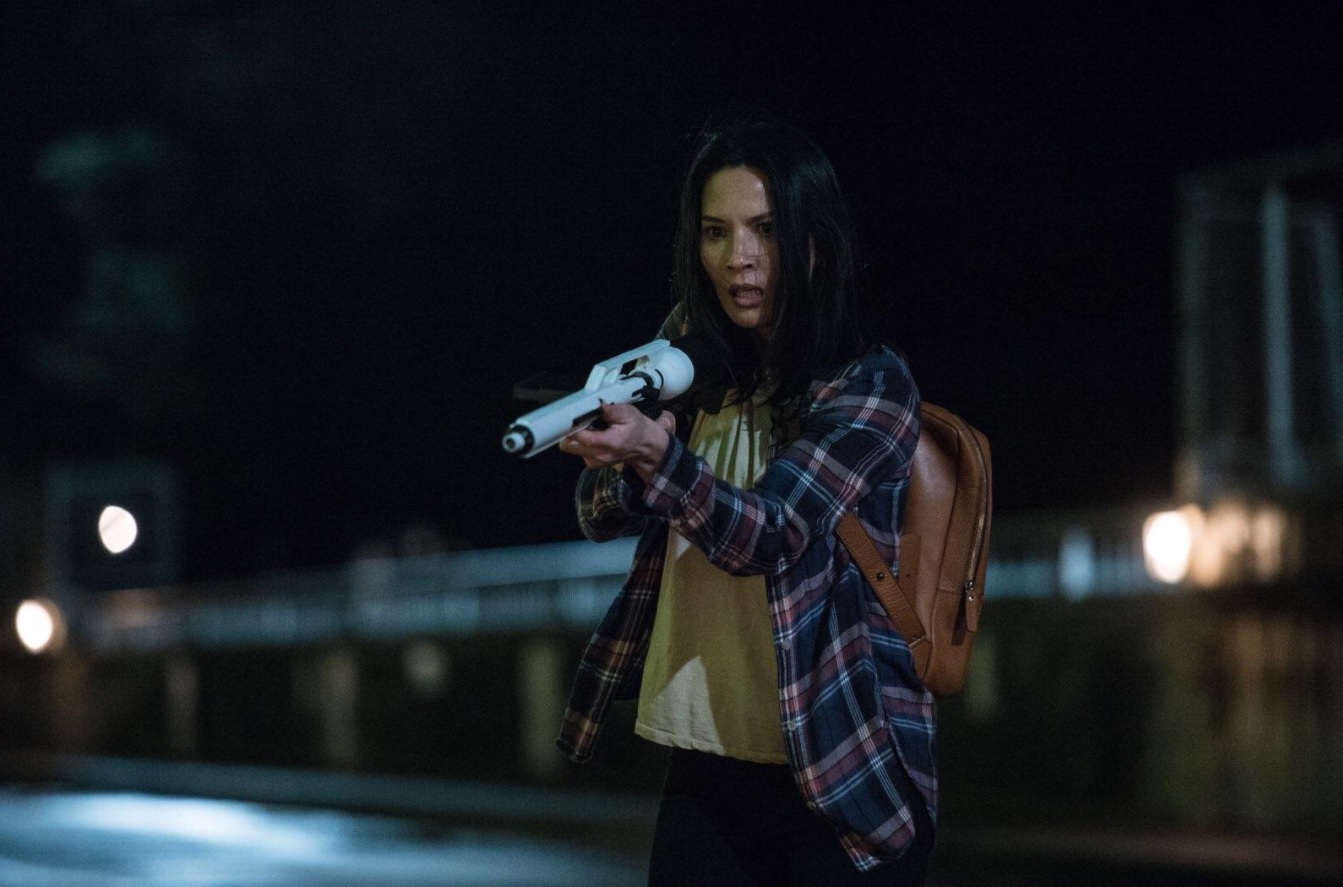
Dr. Brackett (Olivia Munn) – The Brains
As the sole female lead, Olivia Munn’s Dr. Casey Brackett is far from just another “token female” or one note, super-powered badass. She’s a legitimate human being thrust into an extraordinary situation. The actress is as friendly and welcoming as she appeared to be those many moons ago on G4. She’s come a long way from co-hosting a nerd tech talk show. “My character has been on a list from the CIA because she is an evolutionary biologist, and because of her expertise…she gets called in to the labs and gets to try and offer her help — and then things happen!” she coyly ends as to avoid any spoilers.
“There’s a small scene where my character is shown pictures [of the predator] for the first time….This is like seeing God to her. This is what she’s studying, how creatures change and evolve and how it’s not scary. It‘s a very beautiful thing to see…There is an element of realizing when you’re in danger and at the same time, trying to assess. She doesn’t just jump to conclusions just because she doesn’t look like them and she isn’t speaking the same language, doesn’t mean that you shoot it right away. That’s a lesson for everyone in life.”
When asked if we might see the Predators evolve and change throughout the film, Munn gives a cheeky grin and responds, “That’s a very good question.”

Rory (Jacob Tremblay) – The Key
The ten year old boy who has been making a name for himself since the critically acclaimed role in The Room is far from your typical child actor. He’s smart as a whip and gives commanding, thoughtful performances; but unlike some Stepford-esque child actors, Tremblay is still a kid at heart who gets excited by the idea of Nerf Guns. Though, Shane Black jokingly thinks otherwise, “It’s uncanny. He’s a mutant…I’ve never seen anything like it. Like cramming Peter O’Toole into a miniature body.”
We learn that Tremblay’s character, Rory, is autistic. This leaves him with an uncanny ability to understand various languages…perhaps even that of the Predators? To prepare for the role Tremblay and Black visited various autism centers where the young actor was able to meet those living with the condition and better understand their physicality. While it may have been research for the role, in Tremblay’s words they just went “to hang out with some kids.”
While he may be too young to buy a ticket for The Predator once it’s released, they hasn’t stopped Tremblay from seeing the original film.
“It was really exciting because I saw the first movie with Arnold Schwarzenegger, and I loved [it] and I wanted to be him for Halloween. Plus, this is my first action movie, and I was really excited about that…When I heard I could get the part I was like, “YEAH!”
It doesn’t hurt that Tremblay, Black, and Holbrook have had what sounds like several Nerf battles at the film’s production office, but Tremblay was obviously having a blast working on this particular set. “I wouldn’t do it if it wasn’t fun.”
Just how fun is it acting against a 7 foot tall killer alien? Surely that would be terrifying for a 10 year old? Nah. Tremblay excitedly told us, “I got to fist bump him!”