


Rory (Jacob Tremblay), an eight year old boy wearing an over-sized yellow hoodie, is chased by a neighborhood dog onto the school baseball field only to come under attack by something much more vicious… an even bigger, alien canine. Eventually, his father, Quint (Boyd Holbrook), comes to his rescue along with a ragtag team of misfits with the telling moniker of “The Loonies”, a group of former military grunts suffering the various repercussions of war. Throughout one long shooting day, I watched this scene play out shot by shot on a monitor, stowed away within a black tent, on the set of Shane Black’s upcoming franchise reboot-quel, The Predator.
For starters, the rumormill has been going back and forth around the film’s locale. Is The Predator finally laying claim to the suburbs? Sort of. The film takes place in Georgia with some scenes that include the relatable neighborhood setting, but the story’s scope far exceeds just those white picket confines to include government research facilities and even the Predator’s spaceship. Of particular note, one large set off to itself was made up to resemble a very familiar looking jungle backdrop.
One thing that is entirely clear from all of the buzzing about on set, Shane Black is setting out to create the ultimate entry in the franchise with a scope unlike any we’ve seen before.
Just how does he intend to do that? It seems that in today’s age of overblown, effects driven superhero movies, Black seeks to recapture the movie-going magic of the 80’s. “You look in the mirror and think ‘Geez. It’d be nice to be a kid again.’ Go back and get the excitement back,” stated Black. Along with co-writer, Fred Dekker (who helped pen the iconic Monster Squad with Black), the two are aiming to deliver a fun, action/thriller hybrid to satisfy their inner fanboys. Black added, “Every once in a while I say, ‘Boy, I’d just love to go do a Predator film with Fred.’ You know something that recalls all those wonderful and exciting days when we were geeks lining up for Star Trek: Wrath of Kahn… There was a great deal of nostalgia, and also a desire to do kind of an old school thriller in the form of Predator.”

Something Old, Something New
Perhaps it was the fact this was ” a film by Shane Black”, or just simply that Predators are fucking cool, which led to the tremendous aura in the air that everyone on set genuinely believed in what they were doing. With almost every actor who stepped into the tent to provide an interview, you could tell they were bubbling with anticipation to say more than they were actually allowed. What was said was a promise from Shane Black. The writer/director promised us a genre-bender the likes of which we haven’t seen in some time. He explains in further detail just what his intent was in returning to the franchise after almost 30 years:
“Let’s try and do an old school, real hearty and heartfelt kind of war movie…All the elements we like: spies, romance, mystery. Just stuff as much genre into one pack as we can. You can literally unpack different facets of the movie. It’s sort of a stew that represents to us the genre movie we would have loved to see when we were coming up…
…There’s an element of intrigue, espionage and mystery…the government is involved in this. It takes it to the level of what happens when Predator strikes and these incursions are not just a every once in a while phenomenon known to a few but have come to the attention of an establishment that is actually set on preparing for and marshalling forces against these incoming Predator strikes. The next step is when they get noticed…And also, what happens when the Predators get a little more ambitious…
…We just tried to take the existing mythology and take it a step further. Ask ‘why’? Why Predators do what they do? What would be the next step for them? How do we up the stakes so that there’s not just a single predator hunting a group of soldiers…How do you make it not just guys with tough talk and big arms? There’s a basic premise that has to be honored every time you make a Predator film. That in some way, whatever the plot turns out to be, it has to at some level represent a hunt. Beyond that, I think there’s infinite variability.”
Considering the script was penned by the duo of Black and Dekker, I walked away from the set with the impression we were getting an adult oriented, R rated, Monster Squad. Instead of riffs on the Universal Classic Monsters we’re getting a possible army of Predators and various other creatures leading into a battle with a group of misfits struggling to overcome their own shit amidst all the gunfire. It’s the style of whiz-bang adventure that’s been promised that paints the picture of this being a throwback to the cinema of the 80’s. At the same time, there seems to be no desire to rinse, wash, repeat. The Predator might be going back to basics, but Black and crew are striving to push things forward and deliver something new and exciting. That approach to the franchise’s revival is one of the things that attracted Boyd Holbrook to the project:
“When people talk about reinventing, I think Christopher Nolan is the only one that’s really taken a franchise that people loved and given it complete freshness. I think that’s what Shane is doing with this, with taking elements that are already pre-existing and in the past franchise and reinventing them. For example, The Loonies, he’s given and designed this great group of guys who are so distinct, but if you reference back to the 1987 version it was very kind of, I hate to say, bland…[The characters] were very face value.
I think what we have is here is kind of like a hybrid. You’ll see a true reference to that once you see the film and what’s going on with all of our Predators. Which is… it does play a little slower like a western which will lend itself to that thrill factor. And then, it’s western and sci fi. I think that [deliberate pace] would build up to the scares.”
Evolution of ‘The Predator’
So, just what the hell is going on “with all of our Predators”? Certainly, while “mum” was the word in regards to plot specifics, we were able to dig up some interesting tidbits. From what we gleamed, the story follows several disparate plot threads that ultimately collide in an epic showdown with the Predators. There is the character of Dr. Casey Brackett (Olivia Munn), an evolutionary biologist, brought in by the government to help study the alien beasts. There is, of course as Keegan-Michael Key puts it, the “Broken Dirty Dozen” known as The Loonies, and then Boyd Holbrook’s deadbeat dad trying to reconnect/save his son, Rory (Tremblay).
It is this last relationship that seems to be the driving force behind the film. As previously mentioned, Tremblay could be seen shooting his scenes with a shiny metal forearm piece that resembled the Predator’s own gauntlet. When asked to clarify, Tremblay was eager to explain, “Rory gets that in the mail [from his father]…I don’t want to spoil too much, but it has this thing inside of it called the key drive which is the key to some cool -” Jacob is instantly “shushed” by his mother who quickly, yet gently covers her hand over his mouth. She whispers, “Those are called spoilers.”
From what I saw and heard on set, it’s safe to say that when The Predator hits theaters later this year, we’ll be getting an epic, action/sci-fi/horror/comedy/western genre-fuck that this fanboy is all too eager for. It’s refreshing to see a film of this scope place character as the main focus for once. Amazing set-pieces and brutal kills are icing on the cake, but strong characters are what we remember most from our favorite films.
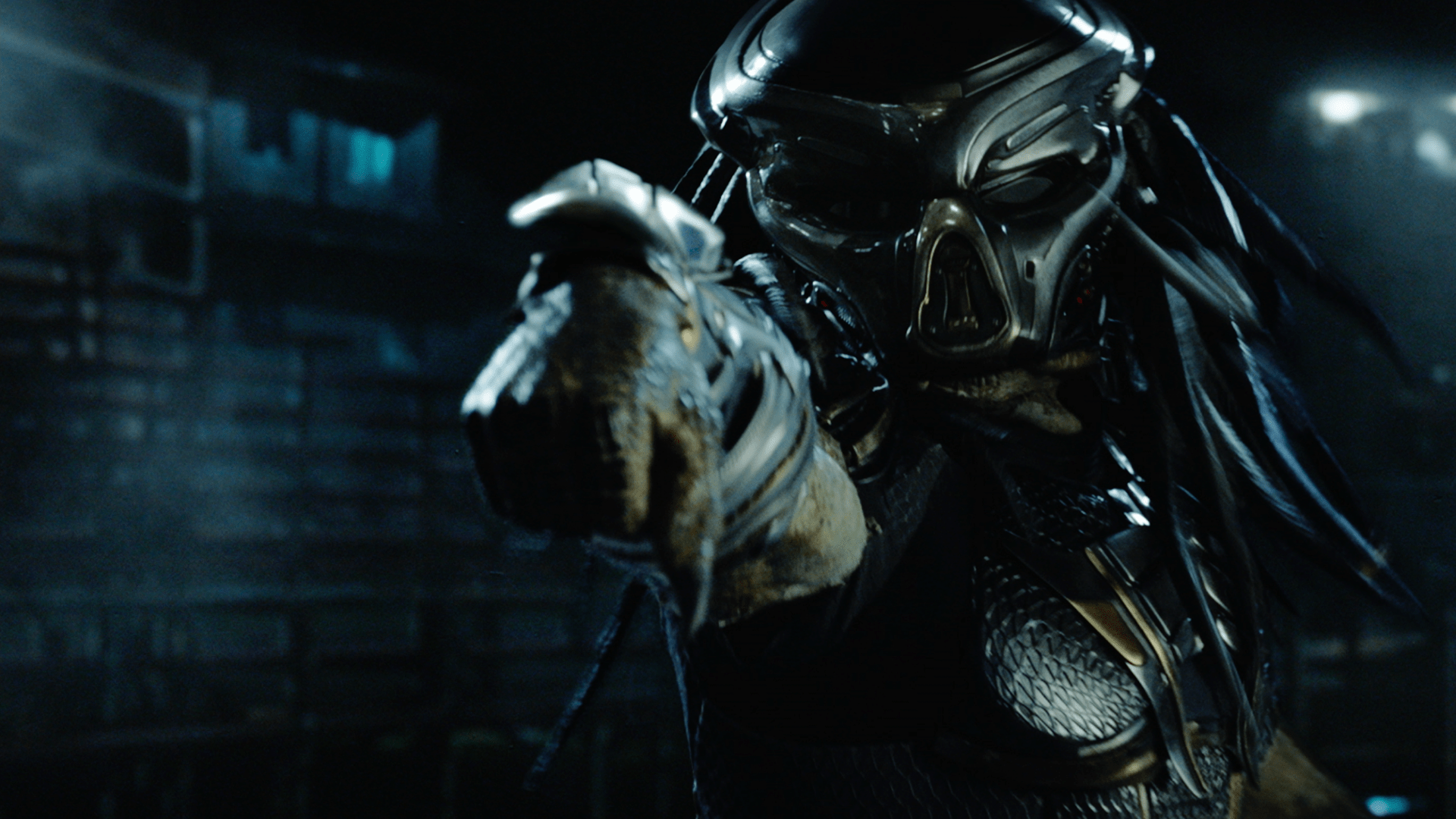
And with all this talk of characterization on set, what about the Predators themselves? Will they be getting a bit more dimensionality this time around? Key struggles with how to answer this question without giving anything away, “The answer is ‘yes’.” Finally ending on a joke, “[The Predator] has a serious soliloquy. You’ve never heard these clicks before…High register clicks. He’s really stretching.”