


Interviews
[Interview] Heading Into the Woods With ‘The Ritual’ Director David Bruckner

This past weekend, Netflix head into the woods with the creature feature The Ritual, directed by David Bruckner (The Signal, V/H/S, Southbound). Last week, we shared this juicy morsel of our chat with the filmmaker, who revealed that that the creature derives from Norse mythology. Now, we dive deep into the film that follows a group of college friends who reunite for a trip to the forest, but encounter a menacing presence in the woods that’s stalking them. Warning that spoilers do follow…
What drew Bruckner to the project was the sense of a deteriorating friendship:
“My manager first slipped me a draft of Joe Barton‘s screenplay in the Spring of 2016 and I followed up immediately with Adam Nevill‘s novel,” Bruckner explained of the genesis of his involvement. “I was blown away on both fronts. While the horror was incredibly compelling, what drew me closest to the material was the relationship among the guys and the sense of deteriorating male friendship.
“I always find that horror works best when it’s tethered to real-world anxieties and this felt especially relevant to me, both personally and as a broader exploration of masculinity in crisis.”
“During the initial prep period, Barton and I worked very closely with a lot of help from Will Tennant and our producer, Richard Holmes to execute what was ultimately a fourth and final draft,” he continues. “I really wanted to preserve Joe’s unique handle on the dialog as well as some important discoveries he had made translating the novel to screen. On the other hand, I had my own experience with Nevill’s book and felt there were some conflicts, particularly between the guys, that needed to find a way back in.”
Speaking to some of the changes, Bruckner continues: “The novel has a lot of bandwidth to dive into both the mythology of the forest and the psychology of Luke, the central protagonist. Because it’s prose, the book can easily maneuver in and out of Luke’s thoughts, oscillating between his inner monologue as he’s increasingly alienated by his friends, and a ton of memory replay as he ponders who they used to be. To translate that directly to screen would involve voiceover, or crosscutting to backstory and would likely undermine the tension of the movie as a movie. They’re just fundamentally different mediums.
“So we created a tragic event at the start of the film that the audience can experience alongside the characters.
“Luke is arguably culpable for what happens, which leads to later resentment, disrespect, and alienation from the rest of his friends. We were aiming for a similar emotional experience as the book, but using an external event to bring it to the surface.
“There are also some seemingly major differences between the end of the book and the movie,” he continues. “I don’t want to give away too much for those who haven’t looked at either, so I’ll just say that they’re more similar than they may seem! But we felt we had to dress it up a little differently, in large part because of limited screen time and the fact that cinematic expectations are a bit more narrow. How hard of a left turn do you want to make in the final act? We thought that needed a little shifting.”

The cinematography is incredible, reminding this writer of An American Werewolf in London, while the locations are equally stunning.
“Well, this was a location shoot through and through,” explained Bruckner. “With the exception of the opening, the entire movie was filmed on the Bucegi Plateau in the Southern Carpathian Mountains. And the spruce forests up there have an extremely distinct look. Because the forest canopy is so dense, there are areas where the needles die off underneath and the branches run straight to the ground.
“This gives the trees a very spiny, threatening look that, for a horror film, feels a little over the top in all the right ways.
“This was consistent with the way Adi Curelea, the production designer, and myself discussed much of the imagery. From the set construction to the atmospheric special effects, to the creature design, we always felt the movie should have a slight arch sensibility; just a touch of playful self-awareness. Perhaps that’s where you detect some similarities to An American Werewolf in London?”
He continues speaking more to the cinematography: “As far as the photography, our DP Andrew Shullkind, who I worked with on Southbound, convinced me to go with a set of Canon cameras and extremely fast lenses that excel in low light conditions. So we were able to cover quite a bit of imagery during twilight hours and much of the night work is lit primarily with the actors’ flashlights. Andrew got a lot of dimension out of the darkness which really puts you in the woods. We also resisted the temptation to do something like this in 2:35 aspect ratio, and instead went with a 2:1 frame because it felt more immersive and takes far better advantage of the towering trees.”
For horror fans looking for similar films, Bruckner reveals several that influenced The Ritual:
“There were some obvious reference points: Deliverance, Wicker Man, and The Descent, but also a bit of [Ben] Wheatley (Kill List, A Field in England). I looked at Greengrass (United 93, Captain Phillips) and Herzog (Aguirre Wrath of God, Rescue Dawn) for performance style. Also Predator, Spielberg’s War of the Worlds, The Grey, and anything I could find shot in a forest. Of course, some of it aids in brainstorming how you’re going to use the camera, but then you get out in the freezing woods and you realize you have to find quicker ways to work anyway. I think there’s something to be said about eventually forgetting your influences and just visualizing the film from your gut.”

For those looking for gore, The Ritual is more about atmosphere and dread:
“I’ve made far bloodier movies! Usually, I love going there, but I’m actually quite sensitive to how violence is employed,” he explained. “It can amplify some disgusting human behavior, or shock something familiar into a state of panic; as long as it contributes to the story in some way. There was something about The Ritual, perhaps the earnestness of the characters, or the familiarity of the conceit, that it just felt indulgent to go too far with the gore.
“The movie is really more about a sense of atmosphere, a lurking dread and surreal head-trip as opposed to buckets of overt horror and revulsion.”
The Ritual truly is the kitchen sink of horror films. Bruckner speaks to the difficulty of pulling off many genres in one movie.
“Usually, I would caution taking on a project that featured so many classic horror tropes. But there was something about reading Adam’s novel that felt completely fresh to me. The characters were extremely real, and the situation they found themselves in felt fluid and had the quality of an ever-descending fever dream. The book simply convinces you to go on that ride. Like you’re experiencing great horror for the first time.
“We knew in a movie those different sub-genres would stand out a bit more and some of our choices, not all, but some, were a bit more conventional than the book,” he continues. “No matter how well you dress it up, it’s still, literally, a “shortcut through woods” movie. And horror fans are razor sharp, they don’t miss a thing. So I’d say one of the biggest challenges with this was figuring out how to modulate the right amount of self-awareness. I definitely didn’t want to do any campy overly postmodern stuff, but I often tried to land a faint, almost imperceptible wink to the audience. As if to say, ‘Yes this is a horror film and yes these are well-traveled tropes, we’re not going to stand above them but we know what we’re wielding.’ And beyond that, fuck it, I want to believe this is happening. It’s just more fun for me that way.
“I should say too, that the choice was made early on to always approach the performances in earnest, not to overly stylize them or bend them to fit whatever movie tropes the story might take on. We had an amazing cast that was committed to this approach from the beginning. The characters aren’t stupid, they know what’s happening to them is insane and yet it’s still happening. It’s a blast to run with that and never get too far above it.”
The Ritual is now streaming on Netflix everywhere.


Interviews
‘Rubberhead’ Director Nick Taylor on FX Maverick Steve Johnson, Practical Effects, and Seven-Year Journey

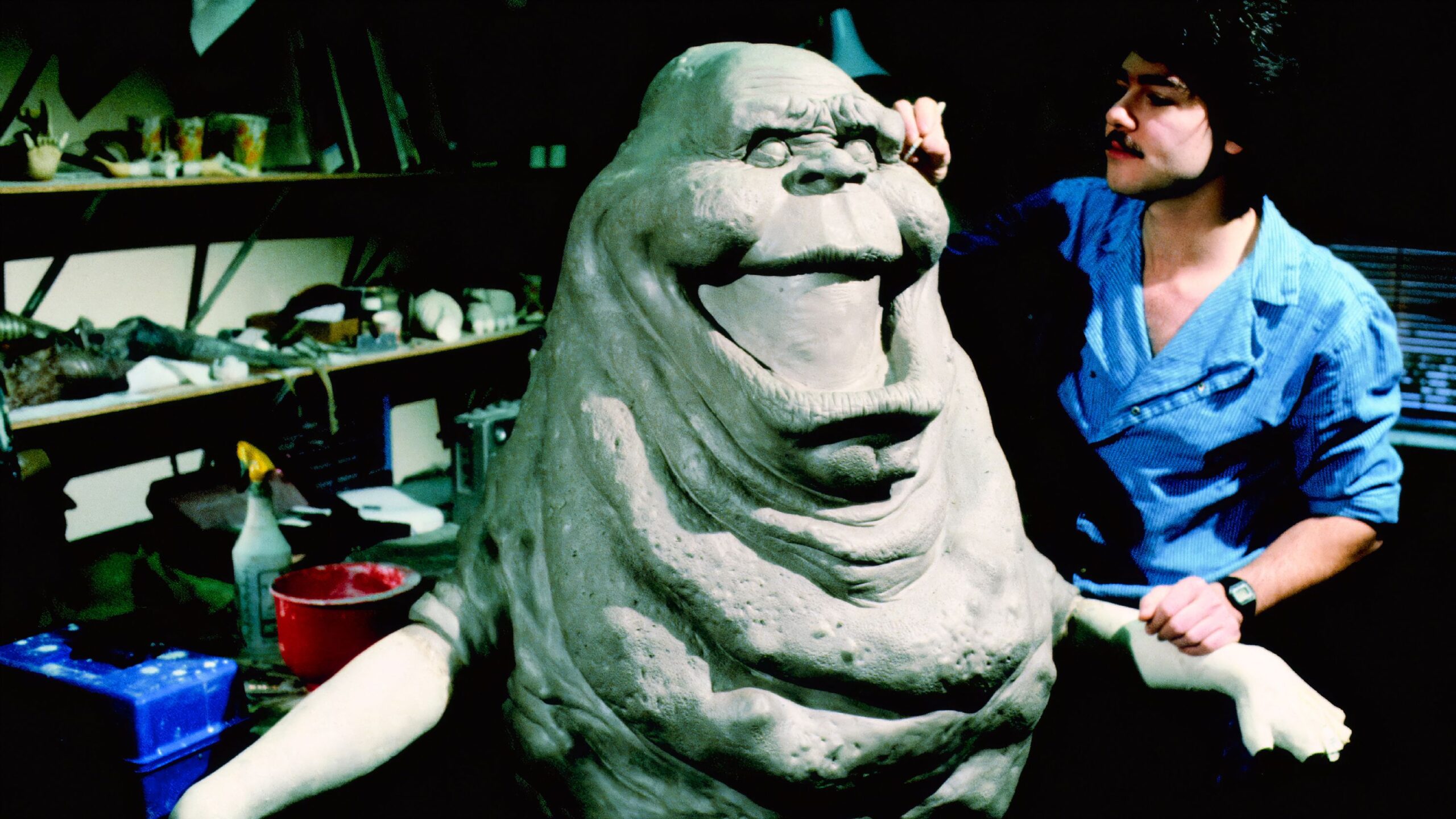
Horror journalist, producer, and podcast host Nick Taylor moves into the director’s seat for his feature debut with illuminating documentary Rubberhead: The Life & Monsters of Steve Johnson.
It chronicles the wild life and career of SFX maverick Steve Johnson, based on the multi-volume book series Rubberhead: Sex, Drugs and Special FX, and those familiar likely already know Rubberhead isn’t your standard horror documentary.
Johnson is responsible for so many memorable movie monsters, having worked on Fright Night, Poltergeist II, An American Werewolf in London, A Nightmare on Elm Street 4: The Dream Master and Night of the Demons, to name a few. He’s also extremely candid in ways that feel atypical in this industry, open about his failures as much as his successes.
“It was a natural progression for sure,” Nick Taylor tells Bloody Disgusting of his transition into filmmaking ahead of Rubberhead‘s world premiere next week at the Fantasia Film Festival on July 23. “I think with my podcast, I got adept at interviewing people and pulling creative lessons out of them, which was the point of my podcast. I wanted this movie to be sort of a creativity pill for artists where if they’re starting a project or feel creatively stuck, they could watch this movie and be inspired and get actual practical creative lessons.”
Taylor’s background in PR and marketing also organically led him down this path.
He charts the course from book promo to documentary director: “But also Bloody Disgusting had a lot to do with this movie because in the very beginning when I first met Steve, I was helping him promote his book and I said, ‘Hey, I got a marketing background and a journalism background. Let me help you promote this book. I’ll just pitch stories from your life to the media, and we’ll see what happens.’ And John Squires wrote an article about Steve making Slimer under the influence of tons and tons of cocaine, and that went fairly viral.”

“For a week, it was story time with Steve,” Taylor continues. “He would tell me a story from his life, and every story was about a major movie, a major director, lots of drugs and alcohol and insanity. I would write them up, and I think John published about three or four of them. So huge shout out to John Squires because that was really great. So yeah, there were definitely a lot of outgrowths of my journalism background that definitely contributed to this movie.”
Rubberhead condenses the multi-book series into a cohesive feature film with a breezy runtime, sparking the obvious question as to how Taylor approached condensing Johnson’s life down to an under 2-hour documentary film.
“That was one of the more difficult parts of all of this, because we had enough for a series or an epically long six-hour fan documentary,” he answers. “But from day one, I did not want to make a fan documentary. I love them. They’re a lot of fun, but I did want the movie to stand on its own two feet as a character-driven portrait of an artist and a time period and a technology, that being practical effects. I did want to be objective. I didn’t want to make this too long. I wanted to make it re-watchable. So I think we just really had to focus on what the narratives were that we wanted to tell. So there were some basically almost cliché archetypical mythic narratives present in Steve’s life. We could have made this way longer, but we wanted to keep it short. But luckily that’s why you have special features.”

Johnson quickly proves to be an engaging subject thanks to his self-effacing wit and frank self-reflections; expect no shortage of stories about how drugs factored into the height of his career or the failures it wrought.
That rare quality was an asset for Rubberhead, Taylor confirms. “He does not shy away from anything about the drugs, the addiction, the bridges burned, the mistakes made, the lessons learned. He just is honest about all of it. He’s had a lot of time for reflection, and he’s done a lot of reflection, so he doesn’t shy away from any of it, which is huge because it’s very refreshing. I don’t think a lot of people are that way, at least in this industry from what I can see. So I think it was hugely beneficial. We wanted to lean into that, and we wanted to make this sort of a gonzo Hunter S. Thompson sort of wild tale through Steve’s overall life.“
Condensing his life into this doc was a slow and steady process for Taylor, too. “It’s been almost seven years. It’s been a labor of love. We’ve been as indie as it gets. We would shoot what we could when we could, and then we would edit when we could. Then after a while it all came together.”
In a way, making Rubberhead brings Taylor’s horror fandom full circle. It turns out that the very film that sparked his interest in the genre and practical effects also comes with an amusing Steve Johnson anecdote.
Taylor explains, “My gateway for sure was Beetlejuice. I saw that at a very young age; I think I was four or five. I felt somebody had shown me, my soul. I get a little emotional thinking about it. There was something about that movie that felt so strange and unusual, but also felt so familiar. It was spooky, but it was fun, and it was lighthearted, and it had humor, but it also had this macabre celebration to it that I just really got into as a kid. I felt somebody had shown me my own soul. And funny story, Steve got fired from Beetlejuice because Tim Burton gave him his hand-drawn designs and Steve’s like, ‘Oh my God, these look like kids did them. This is not what you want. I know what you want. I’m going to redesign these for you.’ And Tim Burton was like, ‘Yeah, no, you’re not.’ So yeah, funny story.”

You must be logged in to post a comment.