


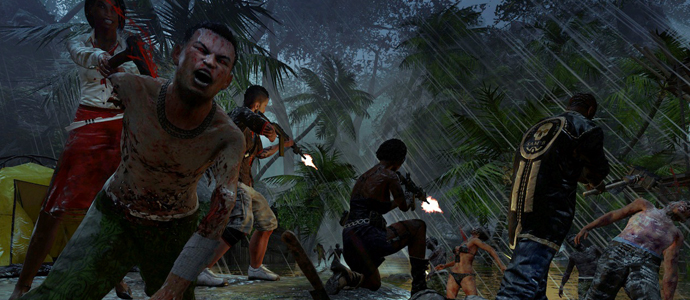
If you’re aching for more cooperative zombie pummeling action, the Dead Island series has you covered. The first game might not have lived up to many fans’ expectations after seeing that heart-wrenching trailer, but it was still an incredibly fun post-apocalyptic RPG. Riptide promises more of what we loved about the first game, along with tweaks to the multiplayer and new features like a new playable character, dynamic weather system, flooding, and Left 4 Dead style crescendo moments.
What do TJ and I think about the next entry in the Dead Island series? Read on and find out!
Adam: I enjoyed my time with the first game, perhaps more so than most gamers. Sure, it had an alarming number of bugs — most of which I was lucky enough not to have to endure — but its four-player co-op, weapon crafting, and big, open world drew me in and refused to let go. With Riptide, they have that same focus on a massive, explorable world, only this time it’s a little more unpredictable. The dynamic weather system, which can cause flooding in some areas, all sounds very exciting.
TJ: I also enjoyed the first game. I was able to look past a lot of its faults for the awesome time I had playing it. I did however, end up playing a large amount of the game by myself, and for that I was disappointed because I was really looking forward to trekking through with friends. I have a big fear that Riptide won’t receive the treatment it needs, and the plaquing bugs won’t get fixed.
Adam: I’m going to hope that Techland (and Deep Silver) know by now that they have a hit on their hands, so they’ll invest more into the vanquishing of bugs than they did last time. This series is strong enough to be the next big zombie franchise, and Deep Silver is growing fairly rapidly — spurred by the success of Dead island and their recent purchase of Saints Row dev Volition — so I expect them to throw more resources into it. The only thing that’s keeping me from getting really excited for it is they aren’t calling Riptide a sequel, so they’re undoubtedly working on the “real” sequel, with this being more of a way for fans to whet their appetites in the meantime.

TJ: Yes true, this title is also being released at a discounted price ($50). That always makes be a bit nervous, though Deadly Premonition put those worries to rest. I know you’re worried a bit about the DLC, have they announced that they will be making some for Riptide?
Adam: I wouldn’t say I’m worried, so much as it being a budget title lowers my expectations for it. As for the DLC, as far as I know nothing has been announced on that front outside of a special weapon and costume that serves as a pre-order bonus. I’m sure they’ll do more than that, and I sincerely hope they do a better job with it than they did with the original game.
TJ: One of my biggest issues with the first game was the characters. I mean, not the characters themselves, but the fact that I felt nothing for them. They were just there. Like robots we controlled. They never spoke to each other during the game, they never expanded on them as people. They seemed so lifeless. I’m seriously hoping that they change that this time around.
Adam: I could not agree more. Character development was an area where Dead Island really failed. I’ll even go a step further and say I hate the current cast. Every one of them is entirely forgettable, or extremely annoying (I’m looking at you, Sam B.). I don’t think they’ll do much to improve on this, seeing as the cast has returned for this outing, so I’m just going to hope that they move on with “Dead Island 2” and let us create our own characters. Let us choose who we want to be, what we look like, and what class or skills we possess. Unless they come up with some insanely likable characters, that’s really the only way to make me actually care about the character I control.
TJ: It was almost a slap in the face after seeing the reveal trailer for the original game. I thought, wow, there is going to be some rich character development in this game. I was thinking I would grow very attached, and possibly have them ripped away from me like my children in the night. But alas, nothing. For Dead Island 2 I would love to see a kick ass cast. But maybe they never wanted that at all. Let’s talk about something else, I’m depressed.
Adam: Okay, then let’s chat about the exciting new stuff. With Riptide, we’re getting a few new features, like a dynamic weather system — something I requested in my wish list a few months back — flooding, and Gears of War style Horde-Lite sections where you’re forced to survive against waves of zombies (and miscellaneous other creatures, I’m guessing).

TJ: YES! Remember in Dead Island, they made SUCH A BIG DEAL about this storm that was coming. The sky would grow darker and darker, and I was like yes, yes, a huge storm is coming and it’s going to be nuts! It never came. I can’t flippin’ wait for dynamic weather. I think more games need weather changes. It makes the game feel so much more real. Rather than sunshine all day. Or worse than that, looking up at a sky that is pretty much painted on. Not even a moving cloud. Lame.
Adam: Yeah, Dead Island was such a tease. I’m surprised more games don’t implement some sort of dynamic weather system. Instead, it’s either scripted — so it’s predictable — or it’s just not there. Or, I suppose in the case of Far Cry 3, it’s random, but it looks awful. Weather can make a game unpredictable, and that’s scary. As a whole, Dead Island isn’t particularly scary, so I think this could make its world feel a little more alive.
TJ: Back to the horde like sections, I personally can never get enough. I’m pretty sure you said you were burnt out on other games attempts at it and failing miserably. I think in the campaign that will really change things up, and it definitely fits. Especially when you’re forced to make tons of noise. I would like to try a horde mode in Riptide as maybe a DLC, but if it isn’t well thought out it would probably end up a catastrophe.
Adam: Yeah, I’d say I definitely have a problem with developers that implement (poorly, I might add) these wave survival modes just so they can slap that feature on the back of the box. Games that do it well, like Gears of War, Left 4 Dead, and Halo are fine. Even Alan Wake had an interesting take on it. Then there are games like The Walking Dead: Survival Instinct, that do a half-assed job of it. That’s never good. Looking at what they’ve shown of it so far, the wave survival sections in Riptide look mildly bare-bones. You have fences, mounted turrets, proximity mines — it looks fun, but it also looks like they’re experimenting with it here so they can flesh it out a bit more later on.
The Verdict:
Adam: Riptide will be fun. I’m sure of it. Will it be a contender for 2013 Game of the Year? Not a chance. Will I spend dozens of hours exploring its world and curb-stomping its denizens with a few friends? Most definitely.
TJ: I know I should be more excited for Riptide, but I’m not. All signs point towards “better than the original”, but I still find myself not as excited as I was for Dead Island. I’m sure they will improve on a lot of aspects of the game that annoyed me in the original. But I still find myself thinking, just give me the third game.
Have a question? Feel free to ever-so-gently toss Adam an email, or follow him on Twitter and Bloody Disgusting.