Reviews
[Review] ‘Onimusha Warlords’ is a Standard Remaster of a PS2 Classic
Capcom’s other great demon-slaying classic from the PS2 era returns. Find out if it’s a warm welcome in our Onimusha Warlords review.
It’s been almost two decades since Onimusha first slashed its way onto screens, quickly becoming a PS2 favorite. After a glowing reception, Capcom was quick to follow with four mainline sequels and then, with the launch of Onimusha: Dawn of Dreams, the fledgling action game series just disappeared.
For close to fourteen years, the only glimpse of a new Onimusha came via a 2012 browser game that was exclusive to Japan. Apart from that? Zilch.
At the same time that Dawn of Dreams launched, Capcom was already starting to pivot more towards a western audience. The Xbox 360 was just on the horizon and so too were Dead Rising and Lost Planet, both of which performed well for the publisher. Capcom doubled down, however, and those westernized games that followed (its Bionic Commando reboot and Dark Void, just to name a couple) didn’t go down well.
In a way, Onimusha being benched during the past console generation may not have been such a bad thing after all but for years fans have waited for its return. And here it is: a full remaster of 2001’s Onimusha: Warlords.
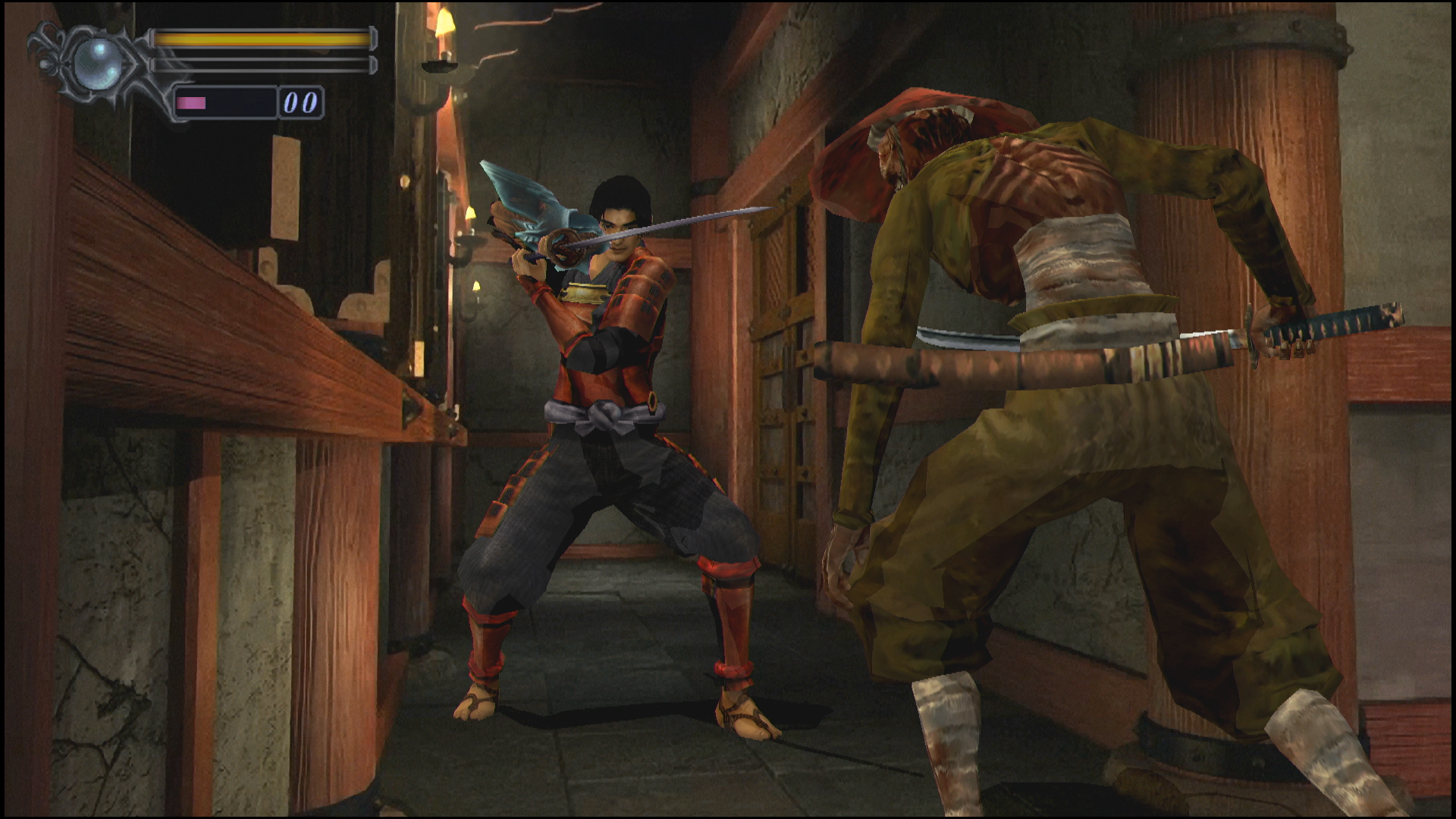
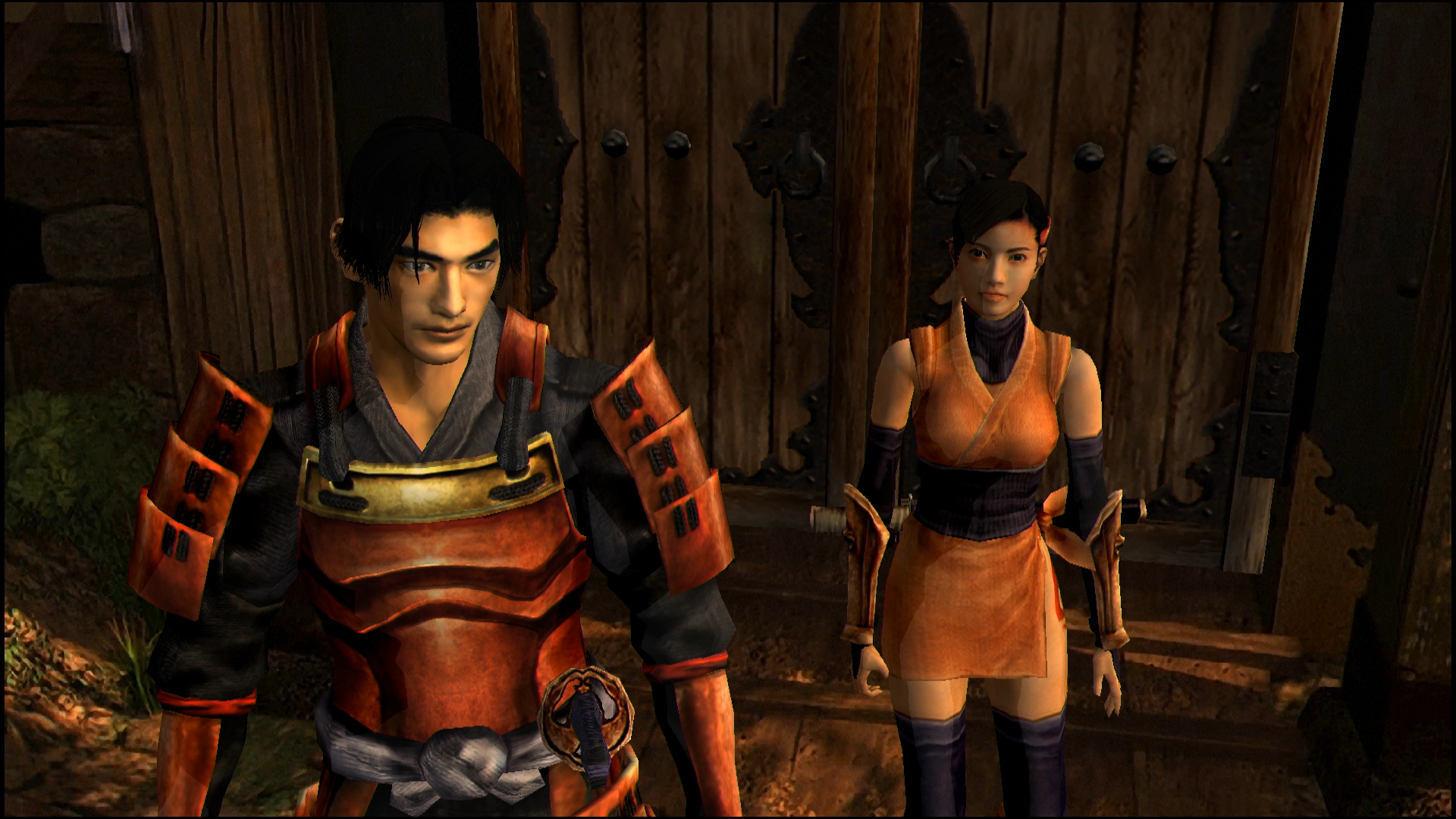
For those who skipped the original, Onimusha is a combat-heavy action game set during the Sengoku period in Japan. The land is in turmoil as warlords muster their clans and go to war, Nobunaga being chief among them, a powerful daimyo often referred to as the “demon king” in most pop culture. That moniker takes on a more literal meaning during Onimusha’s epic opening as he falls in battle, our hero Samanosuke returning to his lord’s castle only to find that Nobunaga has risen again, a demon horde now at his command.
Originally, Onimusha was pitched as a Resident Evil game under the title Sengoku Biohazard. Although Capcom decided to steer the project in a different direction, it’s hard not to look at Onimusha as a game heavily inspired by the world-beating survival horror franchise. From the tank controls (which we’ll get to later) and enemy types, to a familiar approach in level design, the two have much in common, Onimusha also acting as somewhat of a precursor to Devil May Cry.
As Samanosuke, you must repel the demon invasion and thwart Nobunaga’s quest to conquer Japan under this dark new regime. Most of your time will be spent dueling with his minions and exploring the game’s vast castle complex which, in a way, mirrors the Spencer Mansion of Resident Evil.
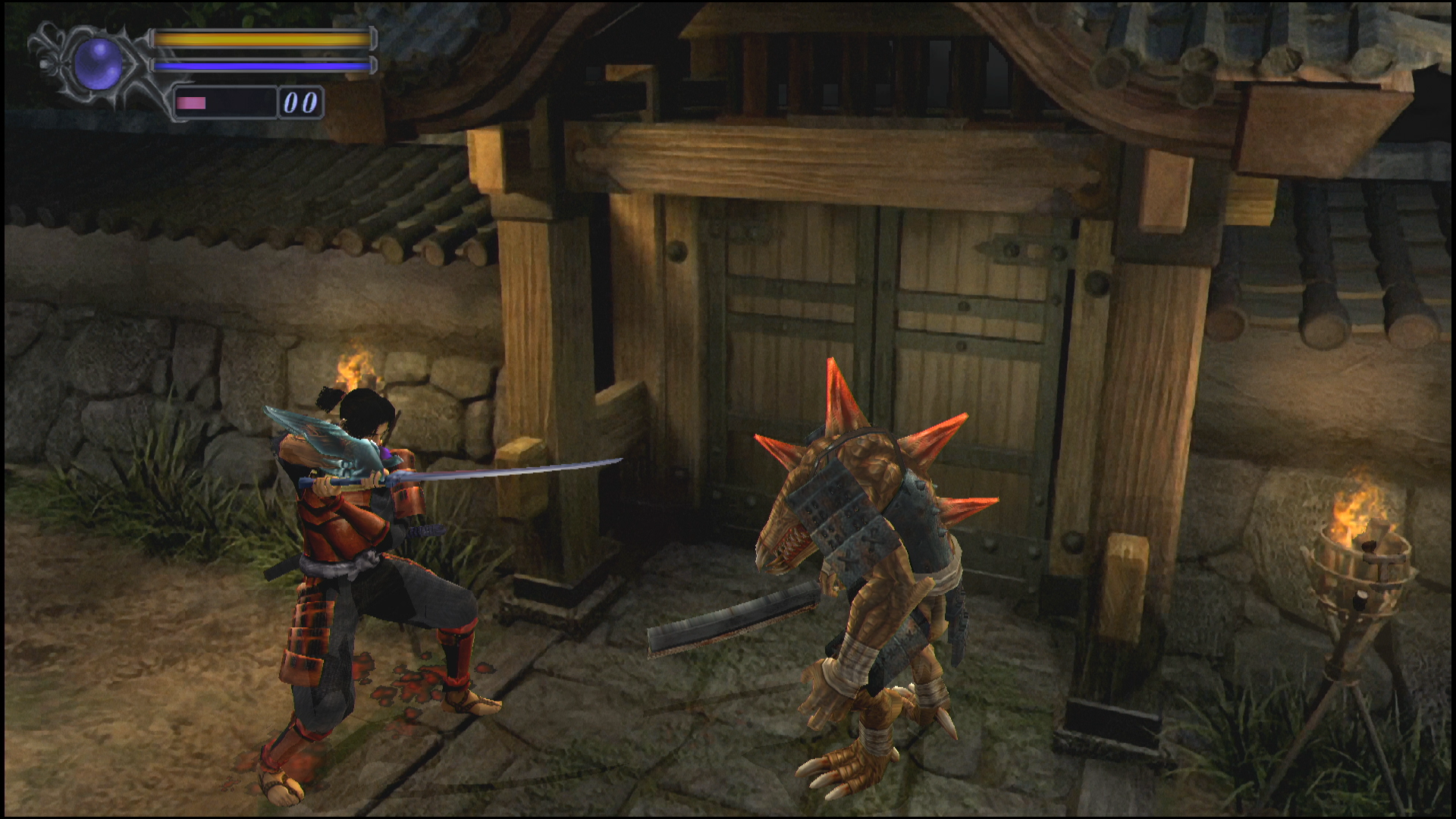
Combat is swift and skillful. Samonosuke’s moveset is somewhat limited though unlocking and switching between various weapons and magical powers add new flavor to the fairly basic gameplay. Naturally, there’s a samurai-esque quality to the way he fights using precise sword strikes, counters, and blocks, encouraging players to circle around individual targets and wait for an opening.
Where most games of this ilk can be incredibly linear, Onimusha: Warlords involves a surprising amount of exploration and puzzle-solving. You’ll often need to loop back and revisit areas in order to find clues and key items in order to progress, again, much like Resident Evil.
For a game that’s almost pushing twenty, this isn’t the prettiest remaster you’ll come across on current gen hardware though it definitely has a nostalgic charm about it. Some of the static backgrounds can look oddly out of place but there’s an appeal to them you just don’t get from full 3D environments.
Aside from sprucing up the visuals, this remaster makes some other noticeable changes. Inventory management can still be a hassle though equipping weapons is now be done at the press of a button instead of diving into menus. You can now move your character using the analogue stick too, supplementing the admittedly archaic “tank” controls that featured in the original release.
While it would have been nice to see Capcom tart up those three original games and present them in one package, simply wanting more of what this remaster has to offer is a good sign. Beneath a new lick of paint and some clever adjustments, Onimusha: Warlords doesn’t make for an essential action game in 2019 but it’s a great modernization all the same and hopefully we’ll see more Capcom classics undergo a similar makeover.

Onimusha Warlords review code for PS4 provided by the publisher.
Onimusha Warlords is out now on PS4, Nintendo Switch, Xbox One, and PC.
Books
‘The Sixth Nik’ Review: Pulitzer Winner Daniel Kraus’s Horror Sci-fi Epic
Daniel Kraus is the 2026 recipient of the Pulitzer Prize for Fiction thanks to the epic highwire act of his World War I fantasy/horror novel Angel Down. This means that Kraus, an author beloved by genre fans for years, now has more eyes on his work than ever before, particularly from readers who might not typically pick up a novel that veers so heavily into hard genre spaces.
This is why I’m thrilled that, by chance, Kraus’ first post-Pulitzer novel is The Sixth Nik, a spacefaring adventure full of horrifying imagination and brimming over with imagination. Like all of his books, it’s an elegantly written, narratively complex piece full of memorable characters given depth and shade, but as with Angel Down, it’s also an effort by Kraus to stretch his wings, work out some prose muscles that he doesn’t use as much in his straight-ahead horror work. If you’re coming to Kraus for the second time after reading Angel Down, you’re going to get something completely different and yet distinctly Kraus-ian, a space odyssey that’ll make your brain tingle even as your stomach is doing cartwheels.
In the future, when humanity has colonized Mars, Europa, and other nearby habitable worlds to varying degrees, Earth is the site of a secluded sect that has made Greenland their home. This sect is responsible for nurturing the Niffakoq, a kind of messianic child warrior whose legacy is passed down in a way similar to the Dalai Lama. The Niffakoq are trained from birth for their “Chore,” a task they must complete that will radically improve some aspect of life in the cosmos, and given brain implants known as “Niks” to enhance their innate empathic abilities. They also, due to the danger of their chores, rarely live beyond the age of 11.
Nine-year-old Sisilla is the latest of these Niffakoq, and she’s just been given her Chore, involving a faraway colonial outpost on a remote planet that’s rarely in touch with the rest of humanity anymore. To achieve her Chore, Sisilla boards The Sickness, an AI-designed, organic ship that looks like a flying tumor, and meets her crew, including everyone from a bodyguard known only as “Murder 005” to a bodacious engineer who revels in changing her appearance through futuristic procedures to a drug-addicted, reconstructed ship’s medic who offers her a chance to try peyote.
Sisilla is not here to make friends. She’s here to do her Chore, fulfill her purpose in the universe, and pass on to make room for the next Niffakoq. But life on The Sickness determines to surprise her, from an entire room that seems to be made of placenta to a glitching robot that seems to know something of her past. Worst of all, though, it seems that something or someone on board is out to harm the whole crew, and the Chore Sisilla’s spent her whole life preparing for is wrapped around a terrible, paradigm-shifting secret that will make her rethink everything about her life, her purpose, and her place among the stars.
This is a lot of groundwork to lay for one story, in typical epic science fiction fashion, and it’s only scratching the surface of what The Sixth Nik has to offer, from ship’s quarters hidden behind curtains of impossibly long human hair to an encounter with worms that left even my strong stomach churning a bit. To pull off something this grand, this multi-tonal and big, Kraus has to lay everything out elegantly, using Sisilla as the viewpoint character and narrator while keeping her in the dark about each key revelation until exactly the right time. It’s not the kind of book I associate with Kraus and his imagination, but he rises to the challenge with a novel that offers something surprising on each new page, a kind of prose sensory overload that almost tips off into being overstuffed. But not quite.
More than the worldbuilding and vibrant cast of characters, though, what makes The Sixth Nik stand out is Kraus’s layered, often cognitively dissonant view of humanity’s future. Technological advances render some troubles obsolete, only to create entirely new problems. Humans morph and shift themselves in so many ways that they sometimes seem to be walking Ships of Theseus. Building ships from organic matter seems more efficient and elegant, yet it fills each voyage with a parade of grotesqueries.
It is a solar system filled with wonders and horrors in equal measure, and it says something deeply relatable and rewarding about the world we’re in now, this mesh of terrors and triumphs, breakthroughs and brokenness. Kraus managed to capture our own fractured view of the present and catapult it several centuries ahead without losing any of his sci-fi bombast or character-driven sense of wonder. That’s a hard trick to pull off, but it makes The Sixth Nik a hell of a read, and a great new primer for the vast imagination of Daniel Kraus.
The Sixth Nik is available in bookstores now.


You must be logged in to post a comment.