


On the anniversary of Roberta Williams’ groundbreaking, under known PC horror game, we look at what makes ‘Phantasmagoria’ so special
“Pray it’s only a nightmare.”
When the survival horror genre of video games comes to mind, the usual suspects that see discussion are titles like Resident Evil, Silent Hill, Dead Space, or even something like the Clock Tower series. One game that stays out of the spotlight, even though it was a formative title for video games and one that sold just as well as any of the aforementioned franchises, is Phantasmagoria from Sierra On-Line. In the days of the ’90s, point-and-click adventure games reigned supreme, with LucasArts and Sierra being the “Nintendo and Sega” of the area and leading the pack for PC gaming. Roberta Williams was Sierra’s wunderkind and the designer responsible for a number of hit franchises like King’s Quest, Mystery House, and The Colonel’s Bequest. She’s also the person largely responsible for adding a graphical interface to adventure games in the first place. But in spite of the many titles that Williams worked on, she’s said that her sole entry in the horror genre, Phantasmagoria, is her favorite.
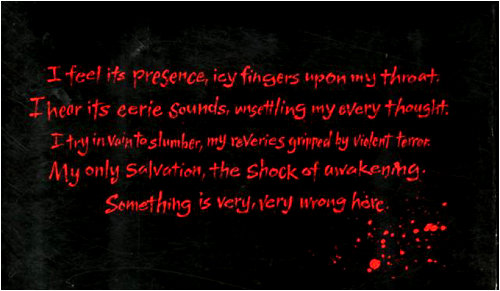
Phantasmagoria is no doubt one of the biggest spectacles of gaming—something that was especially true in 1995. No expense was sparred here and the game sprawled across 7 CD-ROMs (8 on the Sega Saturn port) due to the heavy amount of FMV (Full Motion Video). Even the game’s description on the back of the box is also more cerebral and mood-setting horror than something that actually tells you what the game is about. More unconventional elements like this were great for setting the tone of this horror experience. Williams had been wanting to do a horror game for a while now (her desire in the matter was probably made increasingly urgent due to the fact that her previous game was Mixed-Up Mother Goose Deluxe, which, by the way, is pretty awesome as far as Mother Goose games go, FYI…), but in a very James Cameron sort of way had been waiting eight years until technology was at a point where she thought she could do properly do the genre justice. Williams wrote a 550-page script for Phantasmagoria, (a typical movie screenplay is around 120 pages, as a point of reference), which required a cast of 25 actors, a production team of over 200 people, took two years to fully develop and four months to film. Phantasmagoria’s initial budget was $800,000, but by the end of production costs had hit a staggering total of $4.5 million (with the game also being filmed in a $1.5 million studio that Sierra built specifically for it). Other luxuries were also brought in like a professional special effects team to handle that area of the game and a choir of over 100 people being assembled to achieve the game’s opening theme.

In spite of these many gambles Phantasmagoria was a huge success, bringing in over $12 million in its opening weekend alone and being one of the best selling games of 1995. To take this one step farther, Sierra’s stock rose from $3.875 in June of that year and was up at $43.25 by September, primarily due to the anticipation and impact of Phantasmagoria, which is just insane. This game is a perfectly fitting example of when some new sort of technology comes out and absolutely everyone has to experience it, not to mention that the advent of FMV technology would also leave a considerable impact on the gaming landscape, too. Sierra would continue to use this technology on The Beast Within: A Gabriel Knight Mystery, while some game developers from other studios even began to worry that these ultra-productions of games that spanned many CDs would become to be the expected norm, with them fearing the danger of game’s losing core fundamentals in favor of showmanship.
Phantasmagoria was not the first title to use FMV technology, but they featured a mix of both real actors in the cutscenes as well as real actors in 3D rendered environments leading to a curious product. Most video games of the time would feature somewhere between 80 to 100 backgrounds, but Phantasmagoria had more than 1000. The game’s graphic violence and content also led to some controversy where the title was attacked by a number of people, refused to be carried by some retailers, and was outright banned altogether in Australia due to their censorship laws. There was a password-operated censorship system in the game to tone down the violence, but that didn’t seem to placate anyone. Unsurprisingly, all of this red tape around the game just made horror fans crave it even more. It was the perfect marketing tool.
The story in Phantasmagoria is hardly anything revolutionary. Newlyweds, Adrienne and Don, move into a house in Massachusetts that was once owned by a practitioner of the dark arts. This evil soul takes hold of Don while Adrienne must survive this nightmare and figure out the mystery behind it all. If Williams didn’t go ahead and cite The Shining as a major influence here, it would still be pretty obvious that the game takes inspiration from the classic film. Don’s possession feels much like Jack Torrance’s and he gradually becomes more unhinged as this house and the spirit inside it take stronger hold over him.

In terms of gameplay, Phantasmagoria is no different than the majority of point-and-click adventure games of the time, with familiar trial and error mechanics stringing everything together in a way that Sierra did like no other. Puzzles take a backseat to the FMV here, resulting in the difficulty being a little disappointing and condescending by King’s Quest standards. Honestly, it’s frustrating how little you’re actually controlling this game, with so much here seeing FMV sequences finishing your sentences with you only having the briefest of interactions along the way. This also inevitably leads into a lot of heavy exposition where video is just telling you backstory rather than you actually playing a game. The assumption present is that all of this is forgivable and fascinating due to the graphical innovations that are present. All of this becomes kind of laughable when you look at the screen within a screen that the FMV plays out of so it can optimize correctly. There’s so much wasted space here that it becomes almost as big a focus as the video itself.
It’s a little insane how much the game banks off of you being wowed by all of this. For example, one sequence sees Adrienne rooting around with a letter opener for literally three minutes, only for nothing at all to be achieved. Sequences like this happen simply because the game’s production team believes that literally anything shown through FMV is fascinating and groundbreaking. There’s an exceptionally long sequence of Adrienne tearing down a wall to get through where it really shows all the boards getting broken to great detail, pulling off the most comprehensive “wall tearing” animation to date. Much of this attitude fuels the game where weird amounts of focus are placed on random animations or elements that ultimately aren’t important. It’s a good barometer for where FMV games were at during this time, gamers’ brief obsession with them, and why they were quickly abandoned accordingly.
Characters are always a crucial part of a horror game (or film) and as mentioned before, Williams’ title assembles a roster of 25 weirdos to bring this story to life. It’s a little comforting to see Williams leaning into stereotypes as a means of automatically filling in backstory. It’s not the most progressive things to do, but it’s an approach that works for horror. Especially for a video game made in 1995. Who’s the deepest video game character from that time period that comes to mind? Crash Bandicoot?

Some of the more standout additions to the cast come in the form Cyrus, who could give Of Mice and Men’s Lenny a run for his money (at one point he pulls down a tree to fashion into a bridge, and exclaims, “Of cowse I did! I’m stwong!”), and his mother Harriet, with weirdness constantly emanating off of them. Cyrus nearly mutilates a cat in one scene with all of this shocking content automatically becoming a little hokey due to the FMV filter it’s coming through. Then, the villain during all of this is an evil magician named Zoltan Carnovasch of all things, which seems more like a wizard foe from out of King’s Quest instead. Don’t worry though, if that name seems like a little too much, his magician stage name is Carno, so dealer’s choice here. After a magic trick went wrong, Carno became coma bound before becoming an evil spirit that has a heavy case of revenge on his mind.
Through Williams’ career she began to become known for her unforgiving adventure games where gamers could actually be punished and die on their quests, making saving a necessity and experimenting a tense experience. Phantasmagoria’s environment feels tailor-made for a game that’s focus is horror rather than adventure, and while not quite hitting the same tense heights from other titles from Williams’ oeuvre, watching your character die and fail on their journey does give this game a tremendous amount of charm (especially with the production quality of all of these ridiculous death sequences). The majority of these are saved until the latter moments of the game, but they certainly make an impact.
On the topic of these death sequences, it’s worth discussing the many murders from Phantasmagoria to a more thorough degree since they yield such significance. Carno arguably operates with a sort of Freddy Krueger black wit to his murders, which is never a bad thing in my opinion. Each of his executions contain some sort of excuse me? element that you just can’t believe. There’s a murder in the greenhouse, where it looks like a woman is being fed dirt until she dies, and then gets a trowel to the mouth to top it all off. Another seemingly innocent scene between Carno and his wife, where they share fine wine and toast one another leads to a sequence that’s almost too ridiculous to explain. It’s a moment that gives the Joker’s “pencil trick” in The Dark Knight a run for its money and is capped with the perfect line of, “No, here’s to you.” There’s such a sadistic glee in the murders here that it’s hard to not think that Williams is being tongue in cheek on the topic.

One particularly violent ending for Adrienne sees Don putting you in the Throne of Terror, punching you in the face, repeatedly calling you a bitch, and then hit in the face all You’re Next style. This all actually works due to how graphic and aggressive it is. Another prime example is this neck breaking murder which is one of the more disturbing, graphic things you’ll come across in a video game, in spite of how much further the form has come at this point. Using real people and the simple brutality of it all gives all of this material a lot more weight. This might feel like a campy B-horror movie 90% of the time, but it’s scenes like these that briefly make you think that you’ve flipped over to a snuff film. The best death of them all though—and one that I still find difficult to watch—is where Carno kills Regina by putting a funnel in her mouth and jamming food down it into her throat. And by food, I mean things like tripe and “scrambled brains.” If the subject matter doesn’t get you, the sound design on the scene will. More great work here. Finally, it’s kind of ridiculous that the final act of the game sees a huge Xenomorph-esque demon coming to be, but the ways in which he deals with you if you’re not fast enough lead to maybe the best piece of animation in the entire game.
The deaths are clearly a big takeaway from Phantasmagoria and part of what gave it its reputation in the first place, but there’s still plenty of other weirdness in this title. 1995 may be in the infancy of survival horror as a genre but it’s interesting to see which elements from the title actually manage to be scary and which reek of the clunky medium that they’re being presented in. For the most part, Phantasmagoria is not a scary game, and it’s even a little disappointing as a game in general since so little of this 7-disc survival exercise actually sees you doing much. In that sense, rating Phantasmagoria as a horror film instead is an interesting endeavor. I’m actually a little surprised that someone on the Internet hasn’t gone about and attempted to stitch a narrative together with all of the FMV content. I daresay it maybe does work better as a horror film. It’s not a good horror film, but it makes for a great B-horror movie, and I’ll gladly take one of those any day of the week, especially with the acting going on here.
The game kicks off with Adrienne experiencing an absurd nightmare, which is a lot more WTF and confusing than it is frightening. That being said, this intro now does a great job at sending you back to the ’90s and the “weirdness” of the era. Like this really is just a bizarre hodgepodge of computer graphics set to some eerie chanting that hopes for the best. At other times scenarios like a séance take place because why not! “Scary” concepts are continually thrown in, creating a good picture of the cluttered composition of some of ’90s horror. While on the topic of the séance, during it Harriet happens to vomit, with this vomit appearing to be sentient monster vomit that then begins to tell people what to do. The effects and voice work here actually are kind of impressive for the time, as ridiculous as the concept is. It feels very Hellraiser, surprisingly. Another well-done concept sees you constantly looking into mirrors to no avail, only for the game to finally surprise you and make use of the moment. It’s these instances of toying with your expectations where Phantasmagoria shines.

The game also explores Don ‘s possession in some interesting ways with the whole thing being such an unbelievably over the top performance. At one point he’s literally Pagliacci-ing himself up as a ridiculous culmination of all of this. It’s all just being weird and “creepy” for no reason. There is a scene towards the end of the game where you stumble upon Don’s collection of cut up photos of Adrienne which does tap into a genuinely uncomfortable place, but ultimately falls short. Possessed Don also ends up leading to a rape scene with Adrienne, which was the main factor in the game’s banning. Again, this kind of feels like Williams is going for broke and rebelling from her Mother Goose ways. There is a moment in Phantasmagoria though where you’re told to “Find the dragon…” that almost feels like Williams forgot for a minute that she’s in a horror game and not the land of Daventry.
Perhaps the most bizarre thing here is that after you escape from this huge demon and leave this cursed house, the game’s ending is simply Adrienne walking away in a dazed stupor. Cut to credits. It’s such a weird, abrupt conclusion for a game that tends to make a meal (more scrambled brains, please) out of everything. A sequel to Phantasmagoria was unsurprisingly made, but not with Williams’ involvement due to her being too busy working on King’s Quest VII at the time. Notably though, Williams did express interest in returning for a third title in the series, but obviously that ship eventually sailed. Phantasmagoria 2: A Puzzle of Flesh’s (somehow this has never been used as a Hellraiser subtitle) story is unrelated to the first title and it doesn’t seem to have much of the same charm as the original. The same FMV style is present, but it results in a much clunkier game with deaths that hardly hold a candle to the original.
Phantasmagoria is an odd piece of horror history that deserves your attention if you get the opportunity. Honestly this is the sort of game that’s perfect to have a few friends over where you just mock and laugh at it through the night. It has endless personality, a style that warms your nostalgia glands, and some of the grisliest murders in video gaming.
Plus, it also has the biggest fixation on drain cleaner that I’ve ever seen in a video game.