News
‘Videogames Make Better Horror Than Hollywood’, What Do YOU Think?

So, it’s a little past it’s prime, Wired posted this article about a year ago, but hey, why not post about it and see what everyone thinks. Wired’s Clive Thompson seems to think that video games nowadays are a lot more scary than movies. I’m inclined to agree with him. I find myself getting a lot more freaked out when I shut the lights off and play a horror game than a horror movie. Maybe I’m watching the wrong movies. We’ll read his article and let me know what you think!
“Gore Is Less: Videogames Make Better Horror Than Hollywood
By Clive Thompson Email 08.28.07
I’d only been playing BioShock for 15 minutes, and already I was trembling like a little girl.
It’s hard to disentangle what precisely was scaring the crap out of me. Maybe it was hearing the rumbling moans of a nearby Big Daddy, and realizing it was hunting for me. Maybe it was the way those filthy, genetically modified humans would pop out of nowhere, dressed, improbably, in Victorian clothes and creepy Eyes Wide Shut clown masks. Or maybe it was their weirdly garbled dialogue — how they’d shriek, “Get away from me!” while slashing at me with lead pipes. The fact is, I like to be scared out of my wits. I’m one of those wimps who is easily spooked yet generally enjoys the sensation. So ever since I was a kid, I’ve loved good horror movies — I’d turn out the lights freak myself out with classics like Halloween, Friday the 13th or The Exorcist.
Yet here’s the thing: For several years now, I’ve found that my favorite horror experiences aren’t coming from movies any more. They’re coming from games.
Why? Partly it’s because films have become much less artistically interesting. With a choice few exceptions — like the superb The Ring — I’ve found that modern horror movies have been offering less and less suspense, and more and more gore. Maybe it’s due to the rampaging success of Saw, which gave birth to the current trend toward torture-chic and metric tonnage of blood in scary movies.
In contrast, the best scary-game designers have quietly perfected the interplay of tension and release that makes for a truly cardiac horror experience. They have, in a sense, become even more faithful interpreters of the horror tradition movies than Hollywood directors.
In BioShock, for example, the audio editors are masterful at generating free-floating anxiety. As you wander through the game’s ruined city, whispering voices pan in and out of your skull. Often it’s the semilucid/semicrazy patter of the gibbering “splicer” humans, but either way, it makes you feel as nuts as they are.
Even worse is the sound of the ultra-Freudian evil-girl Little Sisters. Every time I’d stumble into a dark room and hear one of them say “What’s that sound, Mr. Bubbles?” in her chirpy, gargling-on-blood voice, the hair on my neck stood up. It was partly because, well, evil little girls are scary, and partly because I knew I was about to get my ass handed to me.
Indeed, the endless potential for ass-handing is why games may actually be a superior medium to films for scaring the bejesus out of you. The horror flicks of the ’80s always tried to generate a sort of proto-interactivity: all those terrified viewers, screaming “Don’t go in there!” at the screen, wishing they could somehow reach out and personally guide the Final Girl to safety.
In a game, of course, the fourth wall is obliterated, and you actually do have the choice about whether to go into The Bad Room or to run screaming. If you’re a total coward (like me) this ability to control your fate induces considerably more suspense, because I head-game myself into a frenzy. I’ll start down a corridor, hear something freaky up ahead, then freeze in panic. Maybe if I stay quiet the monster will go away? Shit, maybe it’s already headed this way, and I should move! But if I move the monster will hear me … so maybe I should stay quiet … gaaaaah!
Games already seem like dream states. You’re wandering around a strange new world, where you simultaneously are and aren’t yourself. This is already an inherently uncanny experience. That’s why a well-made horror game feels so claustrophobically like being locked inside a really bad — by which I mean a really good — nightmare.
Still, there are some interesting limitations on the form. I find that scary games almost always lose their scariness after about three hours. This is due to the inherent repetitiveness of games: After you’ve fought your 200th “splicer” in BioShock, you’re pretty accustomed to their gurgly ramblings, their patterns of attack, the boo-yah outta-nowhere teleportations. I was still tense, but no longer, you know, wetting myself.
The only way a game can continue to frighten you is if it constantly subjects you to new scary things, keeping you eternally off balance. But few publishers are willing to spend money on enough designer hours to churn out 40 hours of genuinely new content. Instead, they inevitably wind up recycling the same opponents, the same animations, and perhaps worst of all, the same audio cues. (The quickest way to ruin a scary mood is to have the monsters endlessly repeat the same two or three catchphrases over and over again; it begins to feel like telemarketing.) The best horror games — I’d include some of the Silent Hill and Resident Evil titles in this category — have come the closest to keeping things fresh as you play.
Still, I’m not complaining too much. BioShock was plenty freaky enough; I wrote this column with the lights on.”




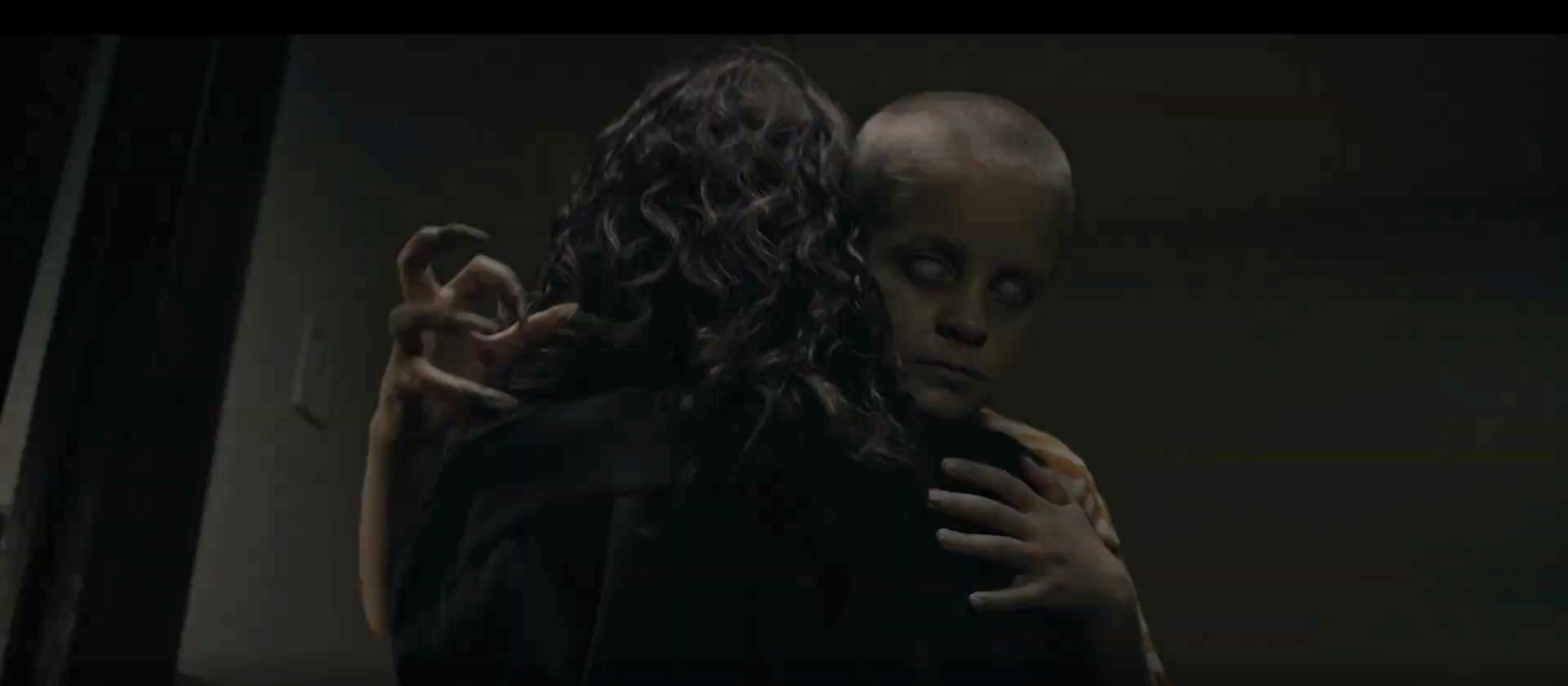
Let’s start with the good news. Lockbox looks far better than its misleading marketing materials suggest, a supernatural horror movie so darkly lit and color graded that you’ll have to squint your way through jump scares. It’s also anchored by reliable genre performers. That’s also about where the good news ends with this rote adaptation of Knifepoint Horror Podcast story “Winthrop.”
The empathetic Carla Gugino gives her all as Ellen, a saint of a woman with boundless patience who takes on life’s hard luck with a kind smile. After giving up her career as a fashion designer to become caretaker for a dying mother, she’s then forced to reinvent herself once more when her caretaker role ends. That catches us up to the events of Lockbox, where Ellen is asked to take in a cousin she hasn’t seen in quite some time who’s dealing with severe PTSD.
Just as Ellen finally establishes a real connection with Winthrop (Lou Taylor Pucci), it’s interrupted by the arrival of peculiar neighbor Vahna (Katharine Isabelle), who spells clear trouble. When Vahna shows up dead, it sets in motion a supernatural battle of possession.

Image Credit: Aura entertainment
Director Daniel Stamm (The Last Exorcism, Prey for the Devil) and screenwriter Justin Yoffe approach Lockbox in the broadest of brushstrokes, dooming it from the start with clunky storytelling and woefully underdeveloped themes of heady topics like PTSD. Winthrop is a character that comes loaded with emotional baggage and trauma that’s piled on throughout his tragic life, but much like its title, his interiority and history are treated like a tightly guarded secret meant to prolong the supernatural mystery.
The problem here, though, is that Lockbox is too sparse to sustain mystery at all, and it instead robs Winthrop of characterization. It winds up trapping the talented Pucci without anywhere to go, toggling between wounded animal and mentally disoriented.
From there, Lockbox bounds through plot developments without any sense of stakes or purpose, peppered by a smattering of haphazard paint-by-numbers jump scares. The only unwavering constant is Ellen’s resolute faith, and Stamm seems to leave it entirely to Gugino to guide confused audiences through this inconsequential story right up until its supernatural climax.

Image Credit: Aura entertainment
To give more credit, Lockbox at least injects an unconventional exorcism here; just don’t expect much in the way of explanation. When the film finally reveals the meaning behind its title, it dangles a fascinating carrot it has zero interest in delivering. More than a severe lack of fleshing out its characters beyond plot drivers or devices, this faith-based flick also seems terrified to offer any worldbuilding whatsoever.
Yoffe’s script stretches the short story beyond its means instead of fleshing it out, and Stamm fills out the gaps with cheap CGI scares and overwrought performances; Isabelle’s Vahna is beyond cartoonish in her villainy. It’s also pretty nonsensical, treating only Ellen’s faith with the utmost sincerity and largely squandering its typically reliable talent. So much so that the final imagery, pure sunkissed saccharine sentimentality, leaves you with the feeling that this horror movie might be better suited as an entry in Chicken Soup for the Soul.
Lockbox releases in select theaters on July 3, 2026.

You must be logged in to post a comment.