News
Some Epic Ghostbusters Screens And Developers Diaries Part 1

Ghostbusters, possibly the greatest game of all time? Who knows, but I sure hope so. And as of right now it sure is looking that way. Now, if you head past the break you can see 3 pics, and read read read about how this whole crazy idea to make an amazing Ghostbusters game came about. And look out for the game on every system ever in June of this year (thank you Atari).

 |
 |
 |
It Begins
So he looks across the conference table over his impressive beard at us. Pauses. Then he says, “It’s Ghostbusters. We’re going to make a Ghostbusters game. The first really good one.”
And the other one, who for the first time since we met has paused talking for almost two consecutive minutes, adds this: “And we think you’re the right guys do it. You up for it?”
Nobody says anything for a long time. They think that after all the buildup and mystery maybe we’re disappointed, that maybe we’re trying to assess the fastest way of out of the room. But that’s not the case. The fact is that Brendan is sitting in stunned silence and I’m just trying to keep from swallowing my tongue. Mark Randel (Terminal Reality President & Chief Technologist) is taking it better: he’s just near-catatonic.
It was January 2006. We arrived at the publisher forty minutes ago, one of a few stops on a tour to show off our Infernal Engine next-gen technology demo and an original game IP we’d been developing (‘the publisher’ at this time being Vivendi, before Atari took over the title in 2008: look up ‘Activision Blizzard merger’ on Wikipedia for more info). In addition to cutting-edge lighting, materials, and rendering, the tech demo depicted squad gameplay action, heavy emphasis on chaotic environmental destruction, and extremely realistic physical interaction.
It was the massive destruction is what really got their attention. Seriously: fiery explosions & debris will get your foot in any door.
Vivendi Executive Producers John Melchior (tall, quietly fast-talking, awesome), and Pete Wanat (beard & soda also awesome) introduced themselves and let us know immediately that they were the two most hated men at this publisher. John O’Keefe (Terminal Studio Director) asked if maybe there was someone else there we could talk to.
They watched our demo politely, exchanged mysterious raised eyebrows, asked a few pointed questions, and then left for a private discussion in the hall.
When they came back they seemed to have agreed on something. They told us they’d been working on developing a movie license IP. Brendan Goss (Terminal Reality Executive Producer) shot a look my way: Uh-oh. Here we go again. But this was a really big one, they continued: a really great one. And it wasn’t tied to an upcoming theater release in less than twelve months.
Then they dropped the G-bomb.
There it was, out in the open. Ghostbusters. Maybe one of the greatest movies made. Definitely one of the funniest. We were getting a crack at it. To say we were thrilled is a lazy understatement. Pleasantly electrified is closer to the truth. It wasn’t until later, after the shock wore off some, when we realized the depth of the responsibility we had staked ourselves to when we finally stammered, “Y-yes! Of course we’ll do it!”
Stars Align
The Ghostbusters game finally happened as the result of a fairly rarefied confluence of elements, a sort of Hollywood fairy tale.
Sony Pictures Consumer Products (Mark Caplan & Keith Hargrove) knew that the time was ripe for a Ghostbusters revival, and wanted to wrap it around a centerpiece game. Sony felt that game technology had finally arrived and were looking for a developer with the right mix of passion and skills to do the project correctly. First, Sony knew they needed to do two things: 1. Make sure all IP holders—which includes the director, three of the original Ghostbusters stars, and Sony Pictures itself—would be totally on board; and 2. Find a publisher that could make the game happen with as much of the original talent involved, as possible (i.e. the Ghostbusters).
Across town at the publisher, John and Pete had been talking about doing a GB game for quite a while, and had started talking to the owners of the property. They were also trying to sell their own upper management on the concept. Some reluctance is certainly understandable. The reason we jumped at the chance was the same reason the finance people were shy: a major movie-license game that’s not actually attached to a theatrical release can be a tough sell. There’s no built-in multi-million-dollar studio-financed marketing campaign. With a high-profile title, securing the license can be very expensive, especially when that license is one of the highest-grossing and most beloved films of all times (market research by Vivendi revealed that the enduring ‘no-ghost’ logo ranks just behind Coca-Cola and the Nike Swoosh stripe in order of worldwide recognition). Securing the talent can be both cost-prohibitive, if not impossible to do: Murray, Aykroyd, Ramis, and Reitman haven’t worked as a group for years, and each has his own successful career to manage.
In the meantime, Dan Aykroyd had been trying to get a Ghostbusters film sequel off the ground for years, but was having a hard time reassembling the cast and generating studio interest. He had decided that a CG-animated movie would be the best way to go, since the GB III script called for a daunting budget if shot practically. A few voice-acting sessions would require a much smaller time commitment from the cast. And the now almost-sixty-year old principals wouldn’t have to strap those brutally heavy proton packs back on and run through NYC streets. So, from his perspective, moving to a game format for a true sequel wasn’t too big a leap for him.
The three sides found one other and liked what each was bringing to the table. They worked on pulling the rest of the group back together. And the snowball starts to roll. We jumped on as soon as we could.




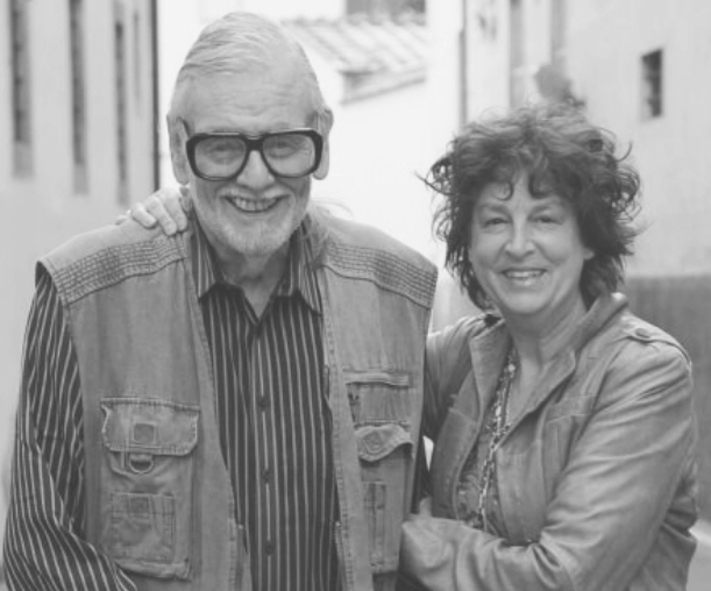
All of us here at Bloody Disgusting are deeply saddened to learn that George A. Romero Foundation Founder and President Suzanne Desrocher-Romero has passed away.
GARF shared in a statement on socials, “It is with a heavy heart that we announce the passing of Suzanne Desrocher Romero. Suzanne passed away of natural causes on June 24 at her home in Toronto after a prolonged illness.”
The statement continues, “Suzanne was the fierce leader of the George A. Romero Estate and The George A. Romero Foundation. She worked tirelessly to preserve George’s legacy. Her work at the foundation will continue to inspire and live on for generations to come. The family asks for privacy at this time.”
Desrocher-Romero founded GARF in 2018, after her late husband’s passing in 2017, and has been a fierce advocate for his legacy and the arts. It was her mission to “strengthen horror as a serious field of global study,” and she was a tremendous fighter on behalf of Romero’s works and supporting new filmmakers inspired by his legacy.
It was Desrocher-Romero who spearheaded the recovery and restoration of The Amusement Park, and, as the person in charge of the George A. Romero estate, worked closely with author Daniel Kraus on completing unfinished novels like Pay the Piper and The Living Dead. She most recently celebrated the restoration of her favorite of Romero’s zombie films, Day of the Dead, and was hard at work producing the upcoming film Twilight of the Dead.
That passionate advocacy led to Suzanne Desrocher-Romero becoming family to Bloody Disgusting as well.
2023 marked the start of an ongoing partnership between Bloody FM and GARF on The Dead, a scripted audio series spanning multiple seasons that saw Desrocher-Romero working closely with the Bloody FM team and mentoring the series’s contributing writers with GARF. To say her loss will be felt internally is an understatement.
“Anytime George Romero is mentioned is good, because what we are doing is to provide a healthy legacy. We’re uplifting his legacy, we’re supporting the archive, and we’re also supporting the Horror Study Center. So, all of these three things are what the Foundation is striving to do. As far as I’m concerned, the more we say George Romero’s name, the better it is,” Desrocher-Romero recently told BD.
It’s the perfect encapsulation of her unwavering enthusiasm for supporting Romero’s legacy and the horror genre, and just a glimpse at how much she contributed to preserving it. She is, in short, an inspiration.
We send our deepest condolences to Suzanne Desrocher-Romero’s family, friends, and GARF.

You must be logged in to post a comment.