Editorials
Special Feature: Real Exorcism Case Studies Part 3

In this sixth and final part of our series on exorcism – in conjunction with Warner Bros. Pictures’ The Rite (releasing nationwide on January 28th) – B-D takes a look at two more famous real-life exorcisms that managed to garner quite a bit of attention in their day. Interestingly, both represent cases when an exorcism became something of a community affair (either intentionally or unintentionally), with throngs of onlookers either witnessing the ritual or actually taking part in it. The difference between them is that in one case the officiating pastor became a respected and sought-after member of the community, while in the other the entire affair was viewed with deep suspicion by skeptics from several corners. Both stand as fascinating examples of the exorcism phenomenon.
Gottliebin Dittus
Year: 1842/43
Place: Mottlingen, Wurttemberg, Germany
 A resident in the small village of Mottlingen, Germany – located in an isolated section of the Black Forest – 28-year-old Gottliebin Dittus was born to deeply religious and superstitious parents and raised in strict adherence to the Lutheran faith. Though her mother and father both died when she was a child, Gottliebin continued to live with her three older siblings and practice at the local church run by Reverend Johann Christoph Blumhardt – a pastor whose belief in the power of the devil was strong.
Neighbors of the Dittus family had lately been reporting eerie noises emanating from within the home during the night, which prompted a local doctor and several other villagers to stay there over the course of an evening. All came away from the experience claiming that the home was “haunted” after reportedly witnessing strange phenomena there. Around the same time Gottliebin began reporting visions of a woman holding a baby in her arms, and later fell into an inexplicable coma for an entire day, prompting Reverend Blumhardt to visit the home. After observing the now-conscious young woman he suggested she be taken to stay at the nearby home of a cousin, as it appeared the bizarre happenings were affecting her worse than the other siblings. As soon as she left, the “hauntings” at the Dittus home allegedly ceased, but Gottliebin continued to be plagued by strange phenomena. It was then determined that she was possessed by a demon.
Blumhardt began visiting Gottliebin on a regular basis, with Gottliebin claiming that shortly after her birth, evil spirits had tried to steal her away before her mother invoked the name of Jesus. In addition, she claimed that her aunt was a witch who had tried to indoctrinate her when she was a child. Blumhardt also witnessed in Gottliebin what he claimed were clear symptoms of possession: speaking in different voices; suffering from violent convulsions; hurling blasphemies; and violently attacking her siblings, among other things. At one point she began speaking in the voice of the dead woman she’d earlier claimed to have visions of, telling the pastor that during her lifetime she had murdered two children and was now in the grip of the devil himself.
Blumhardt soon began the process of carrying out the exorcism, praying over the young woman and fasting in an attempt to cast the evil spirit out. Soon Gottliebin was claiming possession by several demons, and the number continued to grow through the following weeks and months – first three, then seven, then fourteen, and soon enough numbering into the hundreds and later thousands. The once-pious woman became increasingly violent and blasphemous, and she began vomiting up objects such as sand, glass, and nails and losing large amounts of blood. Several of the spirits who had allegedly taken control of her body spoke through the young woman, some of whom reported that they were in fact victims of the possessing demons. In a moment of lucidity Gottliebin reported that she’d recently had a vision in which her soul flew around the earth and witnessed these demons causing a catastrophic earthquake someplace far away. Only a few days later, news of a terrible earthquake in the West Indies reached the village of Mottlingen, seemingly validating the young woman’s possession. Through it all the entire village paid close attention to developments in the case and became deeply invested in the young woman’s deliverance.
The exorcism continued for nearly two years, at which point the hold of the demons over Gottliebin finally seemed to be loosening. On Christmas 1843, the possessing spirits – as if sensing their imminent eradication – made one last attempt at maintaining their control in the earthly sphere when they allegedly made a spiritual attack on Gottliebin’s brother and sister. While the brother recovered quickly, the sister Katharina soon began exhibiting many of the same symptoms as Gottliebin, and Blumhardt proceeded to turn his attentions on her, as this occurrence seemed to lessen Gottliebin’s own torment. Three days of exorcisms later, Katharina let out one final, terrible scream before proclaiming, “Jesus is victor!” and coming to rest. It was then that both Katharina and Gottliebin were announced to be cleared of demonic influence. Following the ordeal, Blumhardt become something of a celebrity in Mottlingen and nearby communities, with hundreds of parishioners from all around flocking to him in the hopes of being cured of their myriad afflictions. In fact, Gottliebin herself soon moved into the Reverend’s home to assist him in “curing” others long-term.
George Lukins
Year: 1788
Place: Bristol, England
 In the year 1770, tailor George Lukins was putting on a Christmas play with several other young men in his Yatton, Somersetshire neighborhood when he suddenly suffered a convulsive fit and toppled to the ground. After recovering he claimed that an invisible hand had struck him down, and that it had likely been due to the religious nature of the role he’d been performing in the play. However, this supposed “invisible hand” continued to plague the young man, and over the next 18 years he continued to suffer from convulsions, during which he would become violent and engage in all manner of bizarre behavior, including declaring himself to be the devil in an eerie, inhuman tone; speaking and singing in different voices both male and female; and getting down on all fours and barking like a dog. After these fits, each of which would last about an hour, Lukins would emerge greatly debilitated and exhausted, and though many medical treatments were attempted in order to cure him – including a 20-week stay at local St. George’s Hospital – none seemed to have any effect.
Around 1788, the now-44-year-old Lukins began claiming he was possessed by seven demons, and that only through the intervention of seven clergymen who would ask for his deliverance could he be freed from their influence. Word of this strange proclamation began spreading around the small community until eventually the case came to the attention of a local Anglican Reverend by the name of Joseph Easterbrook. After concluding that Lukins – who showed a strong aversion to religious objects – was indeed possessed, Easterbrook gathered together six other clergymen and together prepared to perform an exorcism on the afflicted man at Temple Church in Bristol, where Easterbrook served as vicar.
News of the event quickly spread through the surrounding communities, and it was even published in several local papers. As a result, what Easterbrook had planned on being a private affair became a public spectacle, with throngs of onlookers gathering at the church to witness the exorcism. The ritual, which took place on June 13th, 1788, began with a hymn, during which Lukins began violently convulsing and contorting his face. He then began speaking in the voice of one of the alleged demons, saying that he would never release his hold over Lukins and that he would torment him even worse for attempting the exorcism ritual. Soon enough other supposed demons began speaking through Lukins, and at one point two men from the community even had to hold the man down to keep him from injuring himself or others. Lukins went on to sing an inverted version of the Christian hymn “Te Deum”, singing “we praise thee, oh devil; we acknowledge thee to be the supreme governor”. At one juncture a skeptical clergyman from the community – who was not one of the seven performing the ritual – asked the illiterate Lukins a question in Latin in order to prove the possession was a fraud. However, Lukins reportedly answered with a suitable Latin reply, convincing the other man that this was indeed a case of true possession. Indeed, when asked his name Lukins replied, “I am the devil”.
After commanding the evil spirit(s) to depart from Lukins’ body several times over by invoking the Trinitarian formula (“In the name of the father, and of the son, and of the Holy Spirit”), Lukins began crying out horribly and making exclamations including, “Our Master has deceived us!” and “Must I give up my power?” As the ritual went on, Lukins’ wailing and convulsions increased to an agonizing level, until finally his body relaxed and he proclaimed in his own voice: “Blessed Jesus”. He then recited the Lord’s Prayer before thanking the clergymen and others present and exiting the church.
As word of the Lukins exorcism spread, controversy quickly followed in a country and era in which more and more people had become skeptical of alleged supernatural phenomena. A surgeon by the name of Samuel Norman who had once shared accommodations with Lukins claimed he was merely a talented ventriloquist who was deceiving the public. It was also claimed that Lukins’ original story – that he had been slapped by an “invisible hand” while performing the Christmas play – was nothing more than a case of public drunkenness. Others implied that Lukins used his supposed possession as an excuse not to work or contribute to the community, with some claiming his fits would miraculously clear up once others in town took up a collection for him. Another theory, put forth in an article in The Gentleman’s Magazine and Historical Chronicle, was that Lukins was legitimately suffering from epilepsy and/or St. Vitus’s Dance (a similar disease) and that Easterbrook and the other clergymen had wrongly chalked it up to a spiritual cause. As for Lukins himself, though he became quite the public figure during this period what ultimately became of him is mostly a mystery.



Horror was permanently changed in 1984 when Wes Craven’s A Nightmare on Elm Street unleashed Freddy Krueger on the world. This brutal boogeyman pushed horror to exciting new places, but so much of the character’s impact is the result of Robert Englund’s quintessential performance.
Englund has a long and storied career as a performer that’s covered far more than horror alone. However, there’s such a sublime, sinister synergy between Englund and this heightened genre that’s made him one of horror’s most revered names.
Englund is set to scare audiences again as a malevolent reimagining of Jiminy Cricket in Pinocchio Unstrung, but he’s also been responsible for many more macabre monsters.
The Cricket (Pinocchio Unstrung)

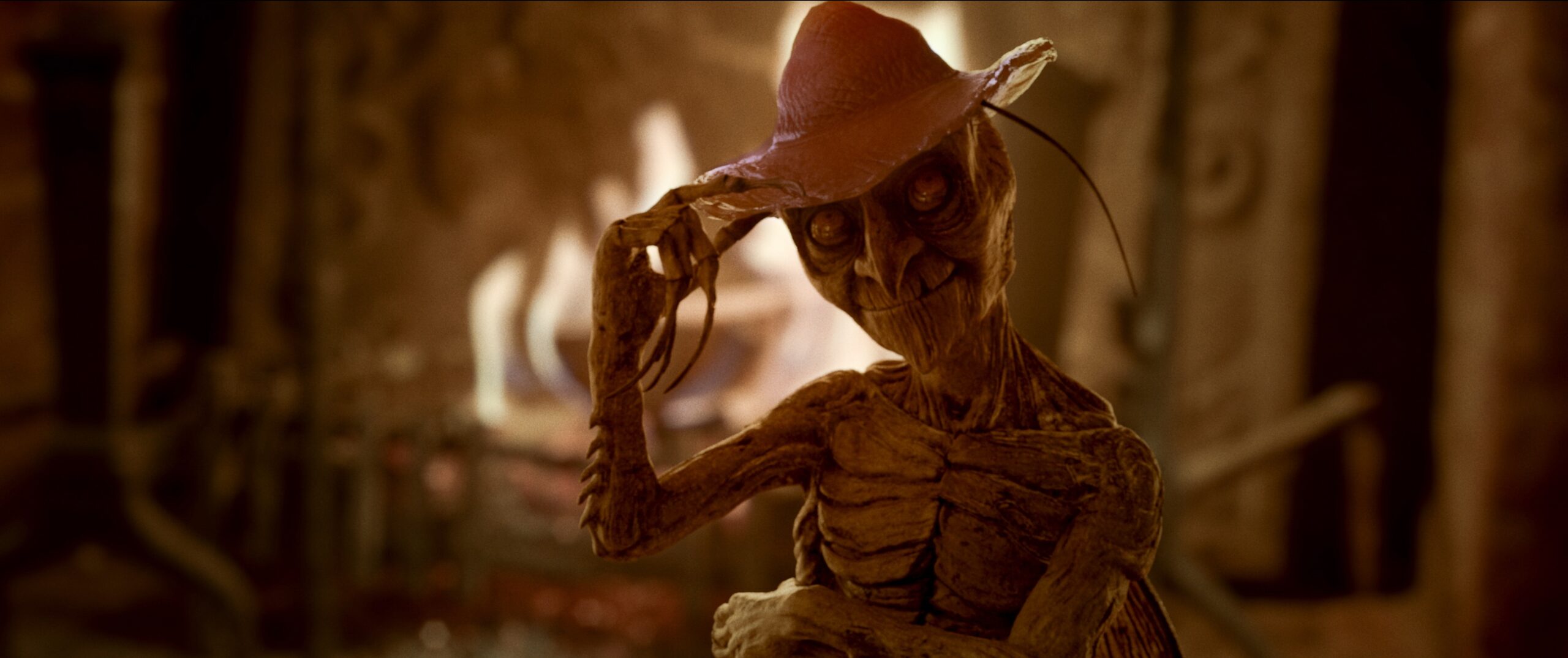
Winnie the Pooh: Blood and Honey has somehow spun a morbid experiment in public domain exploitation into its own cinematic universe, the Twisted Childhood Universe. There’s been increasing promise in the TCU’s various films, which has also led to a growing list of capable horror guest stars, such as Roger L. Jackson, Richard Brake, and now Robert Englund. Englund is by far the most impressive name to attach himself to one of these movies, and Pinocchio Unstrung certainly doesn’t squander the opportunity to have him on board as its terrifying take on Jiminy Cricket. Englund’s performance as “The Cricket” in Pinocchio Unstrung becomes a sinister subversion of the classic character who is meant to function as Pinocchio’s conscience and moral compass.
Englund’s Cricket is instead the ultimate instigator who perpetually pushes Pinocchio into greater violence that condemns humanity and its many misgivings, rather than idolizing all the “real boys” in the world. Pinocchio Unstrung is a love letter to practical effects and old-fashioned animatronics and puppetry. This means that Englund just provides the voice for Cricket, but it’s still a deeply sinister performance and one of the most unnerving characters to appear in the Twisted Childhood Universe. Once again, Englund is careful not to just repurpose his Freddy Krueger persona, and he instead develops an original voice that plays into past renditions of the character. There’s a palpable rage and disdain in Englund’s Cricket that turns him into a threatening loose cannon and makes the audience forget that he’s only a few inches tall.
The Phantom of the Opera (The Phantom of the Opera)

The Phantom of the Opera is a foundational horror story that’s still being explored over a century later. 1989’s cinematic adaptation of Gaston Leroux’s 1910 classic doesn’t always get the respect that it deserves, despite it containing one of Englund’s most nuanced horror performances. Directed by Dwight H. Little, who previously helmed the underrated Halloween 4, The Phantom of the Opera operates as a gorier take on Leroux’s source material that feels like a lost Hammer Film picture. The titular Phantom is the perfect role for Englund following A Nightmare on Elm Street, and his participation in the picture was initiated by Englund promising his agent that he’d do another horror project after Elm Street’s success.
Englund was excited to tackle an iconic character who had previously been portrayed by formative horror legends like Herbert Lom, Claude Rains, and Lon Chaney. Englund beautifully fits the mold and is sublime casting for this ‘80s take on the character. Englund taps into a powerful dichotomy between the Phantom’s brutal and tragically sympathetic nature. It’s a role that’s significantly deeper than Freddy Krueger and better explores Englund’s range as an actor, which helps get him away from cheesy one-liners. It also doesn’t hurt that Little concocts a uniquely twisted take on the Phantom’s disfigurement, which was achieved by sewing human skin onto Englund’s face. The modern-day sequences that bookend the film were meant to tie into a planned sequel, The Phantom of the Opera 2: Terror in Manhattan, which unfortunately never came to fruition.
Victor Creel (Stranger Things)

Love it or hate it, Stranger Things assembled some impressive guest stars that took advantage of their respective legacies as ‘80s genre legends, such as Linda Hamilton, Matthew Modine, Cary Elwes, and Robert Englund. Englund’s turn as Victor Creel in the streaming hit’s fourth season is one of the series’ best performances and a role that rises above the mediocrity around it. Victor Creel is an opportunity for Englund to actually subvert expectations and play against type. It’s brilliant casting that initially conditions the audience to be wary of Creel and view him as a frightening threat. This perception is reinforced when Creel is encountered in a psychiatric ward and horrifically blinded.
Creel’s disturbing eye-gouged appearance is revealed to actually be a symptom of his tragic life and the psychological torment he received from Vecna. Creel is hard to look at, but there’s nothing to fear about him. He’s led a sad life that’s filled with inescapable guilt. He’s more like one of Freddy Krueger’s victims than Freddy himself. Englund goes above and beyond as Victor Creel, and the emotional monologues that he delivers are among some of the actor’s best work and proof that Englund’s still got it.
Marquis de Sade (Night Terrors)

Tobe Hooper’s Night Terrors is a particularly forgettable ’90s horror film that faced a litany of production problems and changes that certainly didn’t do it any favors. The story is a mess, even for a Cannon Video production, but it provides the novelty of Englund pulling double duty as the cruel Marquis de Sade and his modern day descendant, Paul Chevalier. Night Terrors banked on the novelty of Hooper directing Englund as one of history’s greatest monsters, and his performance is easily the best thing about this movie.
There’s an unabashed glee to Englund’s work as the Marquis de Sade that’s reminiscent of Freddy Krueger’s twisted jubilation over his creative murders, yet it doesn’t just feel like a carbon copy of Englund’s iconic role. There’s an appreciated degree of restraint going on before the film goes off the rails and incorporates supernatural elements and abstract dream sequences. Chevalier and his modern cult worship the Marquis de Sade as a deity of torture and liberation. The nightmare sequences that involve the Marquis de Sade are the most chilling and make this figure look as frightening on the outside as he is on the inside. There’s enough to latch onto here, even if the film as a whole is a mess, and Englund doesn’t squander the opportunity to play two sides of the same creepy coin.
Scarecrow (Injustice 2)

Robert Englund is no stranger to voiceover work, and he’s voiced his share of macabre and memorable characters over the years. That being said, one of his most inspired roles is the work that he did in NetherRealm’s dark DC Comics-based fighter, Injustice 2, where he plays Jonathan Crane, better known as the Scarecrow. There’s a certain tongue-in-cheek brilliance to having Englund voicing the Batman rogue who is the self-appointed “Master of Fear.” There’s certainly a meta quality to Englund’s casting here, right down to how some of his dialogue explicitly references Freddy Krueger one-liners like “Welcome to your nightmare” and “Now I’m playing with power.”
Englund doesn’t just phone in this performance or replicate his work as Freddy. The actor cultivates a unique voice for Scarecrow that cuts to the core of this character in a menacing manner. Englund’s Scarecrow is raspy, erratic, and honestly one of the better takes on Dr. Crane. It makes one wonder what he’d be able to accomplish if he were playing the part in live-action. He takes a simple role and breathes fresh life into it. Curiously, it’s not his first time playing a Batman villain. He does comparably interesting work as The Riddler in The Batman and the more obscure sorcerer, Felix Faust, in Justice League.
Evil Bloodthirsty Brian (The Hughleys)

There’s a surprising relationship between horror icons and sitcoms, with Robert Englund being no stranger to adding a devious dose of terror to a farcical comedy. Englund shows up as a playful take on Lucifer in Married…with Children, but he also provides a genuinely chilling performance in the first season of The Hughleys. Season one’s “Storm O’ the Century” is centered around the Hughleys and Rogerses getting stranded at a seemingly haunted hotel during an intense blizzard.
“Storm O’ the Century” functions as a proper love letter to horror fans, with genre guest stars that include The Addams Family’s John Astin, The Shining’s Shelley Duvall, and Robert Englund as the comically-named Evil Bloodthirsty Brian. The episode certainly prioritizes its comedy, but it manages to also be legitimately creepy thanks to a locked-in performance by Englund. He’s used sparingly, but always to punctuate a particular scene and function as a jump scare. Evil Bloodthirsty Brian sports a ghastly scar and has a look that’s just frightening enough to be included on a ’90s sitcom. Anyone who is curious about Englund’s performance can check it out for free on Tubi.
You must be logged in to post a comment.