
Movies
[Review] FF ’11: Second Thoughts on ‘Paranormal Activity 3’

After a mind-blowing secret screening this past Sunday (a title the entire theatre had to swear not to mention on Twitter, FB, or out loud), everyone at Fantastic Fest was theorizing out the wazoo as to what the second one would be. Paramount was rumored to be the studio, which opened the flood gates and had attendees guessing Hugo, MI:4, Tintin or Paranormal Activity 3, with the latter proving to be correct.
Earlier, we posted Corey Mitchell’s positive review and now we have a second by BD stringer Brad McHargue, who also dug the film. Read past the break for his thoughts on the third entry in the franchise, which he said “[keeps] the series fresh and engaging.”

Full disclosure: I saw an incomplete cut of the film. Directors Henry Joost and Ariel Schulman said they mostly had sound issues to complete, but unless they add or change whole scenes, I saw what can essentially be considered a final product.
After Paranormal Activity 2 was released, it was clear a formula had been established. The scares were inconsistent, generally weak, and did little to emulate the originality and fear seen in the original. When the third movie was announced, most rolled their eyes and were upset by the fact that the studio was now simply trying to bleed money off what should have been a single film. It doesn’t matter how unoriginal it is; it’ll still find an audience because people thought the first one was terrifying.
Paranormal Activity 3 opens shortly before the events of Part 2. Katie Featherston brings over several boxes of old VHS tapes to store them at her sister Kristi’s place, all of which vanish after a “robbery.” The film then switches perspectives to 1988, where Dennis, the girls’ mother’s boyfriend, sets up cameras around the house to the strange events that began happening after the arrival of Kristi’s imaginary friend, Toby.
Paranormal Activity 3 is horribly formulaic and does little to distinguish itself from the first two entries in terms of presentation. Recalling the night-by-night set-up of the previous films (complete with droning sound cues to warn the listener that something is about to happen), we’re forced to suspend disbelief from the get-go in order to tolerate the gaping holes in logic and common sense that pervade it. A scare sequence in the bedroom of Katie and Kristi goes completely unmentioned and uninvestigated by their parents, and it’s maddening to think that directors Henry Joost and Ariel Schulman (of Catfish fame) felt this was an acceptable way advance the story. The characters in Paranormal Activity exist in a world where common sense is conspicuously lacking. Why the hell are they always carrying around a camera? Put the damned thing down.
The story itself leaves little to be desired, but the film has entered a world where the “why” is more or less incidental when compared to the “what.” Little is revealed until the intentionally ambiguous (yet incredibly creepy) ending, and although it manages to more or less stay true to the facts presented in the first film regarding the girls’ past, you’re left with some unanswered questions. The viewer is left to fill in the blanks to try and piece together the “why.” This isn’t necessarily a bad thing, but given the mythology they’ve been trying to establish for the past two films, we’ve come to expect a little bit more.
Despite this, Paranormal Activity 3 manages to keep the series fresh by not only bringing the scares on hard and fast, but by deviating from standard “doors opening and closing” tactics that plagued the first one, as well as remaining consistent with its attempts to frighten the viewer, which the second film failed to do. Joost and Schulman jump right into things with a subtle scare reminiscent of the baby powder scene in the first film – which I thought to be the scariest part of this film. From thereon out, they keep things coming at a relentless pace with a mixture of standard scares and mischief – a door opening and closing, phantom footsteps, the standard fare – to those that bring a heavily heightened sense of physical danger. The demon isn’t kidding around this time, and the results are terrifying.
One of the standout additions of the film – one that helps to distinguish the film from the first two – is the use of a rotating camera. Made possible by mounting it on a disassembled oscillating fan, the constant surveying of the kitchen and living room allows Joost and Schulman to play with space and sound in a very creative way. Something will appear in the living room, and as the camera turns toward the kitchen, you’re on the edge of your seat wondering if it’s still going to be there when it returns. It’s kind of a cheap scare, but it’s incredibly effective.
Much like the Saw series, the existence of Paranormal Activity 3 is nothing more than a money grab. There’s not much that can be done with the story to keep it original enough to be satisfying, but Joost and Schulman manage to toss in enough clever scares and a decidedly creepy plot point to keep the series fresh and frightening. It’s not a perfect movie, but it’s damn entertaining.
3.5/5 skulls


Movies
‘Tha Rae: The Exorcist’ Review: Gory Thai Possession Horror Faithfully Adheres to the Tropes [NYAFF 2026]

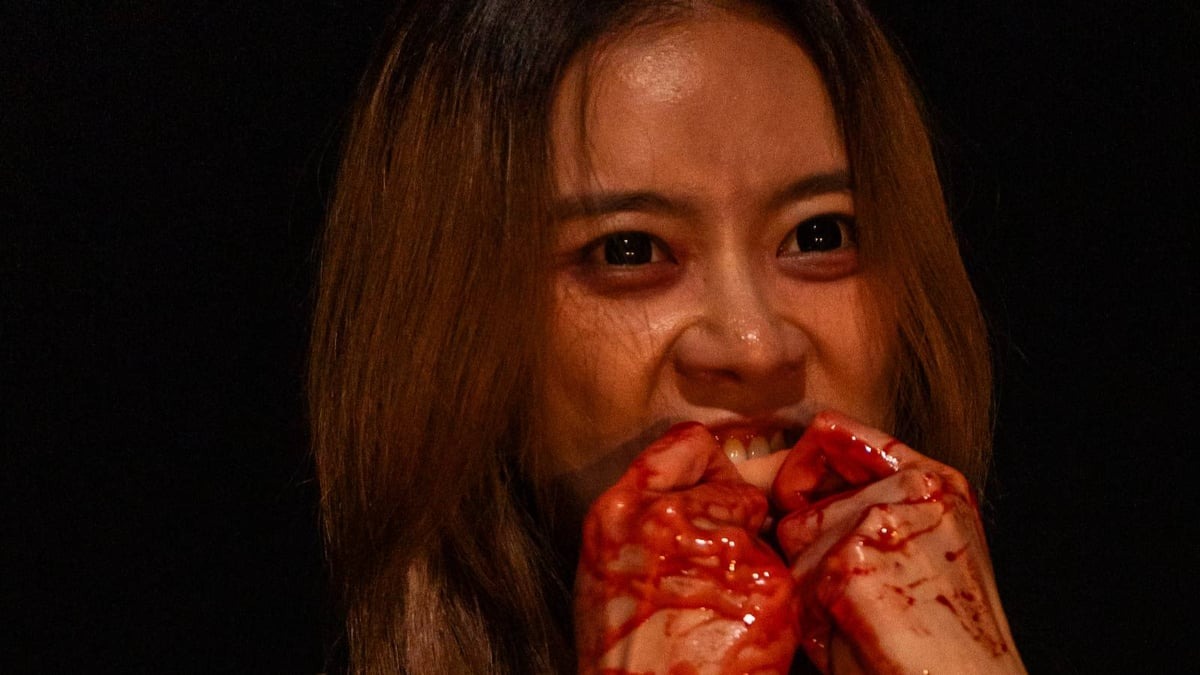
Possession films are an exceedingly common subgenre in horror to the point that far too many of them feel far too familiar. This is a generalization, obviously, but it too often seems that someone is possessed, a representative from the area’s dominant religion is called in, and a fierce spiritual battle comes to a dramatic conclusion. The idea that the demon in question always happens to be of the exorcist’s faith and denomination is simply chalked up to plot necessity.
Tha Rae: The Exorcist adds an intriguing wrinkle into that trope by introducing a demonic entity that rebuffs both a Catholic priest and a local Yao shaman. It’s only when the two join forces that they’re able to put up a fight against the evil being.
The film opens with a Catholic exorcist out of options. A possessed child writhes before him, pustules and other signs of devilish control wracking the little girl’s body with snarls and contortions. Unable to beat the demon, and unwilling to let it grow stronger and move to another host, the priest convinces the child’s mother that death is the only choice left – so they plunge a knife into the girl’s heart.
Forty years later, it’s that same priest, Ming (Thaneth Warakulnukroh), who’s become possessed to the point of attacking and trying to eat other villagers. His daughter Malee (Nichaphat Chatchaipholra) arrives to check in on her father, but she too soon falls prey to a possessive entity with a taste for flesh. Two exorcists with wildly differing faiths and styles are called in – Sopha (Phiravich Attachitsataporn) is a self-described Yao witch doctor and TikTok exorcist who uses props, dance, theatricality, and ancestral spirits to combat the forces of evil, while Father Paolo (Jirayu Tangsrisuk) is entrenched in the traditions and rituals of the Catholic Church.

Photo: © 2025 SAHAMONGKOLFILM INTERNATIONAL COMPANY LIMITED ALL RIGHTS RESERVED. North American Premiere
There’s both tragedy and betrayal at play in the narrative of Tha Rae: The Exorcist, but director/co-writer Taweewat Wantha puts the thematic focus on the collaboration and understanding required to go toe to toe with a deviously malevolent force. It’s an interesting spin on the expected formula, and while the rest of the film stumbles in its supporting players and follows more traditional beats – albeit with some fun, gooey gore – that core element is enough to make it stand apart from the crowd.
Wantha broke onto the film scene with 2004’s memorably titled Sars Wars: Bangkok Zombie Crisis and continued that trend with oddball genre comedies like The Sperm and Kindergarten War, but he found major success with the one-two horror punch of Death Whisperer and Death Whisperer 2. His latest is more in line with those hits as jump scares and local mythologies play into his creepy tale of possession and generational punishment.
Tha Rae: The Exorcist arguably has more personality and humor, and both are due in large part to the character of Sopha and the playful but sincere performance that brings it to life. Where Tangsrisuk is saddled with the more straightlaced priest, Attachitsataporn’s witch doctor enjoys his local celebrity and has fun while aiding his community. Sopha’s social media followers expect a show, and he delivers, but there’s an engaging dynamic at play within him.

Photo: © 2025 SAHAMONGKOLFILM INTERNATIONAL COMPANY LIMITED ALL RIGHTS RESERVED. North American Premiere
Sopha’s grandmother was the original witch doctor, and he was just her apprentice. When she passed – and subsequently became the primary ancestral spirit that he calls upon during his rituals – Sopha took up the mantle. For one reason or another, continuing her legacy requires him to carry on with his more feminine foot forward. Makeup, costumes, and a feminine lilt to the way he walks and talks are all part of the show. He apologizes to Paulo for it, but there’s no shame in his words or tone as he embraces the gifts he holds and the power he wields.
There’s no disdain between the two even as they seem initially unimpressed by each other’s efforts. Eventually, though, after each has struck out in dramatic and painful fashion, they realize a combined approach to fighting this particular demon is the only way forward. It’s here where the film shines brightest with the idea that beliefs can intermingle and co-exist without the need for disdain or dismissal.
The two of them are the heart of Tha Rae: The Exorcist, but the meat and potatoes of the genre come in the form of creepy antics and a bit of the ol’ gut munching. Intestines are nibbled, a feral man bursts through floorboards to terrorize young girls, and the possessed have a generally unsettling look about them. Wantha too often neuters his atmosphere and mood, though, by jumping quickly to the gore. It cuts into the horror of it all, leaving the film to work in fits and bursts rather than as a cohesive, propulsive whole.
Shortcomings in both the script and direction prevent the film from coming close to denser, more memorable, and atmospheric possession horrors like It Comes or The Wailing, but its main theme and dual lead characters still offer up an intriguing combination.
Genre tropes exist for a reason, but Tha Rae: The Exorcist is a good reminder that they also exist to be twisted, teased, and, when necessary, torn to shreds.
Tha Rae: The Exorcist made its North American premiere at the 25th New York Asian Film Festival.

You must be logged in to post a comment.