Movies
[Interview] Director Declan O’Brien Goes Snowbound With ‘Wrong Turn 4: Bloody Beginnings’!


Declan O’Brien was given the reigns to your favorite mutant hillbillies with Wrong Turn 3 and now he steps back up to the plate with their origin story, Wrong Turn 4: Bloody Beginnings.
This time he changes things up a bit by shifting the shooting location to snowy Winnipeg and filming inside a historic hospital for the insane. As for the body count? Well it’s as high (maybe even higher) than ever.
“At an isolated hospital deep in the West Virginia wilderness, three hideously deformed mutants go on a merciless killing spree. Now, decades later, this family of blood-thirsty cannibals is stalking new prey: a group of young skiers trapped by a blizzard. The abandoned medical wards soon become killing fields as the panicked victims come face to face with a chilling choice — fight back or die. With bonus footage too graphic for theaters, ‘Wrong Turn 4’ takes you to the most terrifying place of all…the beginning.”
I recently caught up with O’Brien on the phone and had a quick chat about the shoot. Check it out after the jump!Bloody-Disgusting: Did you approach Wrong Turn 4 from a different angle than Wrong Turn 3?
Declan O’Brien: Well on this one I had a lot more freedom because it’s an origin story. I was a little more free to create how everything began. So in terms of story I could do pretty much anything I wanted to. ‘Wrong Turn 3’ had to follow 2 and 1 chronologically, that sort of stuff.
BD: This one has a different visual template from the others in the sense that it takes place in a snowbound environment. It’s a totally different color palette. Was that exciting for you to work with?
DO: Yeah that was a ton of fun. The movie was shot in Winnipeg in February, which was minus 45 degrees one night while shooting which wasn’t too much fun. But visually, changing the color palette and giving it a creepy vibe, as opposed to being out in the woods in the bright daylight the entire time, [I found] there was a lot more you could do in a dark, wintery cold environment.
BD: In terms of the ensemble, it’s fairly large. What was it like pulling that together?
DO: It was hard at times, you have to service all of these characters. But it was satisfying because the more people you have, the more people you can kill.
BD: As with all the Wrong Turn movies there’s a great sort of gonzo nature to the kills. What was your favorite one to orchestrate?
DO: My favorite one is the effed up fondue scene. I’ve never seen that before and I think the actor did a really good job in dying. And the practical effects guys did a really good job in pulling it off. I found it was really disgusting yet perversely funny at the same time, which is what I was going for.
BD: It seems like you use a lot more practical than CGI. How many hours did a typical kill take to set up?
DO: The hanging scene took the entire day of shooting. Each big kill that I would do I would take the entire day. The CG on this movie was minimal, just snow enhancement and stuff like that. I really wanted to go practical and see what we could achieve and I had a really good crew out of Toronto and they pulled it off.
BD: How did you find the location of the sanitorium?*
DO: It was funny, I came up with the idea for the script and I knew of an old hospital that I had shot at before in Bulgaria or Romania. And I kind of wrote the script around this location that I knew existed. But then, I got a call from a producer in Winnipeg who thought they had exactly what I was looking for. And soon enough I had pictures of this abandoned mental health facility called the Brandon Mental Health center which was built in 1910 and went out of service in the 80’s. And it was just completely creepy and had literally everything I had written for this other hospital. So we decided to go to Winnipeg.
BD: What’s up next for you?
DO: I just finished a screenplay for Fox and we’ll see if that goes into production. Other than that, a lot of golf.
BD: A lot of golf?
DO: Mmm-hmm.
BD: Nice. Any hints as to what the screenplay is?
DO: Can’t talk about it yet. Literally just handed it in last week.
Wrong Turn 4: Bloody Beginnings hits DVD and Blu-ray on October 25th.



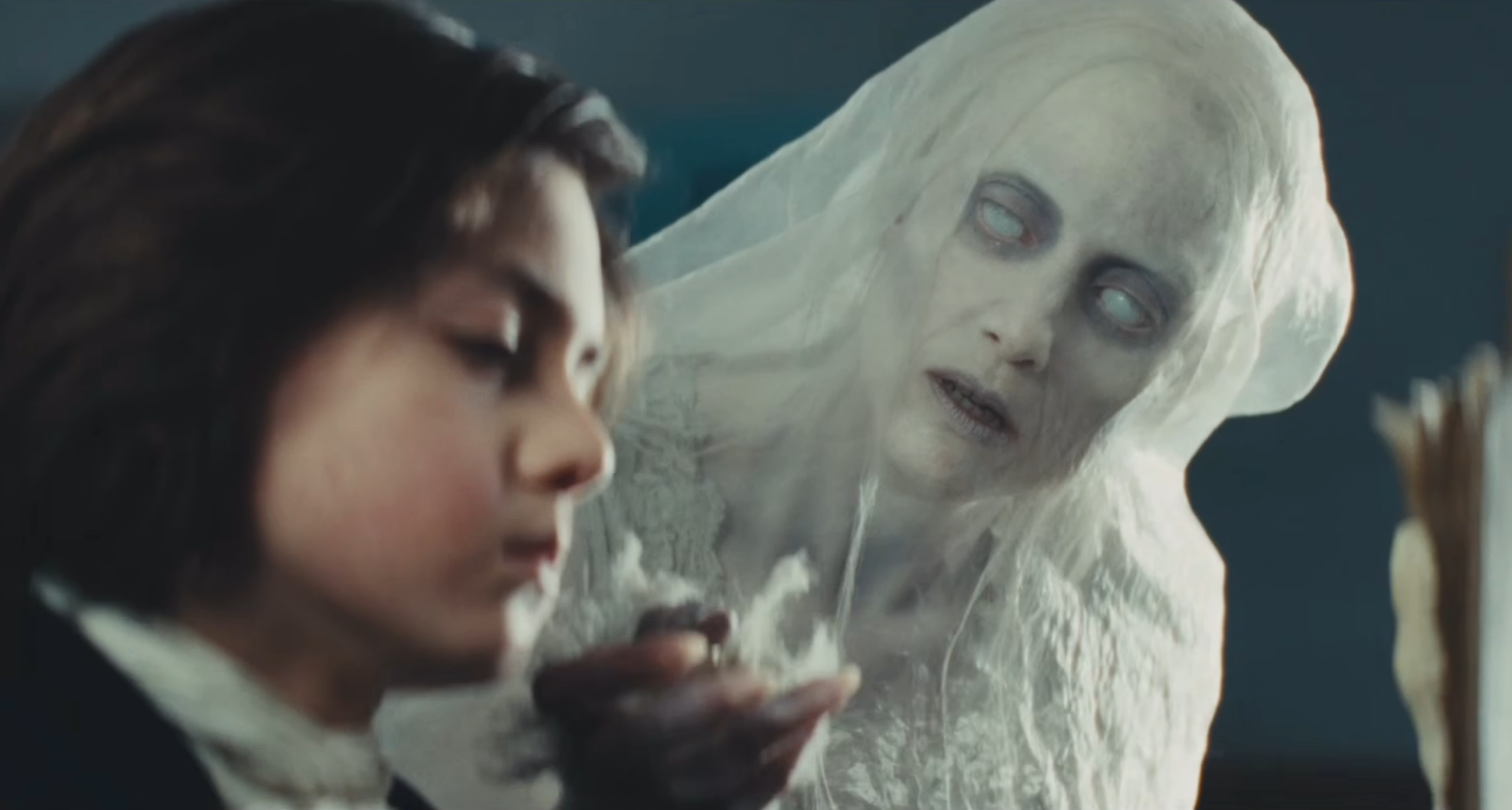
The trailer for Ti West’s upcoming adaptation of A Christmas Carol raised a lot of eyebrows when it dropped earlier this week. While plenty of folks initially dismissed Ebenezer as a derivative project meant to cash in on the recent wave of unnecessary prequels that expand the backstory of beloved characters (such as 2023’s Wonka), Charles Dickens’ original novel already made a point of exploring Ebenezer Scrooge’s origins in detail – meaning that this new film is likely just a particularly faithful adaptation of the source material under a different name.
Couple that with the fact that the movie is being helmed by a genuine horror auteur and I think it’s safe to say that the latest iteration of the first modern ghost story is in good hands.
That being said, one detail that immediately jumped out at me during the brief teaser (other than a blink-and-you’ll-miss-it nod to Johnny Depp’s iconic bedroom death scene from the original A Nightmare on Elm Street) is the fact that many of Ebenezer’s ghosts appear to have been directly lifted from the iconic John Leech illustrations that accompanied the first edition of Dickens’ novel.
Here are a couple of stills from the trailer compared to the original artwork:

The Ghost of Christmas Yet to Come in ‘Ebenezer’ and ‘A Christmas Carol’

The Phantoms in ‘A Christmas Carol’ and ‘Ebenezer’

Marley’s Ghost in ‘Ebenezer’ and ‘A Christmas Carol’
Mainly working with old-school wood and steel engravings that would later be transferred to print, Leech was instrumental in crafting the iconic look of history’s most influential phantoms – especially since Dickens is said to have been deeply involved with the creation of these so-called “comic illustrations.”
And since the novel is commonly said to have popularized spiritualism in Victorian England, much of the ghostly iconography that we still see in genre media to this very day (including some of Ti West’s previous films) can be traced back to the author’s partnership with Leech.
Ebenezer won’t be the first A Christmas Carol adaptation to borrow heavily from these designs, but I can appreciate how Ti West is incorporating an important part of horror history into his latest film.
Ebenezer will be available in theaters starting November 13.

You must be logged in to post a comment.