Editorials
Horror Education of the Week: ‘Prometheus’


Prometheus.
Some of you liked it. The majority of you hated it.
I adore it.
The prequel/not a prequel to Alien (and now maybe it’s a sequel to Blade Runner) follows Dr. Elizabeth Shaw and Dr. Charlie Holloway, along with a crew, to LV-223. After finding multiple drawings across Earth, all depicting the same god-like figure, they set out on their journey to this distant planet. There they hope to find the answers to mankind.
Perhaps Prometheus can be seen as a warning to our society to not put our trust in man as a god. It can also be seen as a warning to not put all of our faith in an invisible God.

Prometheus blows my mind. There are so many complex themes and imagery in it that makes me want to watch it on repeat. I cannot do it justice. There is simply no possible way. I state this with every article where I present ideas to you, but this time I truly mean it. To give every ounce I believe this film deserves would take weeks if not months.
I think Prometheus affects me strongly because I grew up Catholic. I learned the Bible in a manner where I was told that I was special – because I was one of the few that believed in THE ONE TRUE GOD. In the last few years, any ounce of belief has left me. I still hope that there is some purpose to life or a higher being that put all of this into existence, but I simply can no longer put my faith into something I cannot see.
While I cannot give Prometheus the analysis it deserves, I can present the greatest, most obvious theme throughout this incredible film. The concept of God.
From the beginning, Prometheus is saturated with religion.

– The opening of Prometheus opens with a god-like engineer sacrificing himself. As his body deteriorates, it is washed away and DNA broken down. DNA we later discover is identical to human DNA.
– He has sacrificed himself, like Jesus, so that we shall live.
– The name Elizabeth is the Greek transliteration of the Hebrew name Elisheva, meaning “God’s promise”, “oath of God”, or “I am God’s daughter”.
– Elizabeth is always wearing her father’s cross, showing she has faith in God.
– The name Charles is from the Germanic word karl meaning “free man”.
– Charlie’s faith is in science, much like Charles Darwin.
– When Prometheus lands, the captain is seen setting up a Christmas tree. The celebration of the birth of the Son of God.

– There is constant dialogue throughout the movie on what the characters believe, and what they have faith in.
– Elizabeth’s mission is to find the creators. Her thoughts are that the engineers created us, and she wants to know who created them.
– In the pyramid, the crew find the chamber full of the vases of death. This scene is very reminiscent of the egg chamber in Aliens, as mentioned a few weeks ago.
– Behind the giant head in the chamber, is a mural. The mural shows a familiar alien being in a very crucified Christ pose. Yes, it’s our Space Jesus.

– When Charlie and Elizabeth argue about the discovery of the fallen engineers, Charlie states that the realization is that nothing is special. Anyone can create life.
– We then learn that Elizabeth is sterile and cannot conceive. This idea is very important.
– In the Gospel of Luke, Mary, the mother of Jesus, asks how she is to conceive and bear a son, since she is a virgin. She is told it will happen by the power of God.
– After Charlie is infected and is killed, Elizabeth is told by David that she is pregnant. A virgin birth of sorts by the power of the engineer gods.

– Wrapped much like Christ on the cross, Elizabeth preforms surgery to remove the alien embryo from her.
– “Sometimes to create, one must destroy.”
– This quote can be seen everywhere in the Bible, perhaps the most prominent in the Old Testament with the story Noah and his ark. God sends constant rain upon the earth to flood and destroy it so that select humans can start over.
– In the Bible, King David is chosen by God.
– David in the film is stated by Peter Weyland to be his only son. Much like Jesus to God.

– A parallel of the Bible story of David and Goliath can be seen in Prometheus.
– Goliath was a giant and a warrior. David struck Goliath in the forehead with a stone from his sling. Goliath fell dead, and David took Goliath’s sword and beheaded him.
– The Bible story’s point was to show that Goliath represented paganism, and David represented a true faith in God.
– The engineer can be seen as the Goliath figure in Prometheus, however, with the stones of words that David throws, he is far from victorious and ends up being the one beheaded.

– In the Bible, Jesus asks his disciples, “Who do you say that I am?” Simon answers, “You are the Christ, the Son of the living God.”
– Jesus says that Simon is “blessed” to see his true identity. Jesus then calls Simon by the name “Peter” – from the word ‘rock’ in Greek.
– “On this rock I will build my church, and the gates of Hell will not prevail against it.” (Matthew 16:13-20)
– The idea that Peter Weyland hopes to learn the secret to eternal life on LV-223 – a giant rock – can be interpreted in a much deeper sense from the above quote.

– The first scene we see the awakened Peter Weyland, he is having his feet washed.
– At the beginning of the Last Supper, Jesus washed his disciples’ feet. Peter refused to let Jesus wash his feet to which Jesus said: “If I wash thee not, thou hast no part with me”, Peter replied: “Lord, not my feet only, but also my hands and my head”. (John 13:2-11)
– The idea that Weyland’s feet are being washed just before his “last supper” so to speak, is quite significant.
– Weyland’s last words are: “There’s nothing.”
– David answers, “I know. Have a good journey, Mr. Weyland.”
– In the deleted scenes and extras in the dvd set of Prometheus, we see additional amounts of religious imagery.
– At the 2023 TED Conference, Peter Weyland gives a grand speech culminating in “We are the gods now.”
– In an extended conversation with the engineer at the end of the film, Weyland tells him that he made David in his own image. For that, he deserves to live forever as he, too, is a god.
– In a transmission to Weyland, Elizabeth pleas for his assistance, stating “Do you ever feel all the science in the world will never give us the answers we really want?”
– In the end, Elizabeth puts her father’s cross back on as David asks her, “After all this, you still believe, don’t you?”



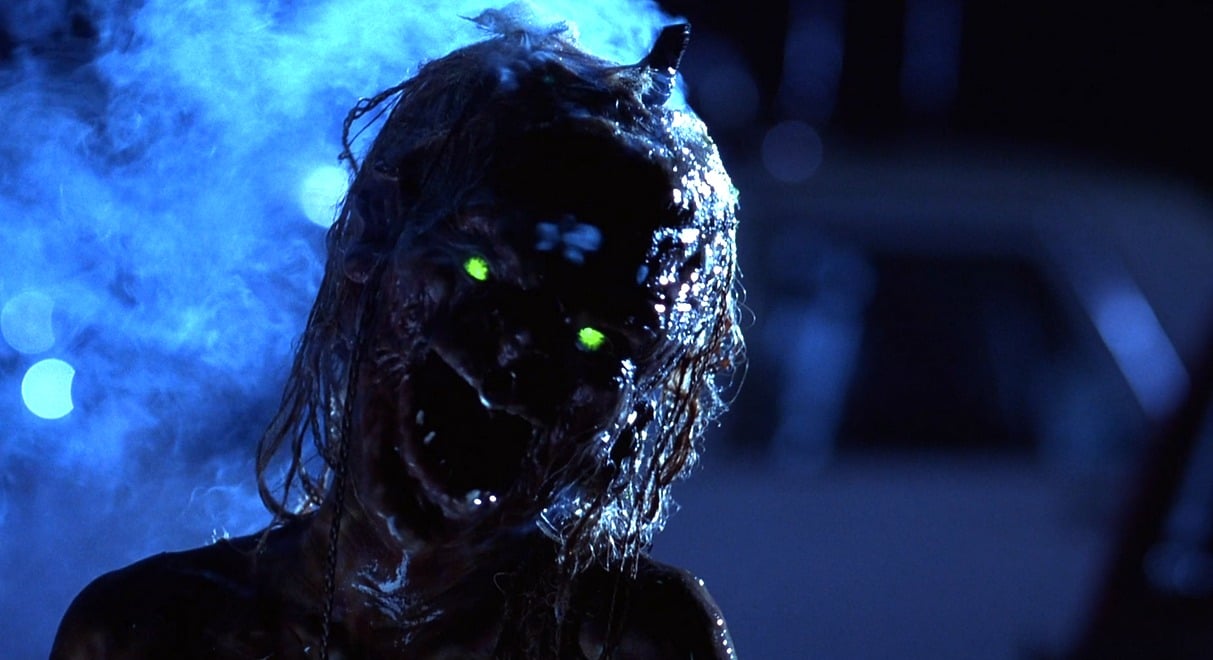
The great Ernest Dickerson turns seventy-five years old this month, so we’re looking back at his most memorable contribution to the horror genre – 1995’s Tales from the Crypt: Demon Knight!
The film hit screens while the Tales from the Crypt series was winding down its run on television, and it stands apart with a story that feels a step or two removed from the franchise norm. That was the smart play, though, as the show’s stories – and those from the original EC comics – work best in short bites. The result is a film that holds up beautifully as a gory good time.
Now keep reading to see what I heard on the commentary for…
Tales from the Crypt: Demon Knight (1995)
Commentator: Ernest Dickerson (director), Michael Felsher (moderator)

1. Dickerson was in post-production on Surviving the Game when he got a call from his agent saying that producer Gil Adler wanted to meet about a Tales from the Crypt feature film. It went well, so Dickerson met with Joel Silver next and secured the job.
2. The original screenplay for the film came to the producers as a spec script wholly detached from the Tales from the Crypt brand. They added the Crypt Keeper (voiced by John Kassir) bookends to make it fit.
3. Dickerson was more familiar with the original EC comic books having read them as a kid, but he had watched a few episodes of the HBO series, so he knew what the current vibe was for the project.
4. Adler directed the film’s wraparound segments, meaning Dickerson never actually got to work with the creepy puppet. “Gil and the Crypt Keeper had a great relationship,” he adds, “they worked together for years.”
5. While he was new to the Tales from the Crypt family, Dickerson had previously worked as a director of photography on the Tales from the Darkside anthology series. That show is underappreciated in my humble opinion, and I will go to bat for both it and the equally underloved Monsters.
6. A big appeal of the horror genre for Dickerson is the idea of dark mysteries that challenge our imagination. For this film, that came down to the mythology being created between the characters.
7. Five executive producers are listed in the opening credits, but Dickerson says the only two he had dealings with were Silver and Richard Donner. The other three were Walter Hill, Robert Zemeckis, and David Giler.
8. Dickerson had only ever seen Billy Zane in movies with a full head of hair, so he was surprised when Zane showed up on the first day with a bald head. “He had this case, and he opened up the case that he had all these hair pieces in, and he says, ‘So which one of these do you think I should use?’” Dickerson looked at him and suggested he just go bald for the character.
9. While the bulk of the opening exteriors were filmed in a desert just outside Los Angeles, the shot of the old church at 11:26 was created on a warehouse hangar soundstage where the film’s interiors were shot.
10. When he had read the script, Dickerson pictured the character of Jeryline (Jada Pinkett Smith) “as a little, tough lady.” He had recently seen Smith in Menace II Society, and while the producers had someone else in mind for the role, he fought to get her instead.
11. Just as Zane surprised Dickerson with his hair (or lack thereof), Smith arrived on the first day with her hair dyed platinum white. He “liked the idea” but asked her to please get it tweaked so it looked more yellowish blond. “It’s definitely a statement.”
12. He had seen Brenda Bakke in the 1989 sci-fi/action film from Japan, Gunhed, and thought she’d be great here as Cordelia. The rest of us might recognize her from Death Spa or Trucks.
13. Felsher comments that the film’s setup does a good job not telegraphing who’s going to live or die, and he uses the “nice guy” (Charles Fleischer) and “the kid” (Ryan O’Donohue) as examples. “You don’t play by those rules here,” he says, and Dickerson replies that he wanted to subvert those rules. That extends to Smith as well because she’s Black, “and usually in movies like this they’re the first folks to die.”
14. Dickerson says they had forty days of filming, “which, the way I’m used to working, was a very generous schedule.” It was budgeted at around $10 million.
15. This probably won’t surprise you, but Zane improvised the bit at 26:25 after he jumps out the window and says, “Fuck this cowboy shit! You fuckin’, hodunk Podunk, well, then, motherfuckers!”
16. In the original script, the demons that The Collector (Zane) raises from the dirt actually looked more like the people they used to be. “They were more human,” but the very smart decision was made in pre-production to make them look far more unique instead.
17. The demons are killed by shooting their eyes, but Dickerson felt there should be one more element to it. “Shoot out their eyes, you gotta duck because the souls come shooting out, and if it hits ya, boom, it can kill ya.” This is a fun touch.
18. He’s been asked more than once if these demons are where Peter Jackson got the idea for how the orcs would look in his Lord of the Rings movies. “They do look like orcs.”
19. He recalls having seen Ronny Yu’s The Bride with White Hair shortly before going to work on Demon Knight, and he hoped to bring some of that staged style into his own film. An example of that in practice is Brayker’s (William Sadler) brief flashbacks to Christ on the cross.
20. Character deaths were mostly based on the idea that “each person’s downfall was going to be predicated by their weakness.” The Collector discovers someone’s weakness and then uses it against them. Cordelia wants to be loved, Jeryline wants to travel, Uncle Willy (Dick Miller) is a horndog for both liquor and ladies, Danny loves horror comics, etc.
21. Dickerson says that plenty of genre classics were in the back of his head while making the film, including Assault on Precinct 13, Alien, Aliens, and more.
22. Cordelia is possessed into a demonic form, and Dickerson’s idea for how she’d look was originally a bit different. “Since Cordelia was a prostitute, I thought that her mouth should actually be a vertical slit that was in her stomach… which would open up with teeth and a tongue.” It was nixed, he says, when “the wife of one of the producers read that and said ‘no way you’re putting that in the movie.’”
23. The key makes an appearance in the followup, Tales from the Crypt: Bordello of Blood, but it wasn’t originally meant to. Apparently, early test audiences expected it to be a more connected sequel to Demon Knight, so the filmmakers added it in to appease them. This is where I go on record saying that Bordello of Blood is a fun time. Can’t touch Demon Knight, obviously, but it’s more entertaining than its reputation suggests.
24. They had to film Uncle Willy’s bar scene “dream” twice, once with the women topless and once with them in bikinis, to have versions for both theaters and television broadcast. “Dick’s a pro.” (To be fair, Dickerson says this in regard to Miller having to endure the makeup application, but the sentiment fits both situations, so…)
25. Dickerson says he’s “always amazed at the love that people show this film,” and adds that fans bring it up to him incredibly often. This is great to hear, as we should always be telling artists how much their work means to us while they’re still alive and able to hear it.
26. Zane also suggested the gag at 1:08:21 with the sponge coming out of his mouth. The beat reminds Dickerson to praise the actor even more, adding that he was an “ally” to the director when “bad ideas” came down from the studio suits.
27. He didn’t get any pushback on killing little Danny. He did insist on one added element, though, as he wanted to immediately follow the boy exploding in the air with a shot of his bloody and torn sneaker hitting the ground below. “And the sneaker had to be a hightop.”
28. Dickerson says there’s “something kinky sexy about” Smith being covered in blood, and then the two commentators go quiet for almost two minutes out of respect for the scene. It’s a good opportunity to reflect on how Dickerson had previously mentioned Alien and Aliens as films being in the back of his head during filming, and how two scenes here reflect that – Jeryline stripping down to her underwear for the final confrontation feels like a nod to Ridley Scott’s film, while an earlier scene with Irene (CCH Pounder) and Dep. Bob (Gary Farmer) realizing they’re surrounded and choosing to blow themselves up alongside some of the demons is something of a callback to the air vent sacrifice in James Cameron’s film.
29. Asked about the film’s critical reception at the time of release, Dickerson says it received good reviews from horror-loving critics and then talks about the importance of horror in general. “Horror has always been a great way of putting out ideas, of talking about some of the things that affect us as people. Some of the best horror, like the best science fiction, talks about what it’s like to be human. Some of the best horror gets very political.”
30. The original ending would have featured The Collector showing “his true self, which is a demon made of fire.” They spent a lot of time trying to make it work, but it was “extremely difficult… back in the day of analog effects.” It was rewritten into the faceoff between him and Jeryline featuring the dancing, the crotch fire, Zane’s attempts at saying “love,” and his eventual demise from her bloody spit.
31. They both agree that a direct sequel to Demon Knight could be a lot of fun, but Dickerson says he’s unaware of any talk on the possibility.
32. Dickerson was super excited about this new Scream Factory Blu-ray in 2015, and he mentions that before its release, he had imported a Blu-ray from Germany presumably to enjoy the film in HD. He’s just like us! (Or am I the only one here who’s imported a German Blu-ray of the much maligned werewolf flick Big Bad Wolf…)
Quotes Without Context

“I was so happy to get Dick Miller for this movie.”
“There was a time when guys used to put ketchup on everything.”
“I’m a big student of Hitchcock, and the best way to make a moment of horror work is to lull the audience into a false sense of security.”
“A villain should always be the most interesting person in a movie.”
“They were a really great bunch of performers who were performing on these little leg-extension stilts wearing a diaper that had a radio-controlled tail that was being manipulated by a special effects tech right out of the frame.”
“It’s hard to direct air; it doesn’t do what you want.”
“The only censorship problem came from the producer’s wife, who didn’t want the vagina dentalis [sic] in the movie.”
“One of the executives wanted to know why the devil didn’t try to have sex with Jada.”
“It always starts with the script.”
Keep up with more horror commentary breakdowns here.
You must be logged in to post a comment.