Books
T.S. Rue’s ‘Nightmare Inn’ Series Opened With Murder and Time Travel [Buried in a Book]


With so many people passing through them over the years, it would only make sense for hotels to be haunted. T.S. Rue is one of many storytellers who agrees with the possibility, and starting in 1993, the young-adult author explored the goings-on at a ghostly getaway called Arcadia. Rue, who also goes by Morton Rhue and Todd Strasser, launched his short-lived Nightmare Inn series with a time-bending tale of jealousy, murder, and possession.
Nightmare Inn, which is the first of four self-contained but overlapping books, begins with two teenage couples doing what people their age do best; they get lost in the woods while traveling to a remote cabin. Sixteen-year-old Sarah has mixed feelings about the trip, even before anything truly creepy happens. Her parents did not raise as much as an eyebrow about Sarah’s unsupervised vacation with her boyfriend, but she wishes they had. Something is already bothering Sarah as she and her boyfriend Matt go to pick up their friends, Adam and Jodie, for what could be the last trip of their lives.
The weirdness officially starts when Sarah calls her friends by the wrong names; she calls Jodie “Ellen” and Adam “Doug.” The group then gets stranded in the forest after Sarah drives Matt’s Isuzu Trooper into the mud while trying to avoid an onrushing pink bus. Of course no one other than Sarah saw this phantom bus. With the rain coming down hard, and no way to get the Isuzu out of the mud, the characters run to the nearest shelter. This brings them to the New Arcadia Inn, a place Sarah somehow knew the name of before ever seeing the sign.

As things tend to go in these situations, the hotel is empty except for an eccentric caretaker. Sebastian, the New Arcadia’s innkeeper who says dated slang, nearly turns the four strangers away until he spots Sarah; something about her changes his mind. Matt and the others think the old man only let them in because he has a crush on Sarah, but Sebastian’s motivations are nothing of the kind. Even so, he keeps his reasons to himself, at least for the time being.
As they wait for Matt’s Isuzu to be repaired, Sarah and her friends succumb to both internal tension and the general eeriness of their accommodations. That panic Sarah felt ahead of the trip has to do with Adam and the kiss they shared. Their lip-lock session was mutually enjoyable, but Adam neither wants to dump Jodie nor go behind her back. This causes Sarah to become jealous and forward; she turns Adam off with her aggressive flirting. Knowing this sort of behavior is out of the ordinary, Sarah realizes something about Arcadia is affecting her.
There is no avoiding teen drama in a story aimed at teens, but luckily enough, Nightmare Inn resumes business as usual once Sarah convinces Matt she only has eyes for him. While Sarah is indeed lying to keep the peace, her and Matt’s brief reconciliation amounts to the best kill in the book. Matt’s fixation on Arcadia’s hot tub costs him his life when he thinks his red-haired girlfriend has come to join him for a late-night soak. Prior to Adam discovering Matt’s corpse later on, the others assume his disappearance is a prank, or he went by himself to pick up the Isuzu. Needless to say, they were dead wrong on both accounts.

Whenever Sebastian is around, he fills in the gaps about the history of Arcadia as well as adds to Sarah’s increasingly bizarre déjà vu. His helpful exposition reveals Arcadia was a hippie commune back in the ‘60s, and it was during this period that a resident named Sharon committed multiple murders. Now, any doubt about the book’s supernaturality is laid to rest as soon as Sebastian drops the date of Sharon’s execution. The air is sucked out of the room as Sarah learns she was born on the exact same day Sharon died: March 19, 1977.
Readers have assuredly jumped to the conclusion of Sarah being Sharon’s reincarnation. On top of the birthday/deathday evidence, Sarah knows things about Arcadia’s past no one else (other than Sebastian) would ever know. And helping Sarah along are dreams and visions about Sharon and her victims. Who, by the way, are relevant to those moments of Sarah misnaming her friends. The unlucky flower children who felt the fatal stab of Sharon’s green knife were in fact her boyfriend Mike, her friend Ellen, and Ellen’s boyfriend, Doug.
The power at the inn eventually goes out during a storm, and Sebastian is conveniently nowhere to be found. The remaining three characters finally make a run for safety by using Jet Skis to cross the lake and get away from Arcadia. Their effort is for naught because Jodie is strangled to death by the same redhead who drowned Matt in the hot tub. Adam understandably assumes Sarah killed both his girlfriend and Matt, but believe it or not, Nightmare Inn has yet to show its full hand.
And then Sarah was looking at someone… who looked just like her.
T.S. Rue wraps things up about as neatly as possible when dealing with spectral time-travel and cursed love quadrangles. Nightmare Inn’s hurried ending absolves its main character of any physical wrongdoing after Sharon appears before her and Adam, but it leaves a few unanswered questions as well. Upon her defeat, Sharon is reduced to a “vague image, hardly more than a shadow,” before she enters and disappears inside of Sarah’s body. This may be a case of soul dualism; Rue declares no absolute answers. However, like Sarah tells herself at one point in the book, “Why bother asking? Things like this just happened at the New Arcadia, that’s all.”
The author could have easily let Sarah and Adam leave with their lives intact, but Nightmare Inn instead goes out on a sad note. One last rug-pull leads to Sarah and Adam falling off a landing, and only the main character survives. Whether or not she is a ghost now remains unclear as Sarah succumbs to her hopelessness. She blames herself for her friends’ deaths, and she believes her parents “hardly cared about her.” To her there is no life worth returning to. At last, Sebastian escorts Sarah back to the New Arcadia, where she, much like Sharon, will probably be staying for a “long, long time.”
There was a time when the young-adult section of bookstores was overflowing with horror and suspense. These books were easily identified by their flashy fonts and garish cover art. This notable subgenre of YA fiction thrived in the ’80s, peaked in the ’90s, and then finally came to an end in the early ’00s. YA horror of this kind is indeed a thing of the past, but the stories live on at Buried in a Book. This recurring column reflects on the nostalgic novels still haunting readers decades later.


![Lois Duncan's 'I Know What You Did Last Summer' Cuts Deeper Than the 1997 Movie [Buried in a Book]](https://i0.wp.com/bloody-disgusting.com/wp-content/uploads/2022/06/I-Know-What-You-Did-Last-Summer-1997-Feature-Image-1920x1080-Edit.jpg?resize=400%2C240&ssl=1)
![Lois Duncan's 'I Know What You Did Last Summer' Cuts Deeper Than the 1997 Movie [Buried in a Book]](https://i0.wp.com/bloody-disgusting.com/wp-content/uploads/2022/06/I-Know-What-You-Did-Last-Summer-1997-Feature-Image-1920x1080-Edit.jpg?resize=80%2C80&ssl=1)


There’s a layer of the mythic in everything Cynthia Pelayo writes, whether she’s charting the little-known history of her home city of Chicago or digging deep into the pool of shared stories that’s served humanity since ancient times. Regardless of subject matter or narrative, Pelayo reads like a writer constantly in search of the threads of legend and myth that bind us all together and keep us awake at night.
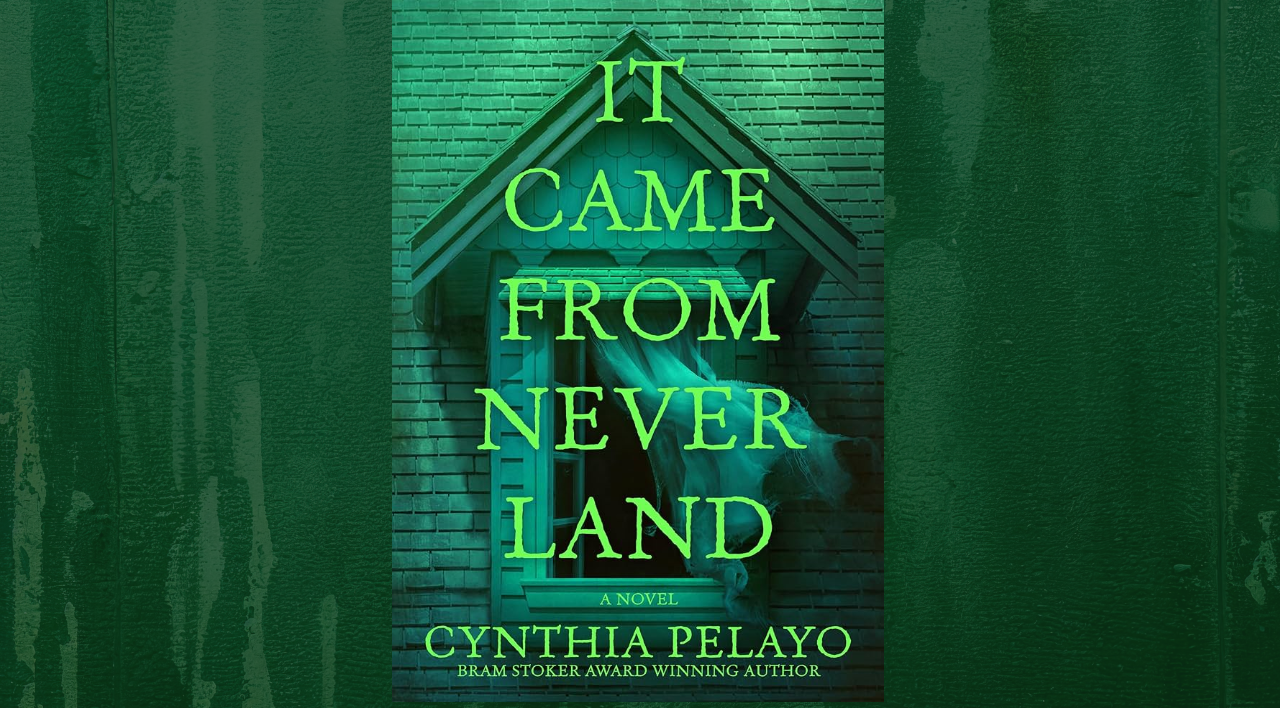
It Came From Neverland, Pelayo’s latest novel, takes that search and applies it to one of the most famous children’s stories ever conceived, J.M. Barrie’s beloved and oft-adapted tale of the Boy Who Never Grew Up. But this is not just a Peter Pan retelling, or a Peter Pan meta-sequel. Through gorgeous prose, finely drawn characters, and an iron grip on the themes that drive the story, Pelayo crafts It Came From Neverland into one of the year’s must-read genre novels, both a horrifying spin on Peter Pan and a luminous dark fantasy about the search for salvation in a cold, brutal world.
In Pelayo’s version of events, Wendy Darling and her brothers John and Michael really did travel to Neverland when they were children, drawn there by a charismatic and irresistible figure called Peter Pan. But this Neverland is far from the Disney version, and after fighting to survive in that ageless place, the children made their way home and shut Peter Pan out of their lives, refusing to so much as utter his name, lest he find them again.
Flash forward to 1914, where Wendy’s working as a schoolteacher at Marigold House, a London orphanage growing increasingly crowded amid the outbreak of World War I. By day, she teaches and volunteers at a local hospital, reading to the war wounded, and by night, she remembers to check every window latch and keep an eye on every shadow. But lately those shadows seem to behave strangely again. Crows caw all around her. And worst of all, children are disappearing again. Peter Pan is back, and faced with memories of how no one believed her the first time, Wendy prepares to face him one more time.
This is a remarkably well-suited atmosphere for moments of classic, chill-inducing terror, and Pelayo wastes no time weaving a world in which every bird call, every stray thought from the mouth of a child, could be evidence that this monstrous Peter Pan is near. Wendy lives a haunted existence, and as the chaos of war grips London, old fears grip her while new ones fight for position. If you come to this novel looking for something like Stephen King’s IT by way of J.M. Barrie, you’re going to get it, through flashbacks and dark lore and wonderfully well-timed scares, but Pelayo’s not done.
This version of Wendy Darling, through whom we see most of the narrative, cares for children in adulthood because she did not receive the care she needed herself as a child in the aftermath of a traumatic experience. She considers it her duty to listen to them, to protect them, to understand them in a world that still views them not as human beings, but as potential locked up in tiny bodies.
Setting the book in 1914, when young men across Europe were signing up to go and die in a war they didn’t quite understand, underscores this beautifully. Children are grist for the mill in the world of It Came From Neverland, their eager spirits waiting to be crushed by a machine of war and empire and capitalism that will not relent even if an armistice eventually arrives. It’s a wider, more existential layer of horror than the storybook monster, which gets us to open the book in the first place, but the real brilliance at work here is how Pelayo ties it all together.
At the core of all of this, the beating, icy heart of It Came From Neverland‘s horror and its search for meaning amid the narratives of war, children’s fiction, collective memory, and more, Pelayo is most interested in what it really means to never grow up. It means retaining a sense of play, yes, but it also means a refusal to move on, to embrace not just the responsibilities of aging, but the moral burdens of it.
Peter Pan is a monster not because he likes to play, but because he does not consider consequences, mortality, or even the needs and desires of others. The same is true of the leaders of Europe sending young men off to die in a war, and the same is true of leaders now, playing dice with human lives amid the rise and fall of the stock market. To never grow up is to lose something essential about being human, and Pelayo depicts that loss as both existentially terrifying and heartbreaking. That terror and heartbreak drive the novel, but Wendy’s efforts to escape that terror and to mend her broken heart make it fly.
It Came From Neverland is available June 9 wherever books are sold.


You must be logged in to post a comment.