Editorials
Children of the Vampire: Horror’s Many Returns to ‘Salem’s Lot’ Over the Years


WARNING: The following contains minor spoilers for various adaptations of Salem’s Lot.
In addition to character-driven novels and disturbing horror, Stephen King is known for writing folksy stories set in the rural Northeast. His bestselling It takes place in Derry, a close approximation to Bangor, Maine, and he’s been returning to Castle Rock, a town first introduced in his 1979 novel The Dead Zone, through forty years of bestselling horror.
But before both of these locations became literary institutions, there was Jerusalem’s Lot, a quaint Maine village with many dark secrets. For every kind and generous resident, there’s another sleeping with the phone repairman, peddling gossip over the register, or making lucrative real estate deals under the table. In his second novel, Salem’s Lot, King delights in uncovering the scandalous sins of this tiny burg before a powerful vampire enters the scene. Kurt Barlow and his familiar Richard Straker ostensibly open an antiques shop, but waste no time spreading their vampiric curse throughout the town.
Four years after the novel’s publication, Tobe Hooper adapted the story into a two-part TV miniseries that remains a cornerstone of the vampire sub genre. The story may be relatively faithful (and admittedly slow in places), but it’s filled with iconic imagery still influencing popular culture. References can be seen as early as the mid 80s with a pair of teen vampire films now considered classics in their own right. Charley Brewster (William Ragsdale), star of Tom Holland’s Fright Night, feels like an older version of Mark Petrie (Lance Kerwin), King’s intrepid horror fan-turned-vampire hunter. The creepy house next door feels like a carbon copy of the Marsten House, right down to the decaying interior and ornate staircase. Remnants of Hooper’s series can also be seen in Joel Schumacher’s 1987 film The Lost Boys as half-vampire Michael (Jason Patric) attempts to float outside his younger brother’s window, a humorous inversion of Hooper’s iconic scene.
The 90s would see more nods to Salem’s Lot in two of TV’s most popular shows. Joss Whedon notes the title as an inspiration for his film-turned-series Buffy the Vampire Slayer, reversing the classic trope of a fair-haired damsel running from a vampire while brave men stand their ground. One might argue that Susan Norton (Bonnie Bedelia) walks up to the Marsten House determined to save her beloved town so that Buffy Summers (Kristy Swanson, Sarah Michelle Gellar) can one day run. The fourth installment of the fan-favorite The Simpsons Treehouse of Horror also features a direct homage to Hooper’s miniseries. Though the first half of “Bart Simpson’s Dracula” pulls from Francis Ford Coppola’s gothic film, the second half is heavily indebted to Salem’s Lot. Like Ralphie Glick (Ronnie Scribner), the head vampire’s first victim is also a child and the friends he converts hover outside a moonlit bedroom window.
More recently, Mike Flanagan’s Midnight Mass feels like a loose interpretation of the novel itself with horrific creature design, character-driven story, and themes of alcoholism and faith all pointing to the nuances of King’s 1975 text.
“Jerusalem’s Lot” and “One For the Road”

Before Tobe Hooper released his iconic adaptation, King returned to the tiny town of Salem’s Lot in two stories published in his first collection. Night Shift opens and closes with a pair of tales that also serve to bookend the novel. “Jerusalem’s Lot” is an epistolary story explaining the village’s otherworldly origins. Nodding to Bram Stoker’s classic novel Dracula in format and H.P. Lovecraft’s Cthulhu Mythos in subject, “Jerusalem’s Lot” dates back to 1985 and consists of correspondence between an unidentified “Bones” and Charles Boone writing from an inherited estate called Chapelwaite. Exploring the surrounding town of Preacher’s Corners, Maine, Charles seeks out a deserted hamlet known as Jerusalem’s Lot–once the home of a fanatical cult who disappeared en masse in 1789. In a rotting chapel, he finds an ancient tome entitled De Vermis Mysteriis, or “The Mysteries of the Worm” and accidentally awakens an otherworldly god. This haunting story adds context to King’s modern novel and describes an evil predating the sinister occupants of the Marsten House.
“One for the Road” pulls the story back to the present a couple of years after Barlow’s destruction. Booth is an elderly resident of Falmouth, Maine who remembers an icy evening in the abandoned Salem’s Lot, a town locals say has “gone bad.” While weathering a fierce nor’easter, Booth and his friend Herb are surprised by a stranger begging for help. Gerard Lumley has taken a shortcut through Salem’s Lot and become stuck in the rapidly growing drifts of snow. His wife and daughter still wait in the car, stranded in the ghostly burg after dark. The horrified friends reluctantly drive him out to the ghostly Lot in a snowmobile, but find his family strangely unaffected by the cold. A malevolent little girl walks without leaving tracks in the snow and tries to draw Herb in for a thank you “kiss.” The story is a haunting coda and reminder that Barlow’s curse lives on in the ill-fated town.
A Return to Salem’s Lot

Hooper’s film ends with a devastating death implying a village overrun with powerful vampires. Despite this perfect setup for a sequel story, it would be another eight years before a cinematic visit would come to pass. Inspired by Thornton Wilder’s Our Town, A Return to Salem’s Lot follows Joe Weber (Michael Moriarty), an anthropologist who moves back to the titular town intent on bonding with his troubled son Jeremy (Ricky Addison Reed) and refurbishing an inherited farmhouse. No sooner have the two arrived than a teenage girl bursts in claiming bloodsucking police have murdered her friends. Investigating this outlandish claim, they discover that Salem’s Lot is home to a colony of vampires. They’ve wisely bred drones to withstand the sunlight and preserve the outward appearance of normalcy. Mayor Judge Axel (Andrew Duggan), implores Joe to observe the colony and write an academic study in hopes of eventually going public.
The climax descends into chaos with pregnant vampires, Nazi hunters, and weaponized American flags while marking Tara Reid’s cinematic debut. Writer/director Larry Cohen originally submitted a script for Hooper’s 1979 adaptation, but lost the gig to Paul Monash. This ambitious sequel serves as a satirical commentary on American capitalist culture, to varying degrees of success. A Return to Salem’s Lot was generally panned, essentially staking any chance for an expanded franchise.
Salem’s Lot (2004)

Twenty-five years after the original adaptation, TNT aired a new version of King’s vampire story. Creator Peter Filardi’s 2004 adaptation of Salem’s Lot features an impressive cast led by Rob Lowe as heroic author Ben Mears. Samantha Mathis plays Susan Norton with Andre Braugher bringing empathy and nuance to Matt Burke, the Lot’s tortured teacher. Rutger Hauer and Donald Sutherland reunite as Barlow and Straker respectively, twelve years after appearing in the original Buffy the Vampire Slayer.
Where Hooper once shied away from more troubling plotlines, director Mikael Salomon leans into the scandal. Young and miserable, newlyweds Royce (Paul Ashcroft) and Sandy (Bree Bain) don’t just abuse their infant son. Sandy seduces then blackmails local doctor James Cody (Robert Mammone). High school student Ruth Crockett (Penny McNamee) must fend off unwanted advances from the dump manager in addition to abuse from her own lecherous father. Salomon also explores the legendary Marsten House and its notorious owner Hubie (Kym Lannin). A young Ben Mears (Daniel Morgan) sneaks into the sinister house just in time to hear Hubie’s final victim die, implying a string of sadistic child murders.
Set in modern day Maine, Filardi’s adaptation wears its early aughts influence on its sleeve, infusing King’s original story with post-9/11 rage. In a notable deviation, Ben and Mark (Dan Byrd) do not flee to Mexico, but track down Father Callahan (James Cromwell) who is still tainted with Barlow’s blood. This framing device mirrors the priest’s return in King’s novel released just months before, a strange coincidence and further proof that ka is a wheel.
Castle Rock: Season Two

The doomed town of Salem’s Lot would lay dormant for another fifteen years before appearing in the second season of Hulu’s Castle Rock. An imaginative redux of King’s popular tropes, season one takes place in the titular hamlet and follows a mysterious prisoner found on the bowels of Shawshank Prison.
Season two features Castle Rock stalwarts ‘Pop’ Merrill (Tim Robbins) and his delinquent nephew ‘Ace’ (Paul Sparks) while shifting portions of the story to the nearby Salem’s Lot. An unstable Nurse named Annie Wilkes (Lizzy Caplan) passes through hoping to score some antipsychotic drugs when she accidentally walks into a centuries-old curse. Having killed Ace in self-defense, she dumps his body at the construction site for a new shopping mall–a detail pulled from King’s original novel. A few days later, she’s surprised to find him standing outside her window, seemingly good as new. Ace’s body has fallen into a pit connected to the legendary Marsten House by a series of tunnels and subterranean chambers.
This infamous building becomes home to a cult of body-snatchers who vanished 400 hundred years before. Answering a question posed in “Jerusalem’s Lot,” the settlers sacrifice their own lives to honor an “angel” who turns out to be the prisoner discovered in season one. Creators Sam Shaw and Dustin Thomason may swap vampires for a murderous cult, but parallels to the original are a surprising treat. Ace becomes the de facto master vampire, orchestrating a horde of loyal followers to transform the town’s residents.
Chapelwaite

Peter Filardi returns to the ill-fated New England village with the 2021 series Chapelwaite. Co-created with Jason Filardi, the period piece expands on King’s short story “Jerusalem’s Lot” set in the tiny town of Preacher’s Corners. Adrien Brody stars as Captain Charles Boone, a grieving widower who moves with his three daughters to the titular estate along with governess Rebecca Morgan (Emily Hampshire). The residents take issue with his arrival based on rumors of occult rituals performed at the house by his mysterious cousin. When a local child dies, they ostracize the family and try to drive them out of the crumbling mansion. But Charles will not be deterred and seeks answers in the abandoned Jerusalem’s Lot.
This gothic horror story brings traditional vampire lore to life with terrifying creature design and grotesque action. The Filardis conclude the piece with a bloody showdown in the infamous village as undead warriors try to spread the vampiric curse.
Forty-nine years after its initial publication, King’s vampires have finally made it back to the big screen with a feature-length film from Gary Dauberman. This blood-soaked adaptation continues the time-honored tradition of exploring the horror of King’s sophomore novel and bringing to life his legendary burg.
By now the story of Salem’s Lot has become a quintessential piece of American folk horror and will likely continue to inspire genre creators for decades to come.
The new Salem’s Lot movie sinks its teeth into Max beginning October 3.


Steven Spielberg has always been conversant in the cinematic language of the horror genre, despite relatively few credits in the genre. His contributions as a writer and producer on things like Poltergeist are legendary, and films like Duel and Jaws certainly wield the horror genre in remarkable, often chilling ways. He may not be a horror filmmaker, but he knows when he needs to scare us, and he has the tools to make that happen.
I didn’t go into Disclosure Day, Spielberg’s alien epic, expecting outright horror, and indeed the film leans much more into thrilling than frightening. This is not a horror film, but for a few minutes in the middle, much to my surprise, it became one.
Spielberg has filmed more than his fair share of scary scenes over the years, but with Disclosure Day, he directed a new contender for the scariest scene of his entire career.
SPOILERS AHEAD for Disclosure Day!

Josh O’Connor in DISCLOSURE DAY, directed by Steven Spielberg.
Among the various alien secrets laced throughout Disclosure Day are a trio of palm-sized rods, the color of pencil graphite. These rods, originating from another planet, can be used for a number of things, but for the purposes of this scene, the most important is “diving,” gripping the rod in one bare hand and using its power to “dive” into the mind of another person.
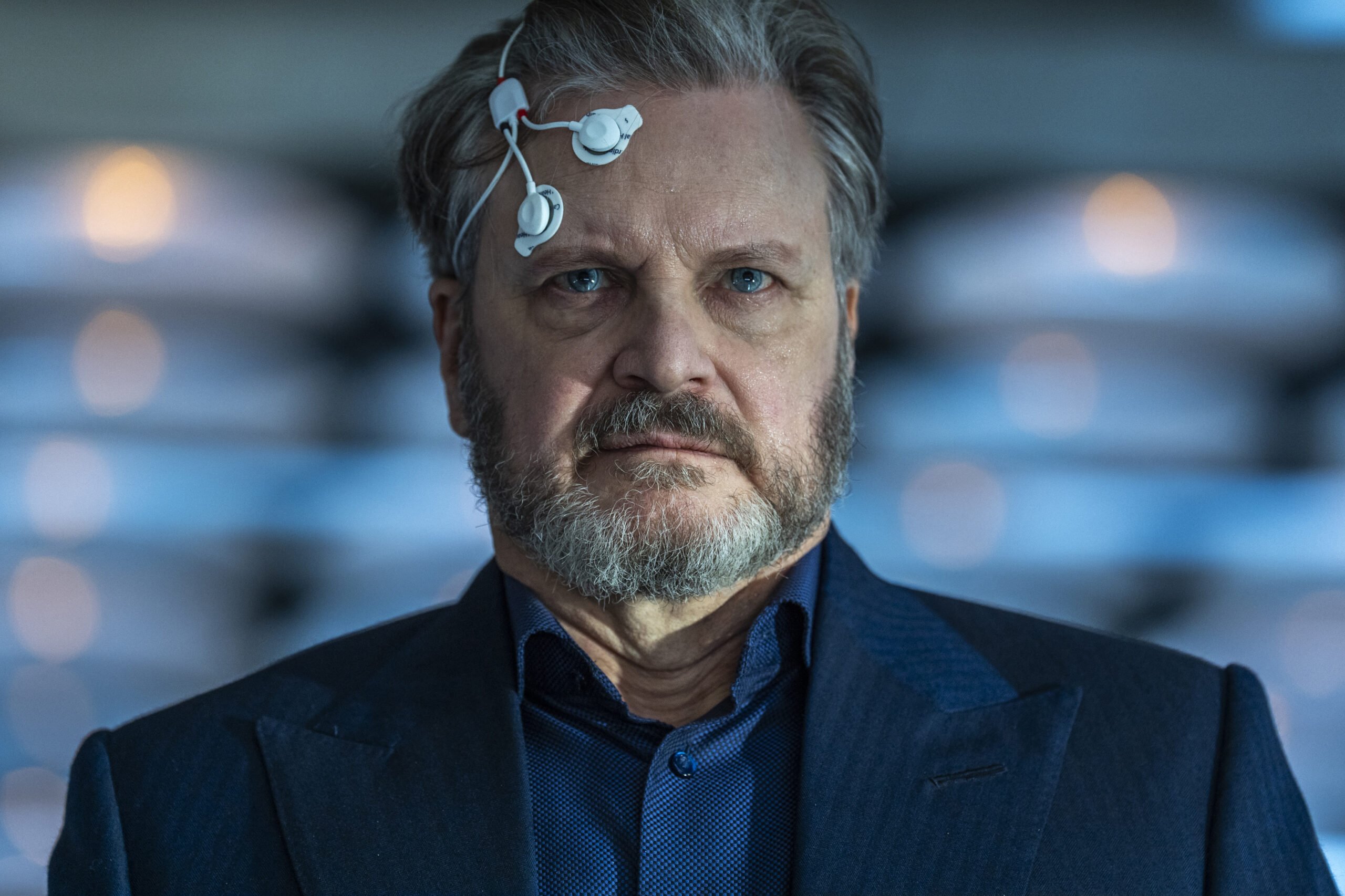
The person holding the rod in this scene is Noah Scanlon (Colin Firth), head of shadowy cybersecurity firm Wordex, who is hellbent on keeping human knowledge of extraterrestrials secret from the general public. Scanlon’s trying to find whistleblower Daniel Kellner (Josh O’Connor), who’s got all of those alien secrets tucked in a backpack while he’s on the run, and while Daniel’s more experienced mind is protected from diving, his girlfriend Jane’s (Eve Hewson) is not. So, monitored by medical personnel at Wordex headquarters (diving is dangerous), Scanlon pushes his way into Jane’s mind to find the location of Daniel’s safe house.
A telepathic invasion is scary enough on its own, but Spielberg doesn’t stop there. When Scanlon dives into Eve’s mind, he appears to her to be sitting across the kitchen table, like he’s in the room. Her bright blue eyes turn Scanlon’s dark brown, and she loses much of her control over her own body, not to mention her mind. Moments before, Daniel finally shared with her the secrets in his backpack, so Jane is shocked, conflicted, deeply vulnerable when Scanlon slips inside her head. This is not just telepathy. This is possession.
Spielberg underscores this not just through the visual language of the scene, as Jane breaks out in a sweat and struggles to sit upright as Scanlon invades her mind, but through Jane’s background. As she revealed to Daniel earlier in the film, Jane is a former novitiate nun who left her convent when she began to question her calling. She still believes firmly in God and, more importantly, believes that perhaps proof of alien life should be kept secret from the public because, in her eyes, it would upset the entire balance of faith in the world. God is a defining factor for humankind, Jane argues, and showing humanity proof of creatures from the stars would undercut that in dangerous ways.

This context, combined with the crucifix necklace Jane’s holding in her hand at the time of the dive, makes this scene the closest thing Spielberg will ever shoot to something out of The Exorcist. It’s not just a battle of wills, but a battle of faith. As an amoral technocrat worms his way into her memories, her beliefs, her faith, Jane turns the crucifix into a weapon, squeezing it until her hand bleeds when she discovers that a pain response can momentarily push Scanlon out of her head.
Of course, when you put a crucifix and a bloody hand together, it conjures images of stigmata. Screenwriter David Koepp pushes the allusion further by having Scanlon quote Christ on the cross to Jane by way of convincing her that she must be the one to stop Daniel by any means necessary.
It’s easy to see why this is scary, right?
On a very basic level, you have a powerful, wealthy man subduing and assaulting an innocent young woman, which is frightening enough. Then, the layers of the scene kick in. Scanlon doesn’t just assault Jane, but possesses her, seizes her memories, her knowledge, and finally her own free will, all while Jane literally clings to her faith in an effort to fight back. Disclosure Day is, among other things, a story about who has a right to the truth, and Scanlon believes that he should be the arbiter of that truth. Not just the truth as he sees it, but the truth as Jane sees it as well. If they don’t see eye to eye, he’ll make her.
But the possession, as it turns out, cuts both ways. Using the rod to dive is, for a normal human being, an intensely strenuous process. Scanlon admits that previous attempts almost killed him, and for some members of his time, so much as touching the rod results in a near-death experience. Even accessing an unprepared mind like Jane’s takes a lot of Scanlon, and when she kicks him out by squeezing the crucifix – again, so much meaning embedded in the details here – his team holds him back and tries to offer medical intervention. But Scanlon persists, pushing them away, and keeps diving back in.
This means that Jane can’t escape him because he just won’t stop pushing back through her defenses, but it also means that each time Scanlon enters her mind, and thus the safe house, he looks more monstrous. By the end, through a combination of lighting and makeup, Firth barely looks human, conjuring up images of the possessed Father Karras at the end of The Exorcist.

Colin Firth (center, standing) in DISCLOSURE DAY, directed by Steven Spielberg.
On a pure, visceral craft level, all of this is quite frightening, but the real trick to making this scene into Spielberg’s most terrifying lies in the more existential horror surrounding all of this. Disclosure Day is a film about the battle for the truth over extraterrestrials, but it’s also about a fight against an impossibly powerful surveillance state, the devaluing of human and alien lives in favor of some nebulous collection of assets, and the value of the individual in a world that increasingly lumps people into demographic boxes and writes them off.
In this scene, the surveillance state becomes supernatural, a human life is worth less than a piece of information, and an extragovernmental technocrat would rather sacrifice his own humanity than see reason. In 2026, few things could be more terrifying than that. Spielberg knows this and wields it mightily, proving once again that, while he’s not a strictly horror filmmaker, he can direct horror with the best of them.
Disclosure Day is in theaters now.

Eve Hewson (second from left) in DISCLOSURE DAY, directed by Steven Spielberg.
You must be logged in to post a comment.