Quantcast
Connect with us

Editorials

Svengoolie is Still Keeping the Tradition of the Horror Host Alive After All These Years

Published

on

If you’re a horror fan and you grew up in Chicago, the horror host known as Svengoolie is probably partly responsible for your love of the genre. I know he is for mine. I was born just outside Chicago and have lived here my entire life, and Svengoolie has been a fixture on local television for nearly all of it. He didn’t necessarily introduce me to horror, but over the years he has certainly played a number of roles in my relationship to it: he has been a teacher, a funny friend (albeit one whom I’ve never met), a comforting presence on a Saturday night. As far as being a Monster Kid is concerned, I can think of few figures who have meant more.

The tradition of the horror host – someone who would appear, usually in costume, at the beginning and end of a movie broadcast, often making corny jokes about whatever was being shown that week – dates back nearly to the earliest airings of horror movies on TV. The most famous of them all is still Elvira, but there are dozens of others who were beloved in their own local markets: there was Vampira and Zacherley and Ghoulardi (played by the father of writer/director Paul Thomas Anderson) and Count Gore Del Vol and Chilly Billy and on and on. Every city had their horror host. Svengoolie was ours. At a time when most of the other horror hosts have retired or been canceled or even passed away, Svengoolie is still going strong. He’s still our horror host in Chicago, and when his weekly series on MeTV went national back in 2011, he became the country’s horror host, too.

I didn’t grow up on the OG Svengoolie. He was before my time. Jerry Bishop originated the character and played him (with a Transylvanian accent and everything) on TV from its debut in 1970 until 1973, when the show was cancelled for six years until it was revived in 1979, with former staff writer-turned-host Rich Koz taking over as the Son of Svengoolie. This was the version of the show on which I grew up, tuning in every Saturday afternoon in the mid-‘80s to Chicago’s WFLD to watch the Son of Svengoolie hosting movies like Godzilla vs. the Smog Monster and Revenge of the Creature and War Gods of the Deep and the original Universal classics like Dracula and The Wolf Man. In the days before these movies were readily available on home video – or even before my family owned a VCR on which to play them – Son of Svengoolie introduced me to the films that would help shape me as a horror fan forever.
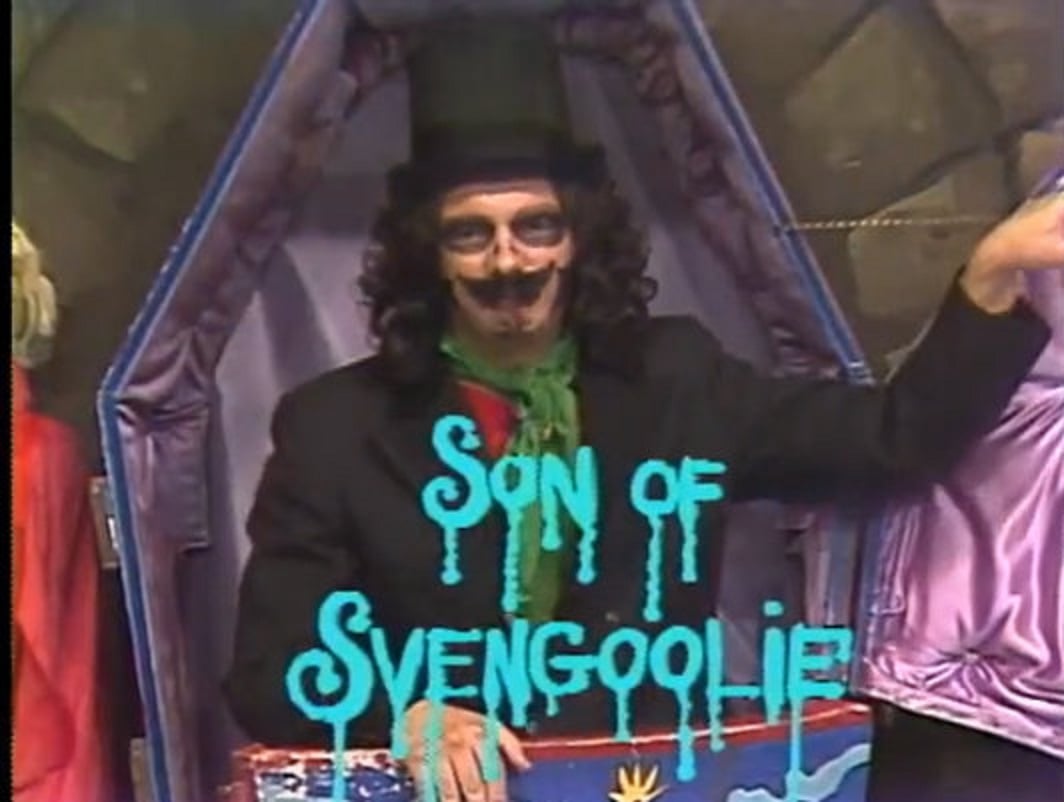
Son of Svengoolie was pulled off the air in 1986 when WFLD sold to Fox, but Rich Koz remained a fixture of Chicago TV and of my childhood, hosting kids’ shows like The Koz Zone and anchoring the local news for a time. He was always a part of my life in some way. When he put the makeup back on in 1994 and returned to TV as Svengoolie – having finally dropped the “Son of” moniker with the blessing of Jerry Bishop – it was a big deal for me. When I was a kid, watching monster movies on Svengoolie was considered cute by those around me, but by ’94 I was no longer at an age where watching monster movies and horror hosts was thought to be “cute.” That was ok. It left me with a choice: appear cool to my classmates, or continue to watch horror and be happy. It’s the choice that many a fan has faced at some point in his or her life, and the way we choose helps define who we are as a person. Svengoolie helped keep me on the path of being a devoted horror fan. But as the genre continues to dominate TV and clean up at the box office in 2018, loving horror is finally considered cool thanks to sites like this and people like Svengoolie, who has helped carry the torch for nearly 40 years.

The thing about Svengoolie is this: he’s so uncool that he’s cool. His jokes are incredibly corny. His set is sparse, his show cheaply produced in such a way that it’s not too far off from a public access production. There’s nothing edgy or hip about him, but because he has remained true to himself year after year – the show is the show is the show – he has circled back around to being hip again. He exists in a space that is free of irony. He has nothing but affection for these movies and doesn’t present them in a mocking way, even if he does make jokes about them. Plus, the show is hipster proof; they can’t make fun of anything about Svengoolie that the show isn’t already making fun of about themselves first. Svengoolie doesn’t care about being cool. He just wants to entertain us, to make us laugh, and to celebrate monster movies, reminding us lifelong fans why we love this stuff and introducing a new generation of would-be horror nerds to movies they’re discovering, as I did, through his show. I can’t think of anything cooler than that.

Lately I’ve been watching Svengoolie with my own son, and the opportunity to share with him something that meant so much to me when I was his age is one I don’t take for granted. It’s too soon to tell whether or not it’s helping turn him into a horror fan, but at the very least it affords me a chance to share my own love of the genre with him so that even if he never goes crazy for monster movies, at least he’ll know why his dad does. I’m not sure I could convince him to sit down and watch The Blob or 20 Million Miles from Earth with me if I just asked nicely, but when I frame it as “Hey, want to watch Svengoolie?” he gets on board. Maybe he’s just doing it to humor me. Or maybe, just maybe, there’s something about all of the hosting segments and jokes and rubber chicken throwing that makes the movies feel safer for him, so he’s more willing to watch. Whatever the case, Svengoolie is responsible for creating new Monster Kids week after week, year after year. For this reason alone, the show is a gift.

I don’t know how much longer we’re going to have Svengoolie to watch on Saturday nights. Rich Koz is just a few years shy of turning 70. He has been performing as Svengoolie for the better part of the last four decades. Sooner or later, he’s going to retire, and that realization makes me almost impossibly sad. He’s one of the last remaining horror hosts in the country, and currently has no clear successor as far as I know. That means when he goes, the tradition of the horror host and a television institution goes with him. And while Rich Koz deserves to retire whenever he sees fit, I’m not ready to say goodbye. I never will be. He’s been a part of my life for so long, I can’t imagine it without him. To be honest, I really don’t want to.

Please, Svengoolie, please never leave us. Young and old alike, Monster Kids everywhere need you.

Click to comment

Editorials

The Mark of the Beast: The Lasting Impact of ‘The Omen’ at 50

Published

on

The Omen at 50

Of the three films that make up the Diabolical Trinity of classic religious horror films—Rosemary’s Baby (1968), The Exorcist (1973), and The Omen (1976)—The Omen is the most purely entertaining.

While Rosemary’s Baby digs into the societal shifts of the 60s and The Exorcist explores spiritual tensions between faith and doubt in an ever-shifting world, The Omen seems most interested in just telling a thrilling story. It achieves this by blending two major trends of the 1970s, the devil movie and the paranoid thriller, into one crackling adventure yarn. In the process, The Omen has sparked fear and curiosity about what could happen in theend timesif such events are to occur.

After seeing The Exorcist, producer Harvey Bernhard contacted writer David Seltzer and said something along the lines of,Hey, write me one of those.Seltzer, having never read the Bible, thought it would be an interesting challenge, so, according to various interviews, he read the Bible and several commentaries in search of a story. Then he stumbled upon a passage in the book of Revelation, the image of a great Beast rising out of the sea, that sparked his imagination. In the commentaries, he found that the sea represented politics in some interpretations of the text, and he began building his story on that foundation.

Seltzer has told this story often, and I am inclined to believe him. However, from there, much of the theological-sounding lore of The Omen was created purely by Seltzer. Many of the ideas surrounding The Antichrist in the film appear to be drawn much more from the pop-eschatology sensation of the 1970s, The Late Great Planet Earth by Hal Lindsay, than any Biblical source.

Lindsay’s book was the bestselling nonfiction book of the 1970s and re-popularized views of thelast daysthat had been dying along with fundamentalism for decades, namely Dispensationalism, Millennialism, and the Pre-Tribulation Rapture. In dispensationalism, history is broken into several epochs of time (or dispensations) that culminate in the return of Christ and his thousand-year (millennial) reign.

Before this return, a seven-year Tribulation will occur in which the Antichrist comes to power and persecutes all who oppose him, culminating in a battle between the forces of good and evil at the valley of Megiddo, usually called Armageddon. Of course, in this worldview, the true believers in Jesus will be lifted out, or raptured, before all this takes place. Since the publication and popularity of The Late Great Planet Earth, this has been the prominent belief in Evangelical and Fundamentalist Christian circles, though Roman Catholic, Orthodox, and mainline Protestant denominations largely reject it.

Lindsay also did something unique that had not been the case even in dispensationalist circles before him—he posited that the creation of the modern state of Israel in 1948 started the countdown to Armageddon. Fans of the film will immediately realize where Seltzer ran with this idea in the first line of the poem created for the movie:When the Jews return to Zion…

Damien Thorn and the Creation of Horror’s “Innocent Villain”

The Omen

Seltzer’s next inspiration focused on the idea of the Antichrist as a child, what he would call the film’sinnocent villain.In watching The Omen, it is readily apparent that Damien Thorn (Harvey Stephens) does not really do anything evil beyond a bit of normal kid mischief. Even the moment in which Damien knocks Kathy Thorn (Lee Remick) over a second-floor railing can be read as an accident orchestrated by Damien’s diabolically connected nanny, Mrs. Baylock (Billie Whitelaw). The film takes this idea of the innocent villain a step further by casting Gregory Peck, best known for playing arguably the greatest father in film history, Atticus Finch in To Kill a Mockingbird (1962), as Damien’s earthly father, an element that greatly satisfied Seltzer.

The New Testament itself says very little about the Antichrist and certainly nothing about his childhood. In fact, the word antichrist is used twice (1 John 2:18 and 2 John 7 for the curious) and refers to groups of people, not a particular person. There is also a passage in 2 Thessalonians 2:1-12 in which the writer (usually attributed to Paul) discussesThe Man of Lawlessnesswho willexalt himself over everything that is called Godandproclaim himself to be God.

Then there is the Beast of Revelation chapter 13 withseven heads and ten hornsthat Seltzer latched onto, which has been interpreted in a multitude of ways over the centuries. Powerful people throughout history, from Charlemagne, various Popes during the Protestant Reformation era, Napoleon and Hitler, to modern politicians, including Ronald Reagan, Bill Clinton, Vladimir Putin, Barack Obama, and Donald Trump, have all had the label placed on them by various circles. Even religious leaders like Billy Graham have not escaped being called the Antichrist.

Lindsay and modern dispensationalists are certain the Antichrist will be a 21st-century individual as they are equally certain that the Rapture, Tribulation, and return of Christ are imminent, likely within their lifetime. Many scholars and theologians, however, interpret these passages as symbolic representations of the Roman Empire and the first-century Caesars who persecuted, tortured, and murdered Christians and Jews who refused to submit to Imperial rule and worship them as gods. For example, that the Beast from the sea in Revelation has seven heads is symbolic of the famous seven mountains of Rome, with the 10 horns referring to rulers and magistrates of the Empire.

But this is all really of no matter to Seltzer and the story of The Omen. Instead of being concerned with any historical or theological accuracy, he instead built his own lore, which sends Robert Thorn and photographer Keith Jennings (David Warner) on a globetrotting investigation into the nature of the Antichrist and how to stop him. Some of this lore includes the child being born of a jackal, the reaction of animals, the protective cult that arises around Damien, the daggers of Megiddo, and maybe most interesting of all, the peculiar flaws in Jennings’s photographs that presage the ways certain individuals will die.

All these aspects are where the paranoid thrillers come in, as films like Blow Up (1966), Z (1969), The Conversation (1974), The Parallax View (1974), 3 Days of the Condor (1975), and All the President’s Men (1976) were all the rage at the time. Especially in the wake of the Watergate scandal, the idea of journalists (like Jennings) as ordinary heroes who could bring down the powerful, nefarious forces in the world was exactly what audiences craved. And what greater hidden evil force was there than the Devil? This is also why the device of the daggers of Megiddo is so important to a movie like this. If Damien is indeed the Antichrist, there must be a way to stop him, though in the Biblical text, the only power capable of destroying the Devil is God Himself.

The Mark of the Beast, 666, and the Film’s Most Famous Religious Symbolism

The piece of lore created for the movie with the most solid Biblical grounding is the Mark of the Beast. Revelation describes a mark on the forehead or hand of those who worship the Beast and his image. Again, this is symbolic language differentiating those who belong to the power of the Roman Empire and those who belong to Christ, who have the Mark of the Lamb. In Seltzer’s hands, the mark is very literal, a birthmark that is borne by not only the Antichrist but all his followers, meaning they are marked from before birth as belonging to Satan, and there is no escaping it. This is all rather distressing to the priest Father Brennan (Patrick Troughton), who betrays his mark by warning Thorn about Damien and pays the price by memorably being impaled by a spire that falls from a church steeple after being struck by lightning.

Why is the mark three sixes? Again, this is drawn from a passage in Revelation that states that the Beast can be identified by calculating his number. In Biblical scholarship, this is believed to be the sum of the name of a man transferred into Hebrew numerology, a practice in which each Hebrew letter also represents a number. Using this method, the number of the name Caesar Nero, which many believe to be the most logical choice, is six hundred sixty-six. In the film and elsewhere, this number is changed to three individual sixes. According to the film, this represents the Diabolical Trinity (a designation also unique to the film) made up of Satan, the Antichrist, and the False Prophet. That Damien carries this unique birthmark under his hair convinces Robert that the child is the Antichrist, and it’s up to him to destroy him.

Part of what makes The Omen great is its ambiguity. Damien could be the Antichrist, or he could be at the center of a series of coincidences. Director Richard Donner stated in interviews that he believed Robert Thorn had gone insane by the end of the film, which, to Donner, is the only explanation for why Thorn would attempt to kill an innocent child. However, that enigmatic smile in the final shot suggests that Damien does embody a spirit of great evil. The sequels, however, all but erase this ambiguity.

In audiences, The Omen sparked a renewed interest in the concept of the Antichrist and the dispensationalist interpretation of the end times that continues to echo throughout the last five decades. Around the time of the film’s release, even Elvis Presley was photographed brandishing a paperback copy of Seltzer’s novelization. Dispensationalist authors like Hal Lindsay, Tim LaHaye, and John Hagee have made millions publishing books and giving lectures about the Antichrist and the end of the world.

The Legacy of The Omen, 50 Years Later

Though A Thief in the Night (1972) preceded The Omen in initial release, it gained quite a resurgence (along with the ability to create three sequels) in the wake of the popularity of The Omen and went on to scar the psyches of Evangelical children for decades. Hal Lindsay was also able to release a film version of The Late Great Planet Earth in 1978, complete with narration and a brief onscreen appearance from Orson Welles.

In the 1990s, the Left Behind series became a cultural phenomenon, spawning twelve books in the core series, a YA spinoff series, video games, and a movie series (2000-2005) starring Kirk Cameron. A bigger studio adaptation of the first book was released in 2014, starring Nicolas Cage. 20th Century Fox and The Omen got in on the renewedend-of-the-worldvigor by releasing a remake of the original film on June 6, 2006. The franchise was revived once again in 2024 with The First Omen, which explores ideas of the Antichrist and the motivations of those in power in our current religious, social, and political context.

But despite all the sequels, spinoffs, rip-offs, remakes, andend timesmoney grabs of the last 50 years, the original version of The Omen remains untouchable. Its greatest strength is that it seeks, first and foremost, to entertain. And it does so admirably.

After half a century, its influence can be felt in horror, the culture at large, and even in various faith circles. It is a testament to the power of story and film that, consciously or unconsciously, fans of The Omen and those who have never seen it alike are, to this very day, marked by the Beast.

Continue Reading