Books
They Came from the ’70s: Revisiting TV Movies ‘Are You in the House Alone?’ and ‘Bad Ronald’


The 1970s saw an explosion of TV-movies, and a number of these small-screen features were based on novels. The two examples here, which are some of the most memorable of their day, sit on opposite ends of the adaptation spectrum. While Bad Ronald (1974) took liberties with its source material, Are You in the House Alone? (1978) stays somewhat true to the spirit of the novel. Both features also teeter on the edge of horror, a recurring genre in the “golden age” of made-for-television movies.
Jack Vance was not a horror-only author, so Bad Ronald (1973) is an anomaly in his overall body of work. ABC quickly acted on the success of the novel, with the network ultimately airing its adaptation a week before Halloween. However, Andrew Peter Marin’s screenplay is different from what Vance had penned. Anyone who has read the original novel would understand — maybe even appreciate — the changes in director Buzz Kulik’s version.
The basic pitch of Bad Ronald is always a profitable one in horror: someone hides in a person’s house without their knowledge. The TV translation of Ronald Wilby’s badness, though, greatly dials back his sociopathy. Yes, Scott Jacoby’s character indeed commits a heinous crime in the beginning of the telefilm, but his literary parallel’s actions are far more contemptible. Vance drummed up a disturbed teen who doesn’t just stop at murder. No, this Ronald is a repeat molester.

Pictured: Print ad for Bad Ronald (1974).
Vance’s novel is not an easy read, despite the author’s talent. The 17-year-old boy depicted here is an irredeemable villain who doesn’t see the wrong in his behaviors. Having a mother like Elaine (played on screen by Kim Hunter) does not help matters; she enables her son, and is partly to blame for what later happens to the new tenants of hers and Ronald’s former home. After Elaine’s sudden passing, Ronald haunts the Wood Family like a ghost. He first steals their food before he steals their daughters. One by one, the Wood girls succumb to a grisly fate before someone figures out Ronald is hiding within the walls of 572 Orchard Street.
Either interpretation of Bad Ronald — in addition there is a French movie from 1992 called Méchant garçon — is an effective and fresh take on the haunted house genre. The TV-movie has a visual advantage to consider; the American Gothicness of the story comes out in waves. Although, the TV-movie makes an attempt to humanize Ronald, a boy whose father gave him up legally and a mother who also abandoned him, albeit unintentionally. Through his creepy peephole Ronald spies on the kind of life he could have led had he grown up differently.
Vance’s Bad Ronald makes the skin crawl for a good 200 or so pages before the titular character gets his much deserved comeuppance. What a sight it would have been had the TV-movie allowed the Wood matriarch (Pippa Scott on screen) to light Ronald on fire like in the book. Nevertheless, what Kulik made of Marin’s script remains influential to this day. There is no doubt that movies made since then have been affected, directly or otherwise, by Bad Ronald.

Pictured: Scott Jacoby and Ted Eccles in Bad Ronald (1974).
Richard Peck’s Are You in the House Alone? (1976) was, in those days, a momentous novel in the world of teen fiction. The frankness toward its subject matter and sympathy toward the victim were both appreciated. And in ways, Walter Grauman’s TV-movie does a respectable job of bringing Peck’s story to life without losing the essence. Writer Judith Parker can’t be overlooked either; her script balances the drama and horror elements quite well. Readers and viewers might hesitate to classify the screen version as strictly horror, yet they can agree Gail Osborne’s ordeal is terrifying.
The 16-year-old at the heart of CBS’ Are You in the House Alone? is played by Kathleen Beller, a veteran of retro television. Connoisseurs of classic TV horror would recognize her face from No Place to Hide and Deadly Messages. Here she plays a San Francisco transplant — a former New Yorker in the book — named Gail who has caught the unwanted attention of a peer. First it’s increasingly obscene notes in her locker, then phone calls ranging from uncomfortable silence to deranged threats. Eventually the anonymous stalker shows his face and rapes Gail. The victim’s terror, however, doesn’t end there.
Are You in the House Alone? grasps the basics of Peck’s novel, but it lacks the lengthier discussions of classism and elitism. Gail’s rapist, her best friend Alison’s boyfriend Phil (Dennis Quaid on screen), is the poster boy for rich and white privilege in this fictional Connecticut town; his pull around these parts keeps him safe for too long. That is then combined with straightforward talk of then-current rape culture and legislation. While the TV rendition doesn’t dwell on these topics as much as they could have, it does make for a good conversation starter.
Something else the TV-movie let slide was the characters. Specifically the men, who television historian Amanda Reyes said in her book, Are You in the House Alone?: A TV Movie Compendium 1964–1999, “are given the short end of the stick.” Reyes went on to say most of the men “are either depicted as rapists or sleazebags, or are shown as emasculated by their inabilities to provide for their family.” The women are treated better from a writing standpoint, yet Alison (Robin Mattson) isn’t afforded the same redeeming moment from the novel, and Gail’s mother (Blythe Danner) never seems as enlightened after constantly criticizing her daughter’s townie boyfriend Steve (Scott Colomby).

Pictured: Kathleen Beller in Are You in the House Alone? (1978).
Are You in the House Alone? was billed as a pure chiller back then — one certain print ad reads more like an ad for the forthcoming When a Stranger Calls (1979) — so imagine the audience’s surprise when they tuned in for a drama. A frightening and often realistic one, but a drama nonetheless. The horror labeling was probably based upon the genre’s success on TV; CBS saw how well horror was doing on other networks and wanted to further explore its own opportunities.
To feel more like horror, Grauman and Parker’s Are You in the House Alone? plays up the stranger danger aspect. A male teacher becomes a red herring for the stalker, as does Gail’s ex-boyfriend, and the suspenseful (and rushed) conclusion greatly differs from that of the novel. Whereas Peck ended on a gloomy and imprecise note reflecting the state of the world, the TV-movie instead settles on a more definitive ending that gives Gail as well as viewers a sense of closure.
Going by just their television reworkings, Bad Ronald and Are You in the House Alone? don’t have a great deal in common other than their mostly teenage cast, domestic dread, and suburban backdrops. Their literary bases, on the other hand, bear more obvious similarities. Unpleasant and sad as they may be, both novels are worthwhile reads that supplement — or in some cases, surpass — their screen adaptations.




Books
Experimentation in ‘You Will Die In This Place’ Provides Wealth of Gameplay Possibilities [Tabletop Terror]

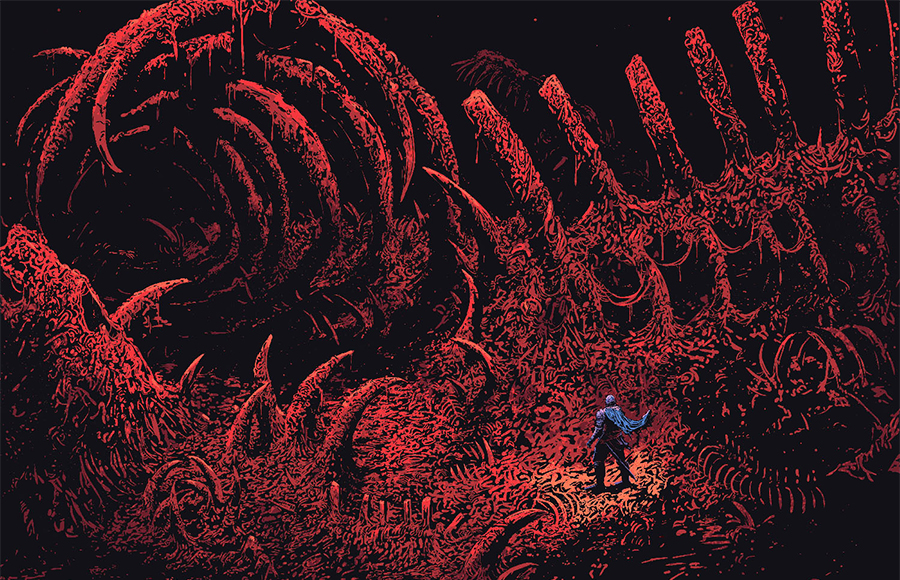
Welcome to Tabletop Terror, a monthly series highlighting roleplaying games new and old.
Tabletop roleplaying game manuals are an interesting object. Traditionally, we want them to be laid out cleanly in a way that’s easy to understand so they can be played effectively. But this means they are often dryly written, focusing on clarity instead of style. That’s not to say they don’t have good art, but they are rarely experimenting with the form in a way that makes the book itself exciting.
Some of my favorite games in recent memory are the ones that purposefully break the rules in an attempt to be just as much of an art book as a rule book. Games like Mork Borg, whose aggressive, borderline unreadable layouts are constantly shifting fonts alongside its maximalist artwork. Games like Triangle Agency, which use in-fiction format changes to illustrate the strange forces at play behind the titular agency. Games like Soul Cemetery, a book that kept up the illusion that it was an instruction manual for a lost PS2-era video game, tell a tale of how our relationship with fiction shapes our lives.
You Will Die In This Place takes this to the extreme, mixing its nihilistic dungeon crawling rulebook with a “House of Leaves“-style meta narrative that tells a deeply personal tale about identity, mortality, and the act of creation. Not only is it stylistically bold and endlessly inventive, but it weaves its characters with a raw believability that brings the book itself to life in a way I’ve never seen in the medium.
The Meta-Narrative That Sets You Will Die In This Place Apart

The actual game is by Elizabeth Little, but it’s framed as a reconstruction of an abandoned project pieced together from various notes and design documents. Fictional tabletop designer Samantha Little is cleaning out boxes in her parents’ attic when she comes across the game, which was originally written by a college friend, Charlotte Avery, whom she hasn’t talked to since graduation.
The version of You Will Die In This Place that you’re reading is one that Samantha has “finished,” compiling Charlotte’s notes, which included design work, microfiction, and illustrations, but the line between Charlotte’s original vision and Samantha’s additions to the work remains a tension throughout. There’s also a third character, KC, who is the book’s editor, who comments to Samantha about the process and questions her decisions. The book presented is the “final version” of the game, along with footnotes that give insight into Samantha’s work on the book and how it felt rediscovering her old friend through these notes.
The actual game part has a premise that seems pretty standard, but is done with its own unique flair, both mechanically and narratively. Your party plays a group of people who have been exiled to the Abyssal Labyrinth, a horrific series of corridors and rooms full of creatures warped by manablight.
You will never return from the labyrinth. There’s no winning your way out.
The title says it all. Rather than being a game about heroically slaying the beast that has cursed the labyrinth, it’s about trying to find meaning before you die in this place. While it’s definitely not the first game where you are doomed adventurers that will reach an unfortunate end before the campaign is over, the way it explores the idea thematically feels unique.
It’s hard to figure out where to even begin to talk about this game, and that’s part of the fun. Should I go into the maybe-too-clever class system first, or dig into the themes about what it means to create? Is it best to dive into the strange bestiary, or do you first need to have context about Charlotte’s thought process through her tangential essays that Samantha decided to include? Maybe I don’t even get into the details of that because the rewarding part of the book is watching it all click together in a holistic way.
Experimental Character Classes and Innovative RPG Mechanics

I’ll start by treating it as a traditional tabletop RPG, but even that will immediately give way to talking about the meta layers. One of the most interesting ways for me to look at what a game is capable of is by looking at its character classes and the ways it expects players to use them to interact with the world through their rules. In a bold move, You Will Die In This Place forgoes traditional conventions by having each class operate on a completely different set of rules. While it may seem like a bit of a stunt at first, it’s very clear that each of these disparate ways of playing is well thought out and intended to convey something important about each class.
The Muzeiiyd Mercenary sounds like the most standard class of all of them, a powerful warrior, but you play by rolling a pool of dice and placing them on different body parts to do different actions, almost like a worker placement board game. The Zibari Headhunter uses a deck of cards and asks you to play poker hands to activate your skills, with your deck acting as an alternate health system. The Corpse Engineer forces you to directly control your character while also doing a programming minigame for a flesh golem that does most of your fighting for you.
The Bermail Knight wears a powerful set of armor, but that comes with a heat management system that alters your available actions as you heat up and cool down. The game’s wizard class, the Blight Channeler, writes as many spells as it can fit on a section of its character sheet, but crosses off words of the spells when using them, while also having to physically tear off pieces of its sheet when injured. There’s even a pair of hidden classes, including one that is written in a cipher that I was not able to solve.
At the beginning of this section, there’s a note about how Charlotte wasn’t a fan of class-based systems because they felt immersion-breaking, and these classes are almost a hyperexaggerated response to that, each being as maximally fiddly as possible in its own unique way. As someone who runs a lot of tabletop RPGs, I pride myself on being able to get a good sense of how something will play just by reading, and I have no idea how these would feel at the table. They definitely are clever, but they might be too clever to the point of not being balanced, or maybe even fun, in action. But I feel like Charlotte would agree with that and respond by saying, “Yeah, pretty cool, right?”
Identity, Roleplaying, and Self-Discovery

The classes are successful on two layers, because they not only offer a fun experimentation with the form, but they also use the mechanics of the game to give us insight into the surrounding meta-narrative of who Charlotte is as a designer and as a person. The notes also mention she was not a fan of levels and hit points, and this game plays with those as well. In an inverse of the traditional power fantasy structure, your characters will get worse the further they get into the dungeon.
When you hit certain thresholds of damage, you will take injuries, which will give you debuffs that will constantly make it harder for you until your death. It’s another bold choice that might not make the game as “fun,” but leans hard into the themes in a way that reinforces the text overall.
The idea of creating characters, both for players and creatures, is one that is very important to Charlotte throughout her notes. Not only was she very particular about putting work into non-playable characters in order to make sure they felt like they had lives that didn’t revolve around waiting for the player characters, but it was also an act that was associated with discovering your own identity.
As the story goes on, it’s revealed that Charlotte is a trans woman, and this fact immediately feels like it unlocks the work thematically. Passages about the disproportionate power of choosing your character’s name make sense within that context. The idea of using roleplaying as a mask to try on different identities is a potent one, made all the more powerful by this detail. The real-life author Elizabeth Little is also trans, making this feel like a deeply personal work that’s just as much about her journey as it is about the fictional characters’ journeys.
The Abyssal Labyrinth’s Bestiary and Worldbuilding

The bestiary of the game contains a lot of strange variants on common ideas, some of them even pushing into experimental territory with their mechanics. Each enemy is described sparsely, with just enough stats and special rules to get you rolling, often leaving the minutiae of the physical description up to you. A giant worm with a human-shaped appendage used to lure unsuspecting individuals, animated chunks of alien meat, and innocuous-looking creatures that devour meaning and words are among the creatures you’ll run into in the Abyssal Labyrinth, making for a more surreal and upsetting dungeon crawl than most.
There are several floors laid out to act as your complete campaign of You Will Die In This Place, each with its own grid layout and threats listed. Many of these are pretty simple fights against enemies, but some of them have clever gimmicks that test the player in ways beyond their character sheet. There’s interesting lore contained within these spaces, but never too much that it takes away from the ominous nature of the setting by filling in too many details.
Coming from Charlotte, who describes her GMing style as one that has trended away from overprepping, I found the explicit dungeon maps to be a bit surprising, but it’s here where much of the tension between the two creative forces of the work comes to a head. This was an unfinished game when Samantha found it, but it becomes clearer as the book goes on that she has made significant changes to the final product, including many that seem to go against Charlotte’s design intent.
So many of the notes and microfiction pieces are about the nature of creation, about what it means to create for the artist and what it means for a piece of the author to live on in the art, making this feel like a strange violation. How much of what we’re reading is Charlotte’s work and how much is Samantha’s, and how much does that really matter if we just want to play the game?
Final Verdict on You Will Die In This Place

You Will Die In This Place is the rare tabletop RPG that I would recommend picking up and reading, even if you have no intention of getting it to the table. As a game, it’s deeply experimental, taking a well-worn grimdark dungeon crawl and bringing it to life with intentionally overcomplicated mechanics that feel fresh and odd, even if they perhaps aren’t the most balanced or intuitive.
As a whole, it’s a marvellous work about the act of creation and finding yourself, even in the face of the bleak world in front of you. It was hard not to make this review into just a list of my favorite passages, but I’d rather leave it to you to discover the story of the Corpse Engineer or Charlotte’s tale of being haunted by the memory of a dying fox or the unsettling demonstration of the natural blind spot we all have in our vision.
There’s so much going on in this book, but it all gels together into one of the most unique tabletop RPGs I’ve ever seen. It’s a powerful statement about the creative process, one that’s inspired me to pick up the proverbial pen again and start writing my own RPG, which is honestly the highest compliment I can give it.
You Will Die In This Place is now available in full over on itch.io.
You must be logged in to post a comment.