
Home Video
DVD Review: Neil Marshall’s ‘Centurion’

Violent historical epics are a somewhat rare commodity, but scarcer are the ones that are actually worth watching. Neil Marshall – who is revered by horror fans for The Descent and loved by almost no one for the action/sci-fi/exploitation monstrosity Doomsday – follows up his genre studio mish-mash by taking a stab at the all-but-forgotten subgenre with Centurion, which comes complete with rolling fireballs and grandiose melee weapon skirmishes. Unfortunately, the film never elevates beyond being average for a variety of reasons, leaving viewers with something merely on the level with Dog Soldiers in terms of entertainment.
 Centurion tells the story of Quintus Dias (Michael Fassbender), the survivor of a Pictish raid on a Roman fort, who teams up with the General Virilus’ (Dominic West) Ninth Legion of Rome to wipe out the Picts and their leader, Gorlacon (Ulrich Thomsen). After the band of men fall into a trap behind enemy lines and Virilus is captured, Dias assumes command of the Legion and races back to the Roman frontier, evading a vicious band of Pict troops led by the vengeful Etain (Olga Kurylenko).
The most interesting aspect of the film, and coincidentally its greatest fault, is that it tells the story from the Roman point-of-view, with the Picts being presented as the antagonists. Historically speaking, Romans are the ones viewed as barbaric and villainous during the 2nd century. It’s a somewhat unique way to explore this chapter in history, considering that horror is the only genre that has successfully had audiences root for the villain on a fairly consistent basis. Regardless, even with full knowledge of the historical context behind the film, the angle would have worked had it not been for the numerous discussions about how the Romans raped and pillaged everything in their path – more specifically, what they did to Etain and her village. It leaves viewers with no one to root for and, in turn, you end up not really caring what happens to anyone because, essentially, they’re all bad guys.
Aside from The Descent, writing has never been Marshall’s strongest suit (that distinction would fall on building tension and action) and Centurion is no exception. The most puzzling part of the script is the introduction of exiled witch Arian (Imogen Poots), is supposed to be a love interest for Dias but there’s no basis for their non-existent relationship, nor is there any chemistry between them. Their few scenes together basically serve as a bridge between the second act and the climax and the only reason for her inclusion in the story is to have somewhere for him to go before the credits roll – which does make sense taking the film’s resolve into account.
Since there is very little character development in the film, the action takes the forefront which is both a blessing and a curse. The action is expertly choreographed and looks beautiful thanks to DP Sam McCurdy, whose style has perfectly bonded with Marshall’s since their work on Dog Soldiers. It is, without a doubt, the film’s strongest attribute. However, aside from a scene early on with the aforementioned fireballs, there is really no variation in the action; in fact, most of the action scenes might as well be considered looped footage, since they mirror each other so closely. Beautiful looking looped footage, but repetitive none the less. Seeing a head loped off loses its luster after it’s been done thirty times in ninety minutes.
Centurion, in a way, proves that Marshall learned from the big mistakes of Doomsday; it’s focused, it makes sense, and while other films might have covered the same ground in the past, it certainly doesn’t rip scenes from them tit-for-tat. Beautiful looking and action packed, Centurion is certainly what the doctor ordered if you’re just looking for a superficial experience. But without character development or a strong stand-out performance, it’s destined for nothing more than lazy Saturday afternoon reruns on USA.
Special Features
Commentary -A informative track featuring Marshall, cinematographer Sam McCurdy (who chimes in later than everyone else), sFx designer Paul Hyett, and production designer Simon Bowles. It’s more of a technical track, rather than one where everyone just rambles, and considering the design and look of the film is its highlight, it’s appreciated.
Blood, Fire, & Fury: Behind The Scenes Of Centurion (26:24) – A decent behind-the-scenes doc that’s split into four parts. The Lost Legion focuses on the legend and story behind the film; Getting Down And Dirty features on-set stories and showcases the authenticity of the film; Guts And Gore is about the practical splatter effects, and walks viewers through a few scenes; and Fireballs, Stunts And Mayhem gives more insight into the effects, this time going through the bigger, action oriented ones, and the training involved in doing them.
Deleted Scene With Commentary (7:58) – Six deleted scenes featuring nothing of interest, with optional commentary from Marshall.
Outtakes (6:14) – Nothing laugh out loud funny, further proving my theory that only Apatow outtake montages are worth watching.
HDNet: A Look At Centurion (04:49) – A pretty typical EPK, featuring interviews with Marshall, West, Kurylenko and Fassbinder, behind-the-scenes footage, and clips from the finished film. It’s really nothing you haven’t heard or seen from watching the other special features on the disc. Considering that it’s basically an On-Demand advertisement for the film, it’s exactly what it’s supposed to be.
Interviews With Cast And Crew (25:41) – Several extensive interviews with Marshall, producer Robert Jones, Fassbender, West, Kurylenko, and Noel Clarke.
Production Design Photo Galleries (4:15) – A slideshow of concept art, the beginning of which is very interesting as they show the process of starting with miniatures and all the changes they go through before production designers start to actually build structures to be used in the film.
Behind The Scenes Footage (11:14) – A lot of b-roll and raw footage from the film, with the majority of it being from action-heavy scenes.
Film: 2.5/5
DVD: 3/5


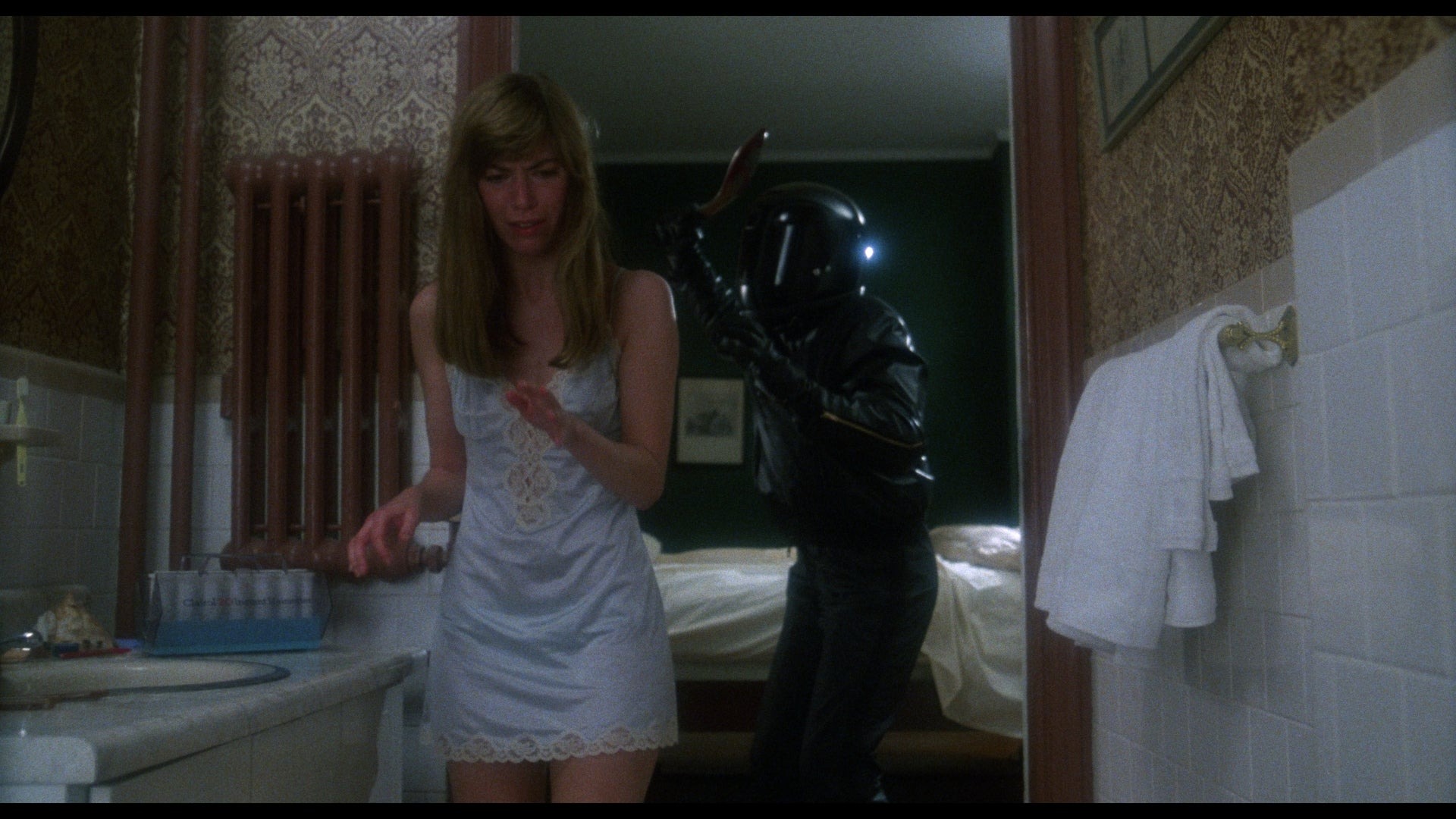
Night School, director Ken Hughes and writer Ruth Avergon‘s tale of a headhunting slasher on the streets of Boston, arrived in the early Golden Age of the slasher film and never quite broke through the endurance test that other films in the subgenre, like Friday the 13th, managed to pass with flying colors. Blame it on a more cerebral tone, a crowded market, whatever you like, but saying it’s a shame that the film didn’t break through doesn’t begin to cover it.
Night School isn’t just an underrated slasher, or an underseen one. For my money, it’s one of the best films the subgenre has ever produced, full stop, and Vinegar Syndrome’s new 4K UHD restoration, arriving just in time for the film’s 45th anniversary, is must-have proof. Stacked with special features highlighting the craft of the film and its place in slasher history, and headlined by a gorgeous restoration showcasing the wonderfully textured production, this is Night School as it’s meant to be seen for slasher devotees everywhere.
So, what makes the film so effective? It starts very simply, with the revelation that a killer with a very cool knife and a motorcycle helmet as a mask is murdering young women in Boston, taking off their heads, and dropping those heads in the nearest body of water (no matter how small).
Solving the case falls on Judd Austin (Leonard Mann), a detective with an academic background who traces all of the victims in one way or another back to a local night school. There, suspicion falls on a womanizing professor (Drew Snyder) who sleeps around on his research assistant and romantic partner, Eleanor (Rachel Ward), whose own death could be right around the corner.

I’m doing my best to stay as spoiler-free as possible here, not just because I think plenty of slasher fans still need to see Night School, but because the film is quite determined to be a whodunit in the classic Italian giallo sense. The kills are brutal and elaborate, the killer deliberately covered head-to-toe in leather and a gleaming black helmet, the knife and the headhunting a disturbing signature. Avergon’s script is well-versed in the trappings of exactly this kind of story, complete with red herrings galore. And yet, by the time it’s all wrapping up, there’s also the sense that the answer was right there in front of you the entire time, something the very best films by legends like Mario Bava and Dario Argento could also achieve.
But on to the restoration: Like the best of the gialli, Night School is also a beautifully engineered film full of colors and delicate camera compositions and sound design. The opening kill, which takes place on a playground carousel outside of a daycare, is rich in exactly this kind of thing, from the cityscapes that lead into the scene to the sound of a motorcycle slowly rolling forward, its engine already dead. Cinematographer Mark Irwin, best known for his many collaborations with David Cronenberg, paints the film in rich reds, absinthe greens, and haunting, chilled blue-white light on wet Boston streets, all of which are preserved beautifully by the restoration team at work on this one.
It’s a movie that very deliberately evokes a specific place – the aging streets of Boston in the 1980s, and the halls of relatively low-level academia – and then takes that place into haunted territory, saturating every frame with color and shadow that suggests a killer lurking just out of view.

Night School is not a massively gore-heavy film, but it does deliver the slasher goods with a series of tense, often unpredictable kills and body discoveries that range from the darkly comic to the flat-out jaw-dropping. That’s thanks to the sound design, the score, the editing from Robert Reitano, and more, all of which add to the film’s giallo soul.
In every case, the scene’s geography is outstanding, and it’s easy to see where the simplest possible kill shot might land, but the film never goes for the obvious. Throw in a surprisingly (for 1981, anyway) feminist bent to the storytelling and some very progressive moments for an early slasher film, and this one fits right in with Black Christmas and The Slumber Party Massacre as a film with depth you can just keep unpacking.
That depth, helped along by a load of featurettes and two new commentary tracks featuring members of the crew, is what stands out the most in this new 4K set. Night School may be a niche film recognized mostly by horror addicts and the slasher faithful, but it deserves to be something more, a landmark on the roadmap of slasher cinema history. It’s one of the best in the genre, and this restoration highlights, underlines, and shouts that from the rooftops.
Night School is now available in 4K UHD from Vinegar Syndrome.


You must be logged in to post a comment.