News
Hunted The Demon’s Forge Review: It’s Gears of Oblivion


Hunted wasn’t really on my radar until I realized that it was taking a fairly ambitious step for fantasy RPG games: it was attempting to take the action heavy co-op and cover system from Gears of War and implementing those features into a fantasy universe, filled with witches, demons and other geeky stuff. I enjoy fantasy RPG games, anyone who knows me is familiar with my incurable addictions to Diablo and Demon’s Souls, and I also thoroughly enjoy the Gears of War games, depute my inability to be anything other than awful at its multiplayer.
That’s the gist of it, and if the game had succeeded in seamlessly sewing the two genres into a cohesive, and preferably fun experience, we could’ve had another great game to make the summer drought less dull. Unfortunately, while trying to blend these things together, something bad happened. Something really, really bad. Find out what after the jump. The Baby Factor: If Gears of War and a random fantasy RPG (let’s say Oblivion, though it really doesn’t matter) got together for a night of kinky activities, the “I’ll be your knight in shining armor, you be my grateful princess” kind of kinky, Hunted: The Demon’s Forge would be their unwanted crackbaby.
I say unwanted because this is a really flawed game. It’s a game with some great, even ambitious ideas, but it’s also one that’s chock full of poorly implemented ones. After grinding through the game’s single-player my main issue is all of those features that most fantasy RPG’s get right, you know, the ones we take for granted (things like a fucking inventory) have either been removed or irreparably harmed.
Arguably the game’s selling point is that it lets you and a friend battle hordes of undead, spiders and massive beasts together. Why? Because everything is more fun with a friend, and that rule applies to practically every facet of life, including eating, gaming, and of course, bitter masturbation. For a game that’s been built from the ground up to cater such a feature, the end result is surprisingly void of features many would expect from a cooperative game.

The first of these is the inability to share items, because why in the world would you want to do that? Of course, this is mostly fueled by the lack of an inventory, more on that later, which removes you of your ability to pick up loot. Now, the game still has loot, but what I found while on my adventure I really couldn’t be excited to own because A.) special items break down really fucking quick, as does everything else, and B.) you can only carry one thing at a time, because for some reason your secondary weapon can’t be replaced.
Why, I ask? Who thought this was a good idea? Who took one of the most fundamental elements of the fantasy RPG genre, the loot, and decided they should remove it of all its allure? Because I know it’ll last me all of five minutes I just don’t care when I find something cool. Who came up with this? I really want to know so I can stare awkwardly into their eyes, piercing their soul with my gaze and removing them of their courage to make another shit idea without consulting someone with a little more common sense.
But you know what? That’s not even the worse thing. You remember that thing I hinted at a few times, the lack of an inventory? Yeah, that’s worse. I suppose the two ideas go hand in hand: crap loot and no inventory, so at least I’m not even the least bit tempted to want to keep an item I might want to use or trade later, oh wait I forgot, no trading items!
The Demon Forge is also plagued by that brown and grey palette that Gears of War has also struggled with. It’s just not interesting to look at. I mean, sure, there are a few decent looking areas with a little flora strewn about, but for the most part it’s just a desaturated mess to look at.

So you’re probably waiting for me to say something positive, and I’m happy to be able to do so. The combat, also a very important feature, is pretty solid. Switching between your close-quarters and ranged weapons is a breeze and firing/attacking with them feels satisfying. The cover system is also surprisingly well implemented. Vaulting over waist high obstacles and hiding behind walls and pillars is intuitive and I rarely came across any problems when doing so.
Using spells is also easy and the arsenal of abilities you’ll acquire work great toward the cooperative nature of the game. You can lift an enemy from afar so your friend can strike them while they’re hanging helplessly in the air, or you can freeze a foe so your ally can shatter them to pieces with a killing blow. Sadly, you’ll have a paltry selection of enemies to use these skills on, but they’re fun nonetheless.
One of the game’s more interesting features is its level creator, dubbed The Crucible. In it you can create a series of arenas that are filled with enemies to dispel before you can proceed to the next area. You can’t create missions or throw in a story, but this definitely adds a good amount of replayability to the game. You also unlock new enemies and environments using the gold you collected during the campaign, but many of the better unlockables require you to play a lot of Hunted before you can get them. What could’ve been a great addition is limited by your inability to share your level with other players or find one another created without joining it randomly.
In the end, Hunted: The Demon’s Forge is the type of game that sounds great on paper, but has failed so terribly in the full realization of its ambitious ideas. It’s an interesting title with some great features, but it’s just such a frustrating experience watching it fail in areas that so many games before it have succeeded.
The Final Word: An admirable, but failed first attempt; there’s some fun to be had but to get your money’s worth over the long haul I recommend you equip a +5 Stamina helmet to help you endure this game.

This review is based on a retail copy of the PS3 version of Hunted: The Demon’s Forge, which was provided by the publisher.
Have a question? Feel free to ever-so-gently toss Adam an email, or follow him on Twitter and Bloody Disgusting.




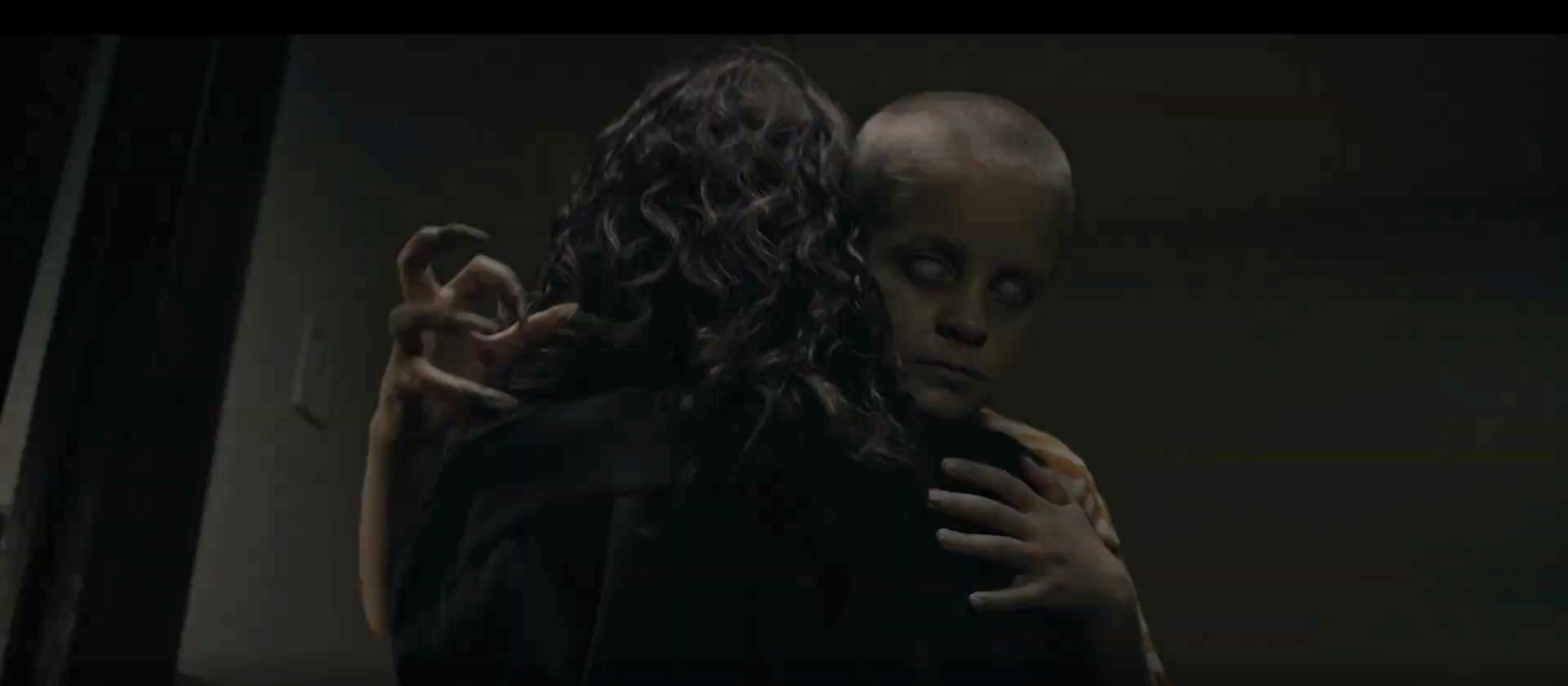
Let’s start with the good news. Lockbox looks far better than its misleading marketing materials suggest, a supernatural horror movie so darkly lit and color graded that you’ll have to squint your way through jump scares. It’s also anchored by reliable genre performers. That’s also about where the good news ends with this rote adaptation of Knifepoint Horror Podcast story “Winthrop.”
The empathetic Carla Gugino gives her all as Ellen, a saint of a woman with boundless patience who takes on life’s hard luck with a kind smile. After giving up her career as a fashion designer to become caretaker for a dying mother, she’s then forced to reinvent herself once more when her caretaker role ends. That catches us up to the events of Lockbox, where Ellen is asked to take in a cousin she hasn’t seen in quite some time who’s dealing with severe PTSD.
Just as Ellen finally establishes a real connection with Winthrop (Lou Taylor Pucci), it’s interrupted by the arrival of peculiar neighbor Vahna (Katharine Isabelle), who spells clear trouble. When Vahna shows up dead, it sets in motion a supernatural battle of possession.

Image Credit: Aura entertainment
Director Daniel Stamm (The Last Exorcism, Prey for the Devil) and screenwriter Justin Yoffe approach Lockbox in the broadest of brushstrokes, dooming it from the start with clunky storytelling and woefully underdeveloped themes of heady topics like PTSD. Winthrop is a character that comes loaded with emotional baggage and trauma that’s piled on throughout his tragic life, but much like its title, his interiority and history are treated like a tightly guarded secret meant to prolong the supernatural mystery.
The problem here, though, is that Lockbox is too sparse to sustain mystery at all, and it instead robs Winthrop of characterization. It winds up trapping the talented Pucci without anywhere to go, toggling between wounded animal and mentally disoriented.
From there, Lockbox bounds through plot developments without any sense of stakes or purpose, peppered by a smattering of haphazard paint-by-numbers jump scares. The only unwavering constant is Ellen’s resolute faith, and Stamm seems to leave it entirely to Gugino to guide confused audiences through this inconsequential story right up until its supernatural climax.

Image Credit: Aura entertainment
To give more credit, Lockbox at least injects an unconventional exorcism here; just don’t expect much in the way of explanation. When the film finally reveals the meaning behind its title, it dangles a fascinating carrot it has zero interest in delivering. More than a severe lack of fleshing out its characters beyond plot drivers or devices, this faith-based flick also seems terrified to offer any worldbuilding whatsoever.
Yoffe’s script stretches the short story beyond its means instead of fleshing it out, and Stamm fills out the gaps with cheap CGI scares and overwrought performances; Isabelle’s Vahna is beyond cartoonish in her villainy. It’s also pretty nonsensical, treating only Ellen’s faith with the utmost sincerity and largely squandering its typically reliable talent. So much so that the final imagery, pure sunkissed saccharine sentimentality, leaves you with the feeling that this horror movie might be better suited as an entry in Chicken Soup for the Soul.
Lockbox releases in select theaters on July 3, 2026.

You must be logged in to post a comment.