
Editorials
We Who Walk Here Walk Alone: Revisiting ‘The Haunting’ at 60

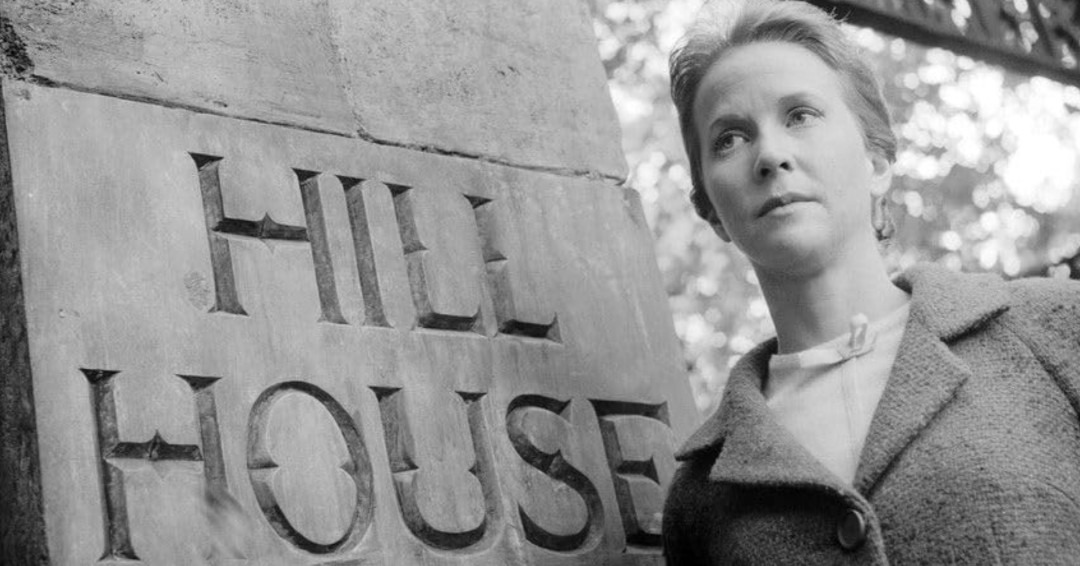
“Hill House, not sane, stood by itself against its hills, holding darkness within…and whatever walked there, walked alone.” – Shirley Jackson, The Haunting of Hill House (1959).
Of all the subgenres of horror, the haunted house story has provided the most opportunities for slow and subtle terror that creeps and crawls its way under the skin and into the psyche. The Old Dark House (1932), The Uninvited (1944), The Innocents (1961), Burnt Offerings (1976), and The Changeling (1980) stand among the best that not only the haunted house film, but all of horror have to offer. For many, the absolute pinnacle of these films is Robert Wise’s 1963 masterpiece of suggestive horror The Haunting. Based on the novel The Haunting of Hill House by Shirley Jackson, the film owes much to the influences of the past while still carving a way toward the future, is populated by rich and relatable characters, and is a deeply felt tragedy of the longing to matter in this big, lonely world.
Robert Wise came up through the ranks at RKO in the 1940s under the influence and presumably tutelage of its two greatest geniuses: Orson Welles and Val Lewton. The influence of these two mentors is evident onscreen in The Haunting in several ways. The film’s technique is in many ways Wellesian—deep focus, unique camera placement and movement, and the composition of the frame. As in the Orson Welles films Wise worked on as editor, Citizen Kane (1941) and The Magnificent Ambersons (1942), characters are set in different planes of depth within the frame, but all are in focus. They are then surrounded by grandiose set design, in the case of The Haunting, the rather baroque architecture of Hill House, which is not too far removed from the Amberson Mansion. Unfortunately, Wise had a great falling out with this first mentor as the studio forced him to re-edit the picture with a reshot ending without Welles’ involvement. Welles never forgave Wise for it and the two never spoke again. Still, the fingerprints of Welles remained as Wise grew as a filmmaker and his influence is very present in The Haunting.
Like the other great haunted house film of the 1960s, The Innocents, The Haunting is beautifully shot in that greatest and rarest of formats—black and white scope, or full widescreen; Twentieth Century Fox’s Cinemascope in the case of the former and Panavision in the latter. The techniques used are modern extensions of the kinds of pioneering work done by the builders of filmmaking language, and perfected by the masters of the 1930s and 40s. As expert as the technical aspects of the film are, they never detract from the story as is the case in the best Orson Welles films and those of Wise’s other great mentor Val Lewton, who gave him his first opportunity to direct a film with The Curse of the Cat People in 1944, another psychologically subtle film about a haunting.

Lewton’s influence is deeply felt in the way the film’s story is told. Lewton was far more interested in the psychological than the sensational. The horror films made between 1942 and 1946 at RKO by the Lewton unit are ambiguous, character-driven, and suggestive. The horror comes from what is not seen rather than from what is shown on screen. His philosophy was that what the audience imagines is far more horrifying than what the filmmaker can show. This makes Lewton’s films an interactive experience for the audience. Wise would often comment that people would say to him “you made the scariest movie I’ve ever seen, and you didn’t show anything.” This is the key to the continuing effectiveness of The Haunting. As with the best of the Lewton movies, it forces the active participation of the audience in that it provides just enough information and allows the imagination of each viewer to fill in the gaps.
This also allows for the psychological underpinnings of the story to work their way into the mind of each viewer and allows them to place themselves inside the situations on screen, or even behind the eyes of a character. For example, as Eleanor (Julie Harris) stares at the wall as she hears voices coming from the other side in one of the film’s most terrifying sequences, is it her or is it the audience that may or may not see a face forming in the shapes in the carvings on the wall? It happens so subtly that some may not even notice it upon first viewing. We are also allowed to ask questions like “is this all just in Eleanor’s mind?” before having the questions shifted when other evidence is presented. The film refuses to lay its cards on the table for as long as it possibly can, even in the iconic sequence in which the door bulges and flexes from some force behind it in the presence of believers and skeptics alike. That force remains unseen because Wise learned his lessons well from Lewton and perhaps H.P. Lovecraft and Edgar Allan Poe before him—what we imagine is far more horrifying than what we see.
One of the reasons why The Haunting works as well as it does is it is populated by characters who stand at different points on the spectrum of belief in the supernatural. Dr. John Markway (Richard Johnson) believes in the validity of the spirit realm, but wants to prove it scientifically so even the greatest skeptic could not poke holes in his methods and theories. Luke Sanderson (Russ Tamblyn) only believes in how much money he can make on Hill House after he inherits it and sells it off to the highest bidder. Theodora (Claire Bloom), known as Theo, is gifted with extra sensory perception but seems to think this could just be an uncanny ability to read people. In her youth, Eleanor had what Markway describes as “a poltergeist experience” in which “showers of stones fell on your house for three days.” But she brushes it off saying that her mother told her it was just the neighbors throwing rocks. More importantly, Eleanor desperately wants it all to be true, and feels that her inclusion in the Hill House experiment could be the one important thing she has been waiting for all her life. In the final act we are introduced to Markway’s wife Grace (Lois Maxwell) who feels that her husband has been wasting his life and destroying his academic reputation by chasing after ghosts.
These characters also have a great deal in common with those found in Lewton films. As in Cat People, I Walked with a Zombie, and The Seventh Victim, the lead characters in The Haunting are women, Eleanor and Theo, who are mirror images of each other. Eleanor, or Nell, is modest, retiring, something of a fragile flower desperate for belonging whose confidence has been chipped away by years of being the sole caregiver for her long-ailing mother. Theo is the opposite—confident, stylish, and in a way rather daring for 1963, openly gay. Same sex female attraction was often buried in the subtext of the Lewton films, specifically the three I mentioned above, but here, one does not need to dig very deep to find it as a key component of Theo. The focus of the film, however, is Eleanor. It is her story, and it is her tragedy.

The Haunting is a film of deep despair. Eleanor, so desperate to belong, so desperate to matter in this cold world, is swindled by a fraud. Not Markway or any of the companions she meets in Hill House, but the house itself. It convinces her that being within its walls is her destiny and her staying there for all time an inevitability. She clings to the line from a song sung in Shakespeare’s Twelfth Night, “journeys end in lovers meeting,” and she believes that Hill House is her lover, the one who will take her for who she is and not demand anything from her. But Hill House is not a lover as she imagines. It is a killer and a swallower of souls. Everything it does, it does for its own benefit. It is the epitome of “The Bad Place.” It does not give, it only takes.
When we are introduced to Nell, she believes there is something waiting for her that will solve all her problems. Instead, she becomes trapped by an obsession that ultimately destroys her. The film’s chilling final line proves that her loneliness only intensifies after Hill House takes what it wants—“we who walk here walk alone.” This is a change from the last line of the novel which repeats the famous opening that concludes “whatever walked there walked alone.” The change to “we who walk here” makes it all so much more personal. And savage. She is so desperate that her journey will end in lovers meeting, believing that Hill House will complete her that she becomes its willing prey. Instead of finding purpose and belonging, she will spend eternity trapped in solitude.
In various interviews Stephen King has conveyed a story about a phone call with Stanley Kubrick as he was adapting The Shining for what would become his 1980 film. To paraphrase the conversation, Kubrick said something like, “don’t you think that all ghost stories are inherently optimistic because they believe in an afterlife?” King thought about this and responded, “well, what about hell?” to which Kubrick responded, “I don’t believe in hell,” and hung up. This interchange somehow defines for me the conclusion of The Haunting, a film that is decidedly not optimistic about life after death. In the world of the film, an afterlife is proven, but not one of hope and joy, but of silence and abandonment. In the end, Nell seems to be trapped in a kind of hell. It is as if Dante’s ancient words should be inscribed upon the doorframes of Hill (Hell) House—“abandon hope all ye who enter here.” Hill House, not sane, stood for ninety years and may stand for ninety more. And those it takes it owns. And those it owns walk alone.
In Bride of Frankenstein, Dr. Pretorius, played by the inimitable Ernest Thesiger, raises his glass and proposes a toast to Colin Clive’s Henry Frankenstein—“to a new world of Gods and Monsters.” I invite you to join me in exploring this world, focusing on horror films from the dawn of the Universal Monster movies in 1931 to the collapse of the studio system and the rise of the new Hollywood rebels in the late 1960’s. With this period as our focus, and occasional ventures beyond, we will explore this magnificent world of classic horror. So, I raise my glass to you and invite you to join me in the toast.


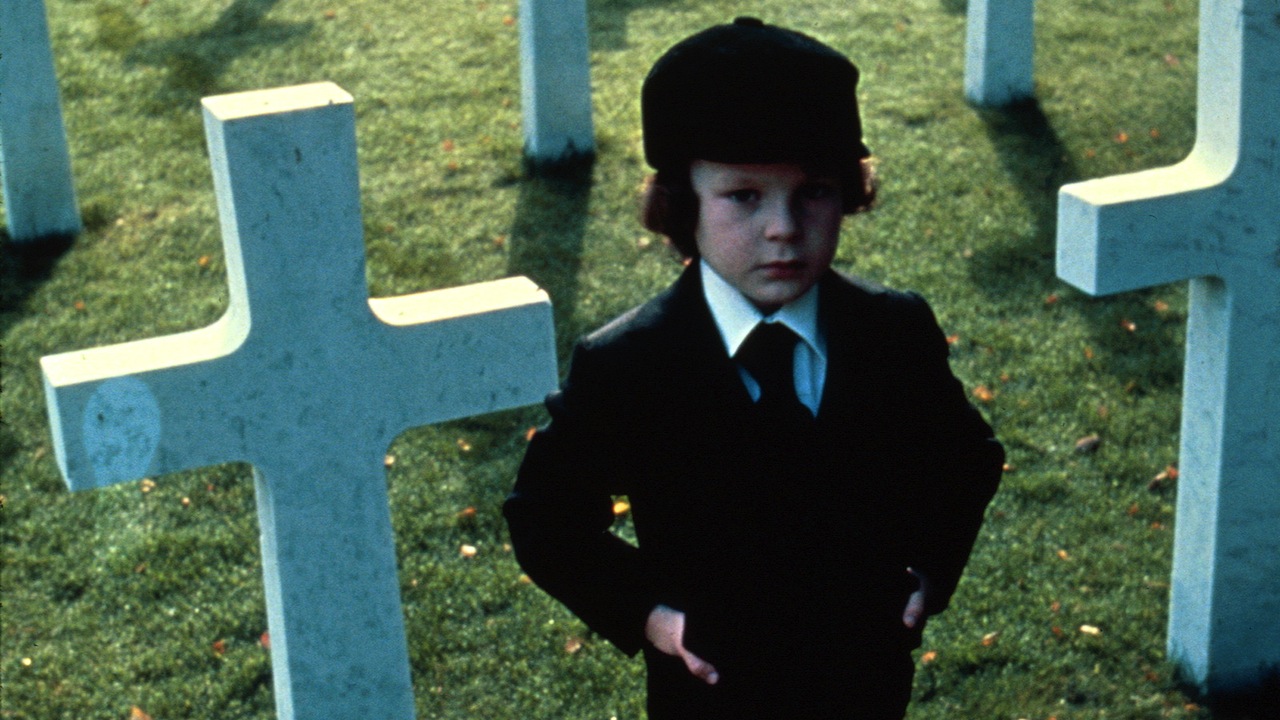
Of the three films that make up the Diabolical Trinity of classic religious horror films—Rosemary’s Baby (1968), The Exorcist (1973), and The Omen (1976)—The Omen is the most purely entertaining.
While Rosemary’s Baby digs into the societal shifts of the 60s and The Exorcist explores spiritual tensions between faith and doubt in an ever-shifting world, The Omen seems most interested in just telling a thrilling story. It achieves this by blending two major trends of the 1970s, the devil movie and the paranoid thriller, into one crackling adventure yarn. In the process, The Omen has sparked fear and curiosity about what could happen in the “end times” if such events are to occur.
After seeing The Exorcist, producer Harvey Bernhard contacted writer David Seltzer and said something along the lines of, “Hey, write me one of those.” Seltzer, having never read the Bible, thought it would be an interesting challenge, so, according to various interviews, he read the Bible and several commentaries in search of a story. Then he stumbled upon a passage in the book of Revelation, the image of a great Beast rising out of the sea, that sparked his imagination. In the commentaries, he found that the sea represented politics in some interpretations of the text, and he began building his story on that foundation.
Seltzer has told this story often, and I am inclined to believe him. However, from there, much of the theological-sounding lore of The Omen was created purely by Seltzer. Many of the ideas surrounding The Antichrist in the film appear to be drawn much more from the pop-eschatology sensation of the 1970s, The Late Great Planet Earth by Hal Lindsay, than any Biblical source.
Lindsay’s book was the bestselling nonfiction book of the 1970s and re-popularized views of the “last days” that had been dying along with fundamentalism for decades, namely Dispensationalism, Millennialism, and the Pre-Tribulation Rapture. In dispensationalism, history is broken into several epochs of time (or dispensations) that culminate in the return of Christ and his thousand-year (millennial) reign.
Before this return, a seven-year Tribulation will occur in which the Antichrist comes to power and persecutes all who oppose him, culminating in a battle between the forces of good and evil at the valley of Megiddo, usually called Armageddon. Of course, in this worldview, the true believers in Jesus will be lifted out, or raptured, before all this takes place. Since the publication and popularity of The Late Great Planet Earth, this has been the prominent belief in Evangelical and Fundamentalist Christian circles, though Roman Catholic, Orthodox, and mainline Protestant denominations largely reject it.
Lindsay also did something unique that had not been the case even in dispensationalist circles before him—he posited that the creation of the modern state of Israel in 1948 started the countdown to Armageddon. Fans of the film will immediately realize where Seltzer ran with this idea in the first line of the poem created for the movie: “When the Jews return to Zion…”
Damien Thorn and the Creation of Horror’s “Innocent Villain”

Seltzer’s next inspiration focused on the idea of the Antichrist as a child, what he would call the film’s “innocent villain.” In watching The Omen, it is readily apparent that Damien Thorn (Harvey Stephens) does not really do anything evil beyond a bit of normal kid mischief. Even the moment in which Damien knocks Kathy Thorn (Lee Remick) over a second-floor railing can be read as an accident orchestrated by Damien’s diabolically connected nanny, Mrs. Baylock (Billie Whitelaw). The film takes this idea of the innocent villain a step further by casting Gregory Peck, best known for playing arguably the greatest father in film history, Atticus Finch in To Kill a Mockingbird (1962), as Damien’s earthly father, an element that greatly satisfied Seltzer.
The New Testament itself says very little about the Antichrist and certainly nothing about his childhood. In fact, the word antichrist is used twice (1 John 2:18 and 2 John 7 for the curious) and refers to groups of people, not a particular person. There is also a passage in 2 Thessalonians 2:1-12 in which the writer (usually attributed to Paul) discusses “The Man of Lawlessness” who will “exalt himself over everything that is called God” and “proclaim himself to be God.”
Then there is the Beast of Revelation chapter 13 with “seven heads and ten horns” that Seltzer latched onto, which has been interpreted in a multitude of ways over the centuries. Powerful people throughout history, from Charlemagne, various Popes during the Protestant Reformation era, Napoleon and Hitler, to modern politicians, including Ronald Reagan, Bill Clinton, Vladimir Putin, Barack Obama, and Donald Trump, have all had the label placed on them by various circles. Even religious leaders like Billy Graham have not escaped being called the Antichrist.
Lindsay and modern dispensationalists are certain the Antichrist will be a 21st-century individual as they are equally certain that the Rapture, Tribulation, and return of Christ are imminent, likely within their lifetime. Many scholars and theologians, however, interpret these passages as symbolic representations of the Roman Empire and the first-century Caesars who persecuted, tortured, and murdered Christians and Jews who refused to submit to Imperial rule and worship them as gods. For example, that the Beast from the sea in Revelation has seven heads is symbolic of the famous seven mountains of Rome, with the 10 horns referring to rulers and magistrates of the Empire.
But this is all really of no matter to Seltzer and the story of The Omen. Instead of being concerned with any historical or theological accuracy, he instead built his own lore, which sends Robert Thorn and photographer Keith Jennings (David Warner) on a globetrotting investigation into the nature of the Antichrist and how to stop him. Some of this lore includes the child being born of a jackal, the reaction of animals, the protective cult that arises around Damien, the daggers of Megiddo, and maybe most interesting of all, the peculiar flaws in Jennings’s photographs that presage the ways certain individuals will die.
All these aspects are where the paranoid thrillers come in, as films like Blow Up (1966), Z (1969), The Conversation (1974), The Parallax View (1974), 3 Days of the Condor (1975), and All the President’s Men (1976) were all the rage at the time. Especially in the wake of the Watergate scandal, the idea of journalists (like Jennings) as ordinary heroes who could bring down the powerful, nefarious forces in the world was exactly what audiences craved. And what greater hidden evil force was there than the Devil? This is also why the device of the daggers of Megiddo is so important to a movie like this. If Damien is indeed the Antichrist, there must be a way to stop him, though in the Biblical text, the only power capable of destroying the Devil is God Himself.
The Mark of the Beast, 666, and the Film’s Most Famous Religious Symbolism

The piece of lore created for the movie with the most solid Biblical grounding is the Mark of the Beast. Revelation describes a mark on the forehead or hand of those who worship the Beast and his image. Again, this is symbolic language differentiating those who belong to the power of the Roman Empire and those who belong to Christ, who have the Mark of the Lamb. In Seltzer’s hands, the mark is very literal, a birthmark that is borne by not only the Antichrist but all his followers, meaning they are marked from before birth as belonging to Satan, and there is no escaping it. This is all rather distressing to the priest Father Brennan (Patrick Troughton), who betrays his mark by warning Thorn about Damien and pays the price by memorably being impaled by a spire that falls from a church steeple after being struck by lightning.
Why is the mark three sixes? Again, this is drawn from a passage in Revelation that states that the Beast can be identified by calculating his number. In Biblical scholarship, this is believed to be the sum of the name of a man transferred into Hebrew numerology, a practice in which each Hebrew letter also represents a number. Using this method, the number of the name Caesar Nero, which many believe to be the most logical choice, is six hundred sixty-six. In the film and elsewhere, this number is changed to three individual sixes. According to the film, this represents the Diabolical Trinity (a designation also unique to the film) made up of Satan, the Antichrist, and the False Prophet. That Damien carries this unique birthmark under his hair convinces Robert that the child is the Antichrist, and it’s up to him to destroy him.
Part of what makes The Omen great is its ambiguity. Damien could be the Antichrist, or he could be at the center of a series of coincidences. Director Richard Donner stated in interviews that he believed Robert Thorn had gone insane by the end of the film, which, to Donner, is the only explanation for why Thorn would attempt to kill an innocent child. However, that enigmatic smile in the final shot suggests that Damien does embody a spirit of great evil. The sequels, however, all but erase this ambiguity.
In audiences, The Omen sparked a renewed interest in the concept of the Antichrist and the dispensationalist interpretation of the end times that continues to echo throughout the last five decades. Around the time of the film’s release, even Elvis Presley was photographed brandishing a paperback copy of Seltzer’s novelization. Dispensationalist authors like Hal Lindsay, Tim LaHaye, and John Hagee have made millions publishing books and giving lectures about the Antichrist and the end of the world.
The Legacy of The Omen, 50 Years Later

Though A Thief in the Night (1972) preceded The Omen in initial release, it gained quite a resurgence (along with the ability to create three sequels) in the wake of the popularity of The Omen and went on to scar the psyches of Evangelical children for decades. Hal Lindsay was also able to release a film version of The Late Great Planet Earth in 1978, complete with narration and a brief onscreen appearance from Orson Welles.
In the 1990s, the Left Behind series became a cultural phenomenon, spawning twelve books in the core series, a YA spinoff series, video games, and a movie series (2000-2005) starring Kirk Cameron. A bigger studio adaptation of the first book was released in 2014, starring Nicolas Cage. 20th Century Fox and The Omen got in on the renewed “end-of-the-world” vigor by releasing a remake of the original film on June 6, 2006. The franchise was revived once again in 2024 with The First Omen, which explores ideas of the Antichrist and the motivations of those in power in our current religious, social, and political context.
But despite all the sequels, spinoffs, rip-offs, remakes, and “end times” money grabs of the last 50 years, the original version of The Omen remains untouchable. Its greatest strength is that it seeks, first and foremost, to entertain. And it does so admirably.
After half a century, its influence can be felt in horror, the culture at large, and even in various faith circles. It is a testament to the power of story and film that, consciously or unconsciously, fans of The Omen and those who have never seen it alike are, to this very day, marked by the Beast.

You must be logged in to post a comment.