Reviews
‘Happy’s Humble Burger Cult’ Review: Deliciously Addictive Multiplayer Horror

I’ve mentioned in multiple reviews that I’m a huge fan of the recent trend in indie gaming where developers transform typically innocuous jobs into genuinely disturbing pieces of interactive horror. That being said, I usually prefer the single player variety of these freaky job simulators, as the added chaos of online multiplayer tends to dilute scares and can even get in the way of telling a proper story – especially when you’re playing with strangers.
I think this pre-existing bias is why I was so thoroughly impressed with Happy’s Humble Burger Cult, as this disturbing fast food restaurant simulator boasts a surprisingly engaging single player mode that’s already worth the price of admission. However, the experience truly shines once you add other players into the mix and realize that the project was sculpted from the ground up to be one hell of an online party game.
Clearly inspired by multiplayer classics like Overcooked! and Phasmophobia, Scythe Dev Team’s latest release is actually a bigger and more elaborate follow-up to their cult-favorite 2021 title, Happy’s Humble Burger Farm. While the new game is similar to that first release in that it also miraculously blends the time-sensitive thrills of working as a fry cook with randomized paranormal phenomena in a twisted simulation, the added multiplayer elements and increased polish make this the definitive Happy Humble Burger experience.
Clock In, Cook Fast, Survive the Shift

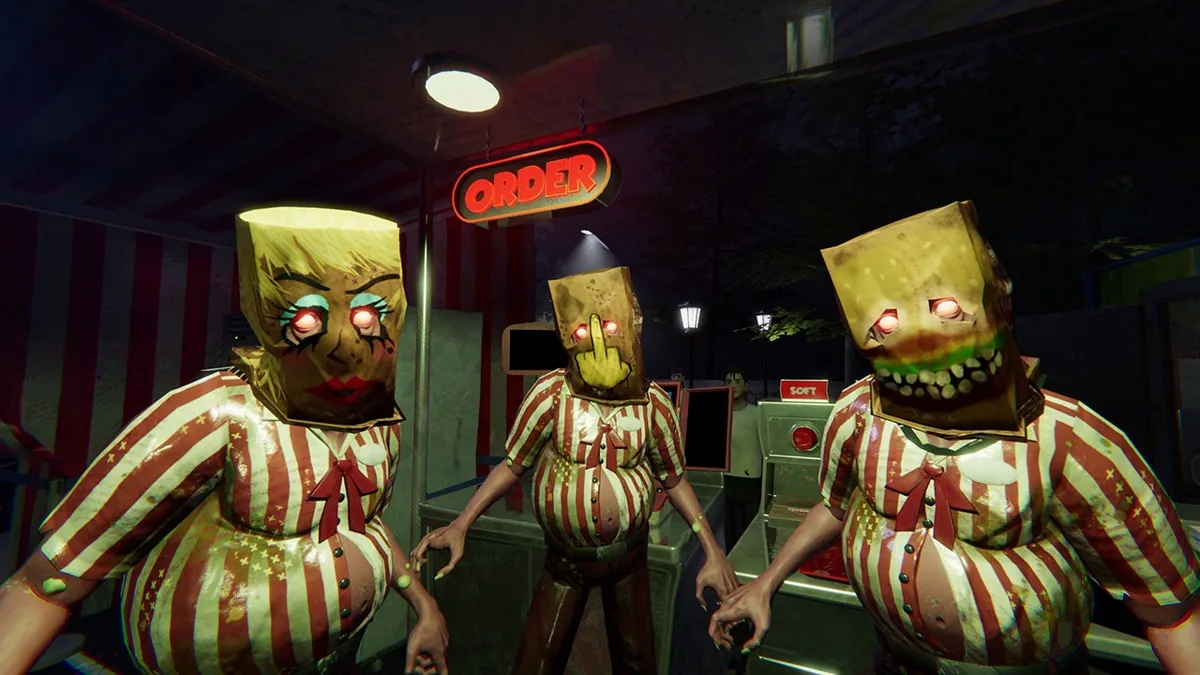
In the new game, players take on the role of a masked test subject trapped inside of a procedurally generated labor experiment orchestrated by the mysterious Paragon Corporation. During your shift at a simulated fast food restaurant, you’ll be expected to prepare cleverly named dishes ranging from Meat Heater burgers to Agent Orange soda and serve them to zombie-like customers in an attempt at satisfying your automated overlords. Unfortunately for you and your minimum wage buddies, the simulation tends to degrade over time, meaning that life-threatening anomalies will inevitably take over the workplace by the end of the shift.
In gameplay terms, this means that the main loop here consists of rushing around the restaurant in first-person and taking orders from bizarre NPCs while you sort through unsanitary ingredients and questionable prep stations before the timer runs out, though you can also spit in your customers’ orders if you feel so inclined. Meanwhile, you’ll also have to deal with common kitchen mishaps like grease fires and interdimensional pest control.
The game also reacts to your microphone, with certain words and phrases activating anomalies that can both help and hinder your progress as you attempt to hit your quota for the day. Naturally, this is only really a factor when playing online, but there’s plenty of opportunity for emergent gameplay here as the unpredictable nature of co-op means that there will be plenty of unintentional incantations going on in the background.
Then we get to my favorite part of the experience in both the game and real-life labor: the final moments of each shift where you have to ritualistically close up shop before you’re allowed to exit the simulation. During these climactic sequences, players have to run to turn off appliances, take out the trash, and perform an assortment of other seemingly menial chores while being chased by a demonic manager with a mean streak and a nasty habit of preventing you from walking away with a paycheck.
Infinite Replay Value in the World’s Worst Restaurant

In between shifts, players will find themselves transported back to a dystopian hub/lobby area where they can engage in a multitude of mini-games ranging from blackjack to janky basketball, and even purchase useful items as well as cosmetic upgrades. It’s here that you realize how the experience is specifically tailored for multiplayer, as this space is obviously meant to be a bustling base of operations for a group of weary co-workers trying to have a good time despite their hellish predicament.
This highly detailed hub also contains most of the lore and story elements that provide narrative context for the overall experience. I honestly felt kind of lost during my first few hours with the title since I had never actually finished Scythe Dev Team’s original Happy’s Humble Burger game, but I ended up looking forward to more of their surprisingly in-depth worldbuilding here after each shift, with the story only getting wackier the deeper I fell into this satirical rabbit hole.
This steady drip-feed of new content, including terrifying/humorous collectables like in-universe VHS tapes, is enough to keep you going for several shifts despite the relatively simple controls and mechanics. The stylish visuals and ominous atmosphere also help to cover up most of the title’s indie blemishes, such as occasionally wonky physics, but it’s really the addicting gameplay loop that’ll keep you hooked to Happy’s Humble Burger Cult.
You’ll inevitably find yourself wanting to fulfill orders faster and faster as you make more money and continue to serve customers in increasingly bizarre situations. Being able to compete/collaborate with friends gives you even more incentive to keep coming back to work -especially once you unlock a unique outfit for your masked guinea pig- with the whole thing feeling a lot like a team-building exercise from hell (but in a good way).
Couple that manic multiplayer energy with procedurally generated challenges and six unique restaurants to manage and you’ve got an interactive horror-comedy experience with nearly limitless replay value.
That being said, I have a feeling that Happy’s Humble Burger Cult might just cause the end of a few friendships due to the game’s high-stakes approach to the junk food industry.
Review code provided by publisher. Happy’s Humble Burger Cult is available now on Steam.





It’s a day of the month ending in Y, and that means it’s time for another killer shark film. Why? Because they’re inexpensive to make, play into an easy fear, and keep finding audiences willing to give them a spin. The Bay is the latest entry in the shark attack subgenre, and while it’s noticeably better than last month’s Chum, it still struggles to barely stay afloat.
Emma (Francesca Eastwood) and Lani (Dani Oliveros) are best friends who’ve traveled to Thailand for a destination wedding, and a chance encounter at the buffet table leads to an unexpected adventure. Mandal (Alexander Wraith) is a friendly, knowledgeable transplant who connects with nature and makes a living by offering boat tours through the area’s scenic waterways. The trips culminate with the opportunity for tourists to witness a shark feeding with local tiger sharks. The tourists aren’t meant to be the food, obviously, but sometimes accidents happen.
The Bay checks off most of the subgenre’s expected beats – an attractive location, an iffy ensemble of characters, a series of poor choices – but it does a few things differently along the way. For one thing, while we see plenty of sharks in the build-up, the first attack doesn’t happen until past the film’s midpoint. Writer/director Phil Volken fills the time leading up to that attack with engaging enough character beats, some genuine suspense, and an abundance of dialogue about how sharks aren’t typically a threat to people – or threats like people. “Sharks hunt,” says Mandal, “humans kill.”
It’s a bit of foreshadowing, perhaps, but it’s also the film’s presiding theme. Sharks don’t want to hurt or kill humans, but “mistakes happen.” Mandal offers up numerous eco-friendly spiels about the role sharks play in the environment, how overhunting could lead to disaster, and how humans are the ones invading their territory. “Don’t act like prey,” and you won’t be bitten, eaten, digested, and shat out by a shark. Pretty simple, if you think about it.

Trouble starts when they toss a chunk of meat into the water attached to a chain and a large female tiger shark gets caught up in it. Mandal’s sidekick, a local man named Ruhan (Ta’imua), panics and starts stabbing at the thrashing creature. He has a history of being bitten by a shark and is clearly frightened, and as the situation worsens, he becomes a far more active threat to the others’ safety than the actual sharks. That character type is pretty common in these films, but it’s a curious choice to make the film’s sole indigenous member of the ensemble the morally weak link.
To be clear, Ta’imua is playing a local but isn’t actually Thai. He is, however, Hawaiian, and The Bay was filmed off Oahu, meaning he’s the only indigenous representation on both counts. The other three characters, all Americans, are brave and willing to risk their own safety for the group, leaving only Ruhan to put a face to the cruel, selfish humans mentioned earlier in the film. It’s certainly a choice!
His performance is somewhat stifled by the desire to make him seem menacing, but it’s passable. The others are equally okay as performers, but it’s only Oliveros’ Dani who stands apart as a spirited individual worthy of viewer fist pumps. Cinematographer Helge Gerull delivers some attractive landscape shots destined to make you consider a Hawaiian vacation, and composer Gad Emile Zeitune finds some effective aural backdrops for the film’s teasingly emotional moments.
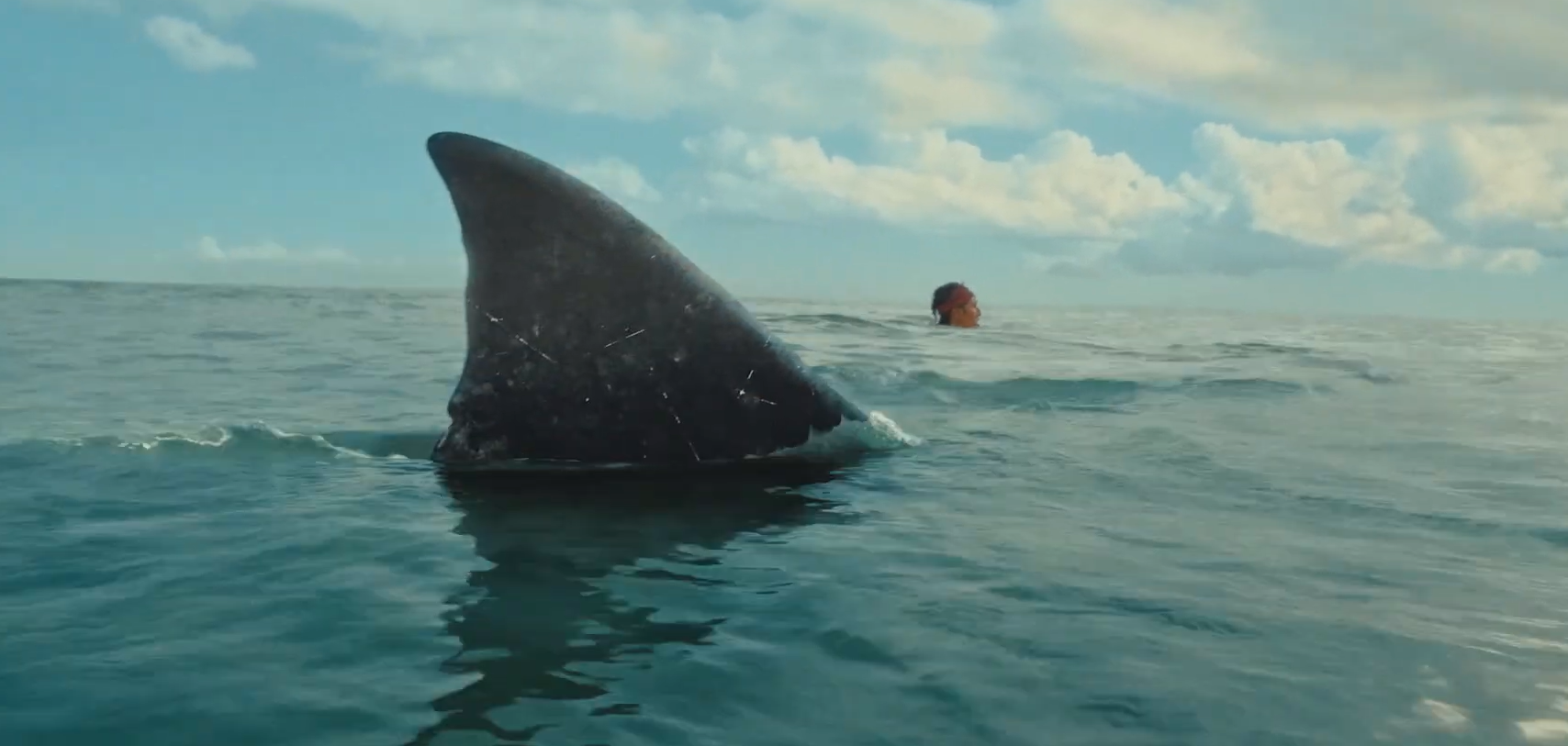
Then there’s the sharks. A major drag on the subgenre these days is the use of cheap CG effects (including the abysmal use of A.I. in Chum), but The Bay sidesteps that problem for the most part. There are real sharks here, lots of them, but they appear to be solely present via stock footage edited into the film. Some CG is used here and there, too, with shots being comped together to tighten the proximity between humans and sharks. Most effective, arguably, are the practical effects used to create fins cutting through the water near the characters.

There’s a sense of grounded reality to the shark kills, and while they’re less showy, they’re weightier as a result. Wounded bodies drift away, and the moment where shark nibbles turn into ferocious feasting feels more inevitable and affecting than sudden or scary. The sole exception to the general quality of those kills is the film’s final shark encounter, which doubles down on the poor choices by pairing a silly CG beat with some poorly matched stock footage.
Pretty much every shark attack movie lives or dies on its presentation of the sharks themselves. There are exceptions, of course, with Steven Spielberg’s Jaws being chief among them – everything about that film, from the writing and acting to the directing and editing, helps make it a masterpiece despite the mechanical shark looking goofy as hell outside of the water – but The Bay isn’t Jaws. It’s not even Jaws: The Revenge. Its live sharks are mildly effective, though, and give it a subdued realism that will likely appeal to viewers averse to CG intrusions. Will that be enough to win them over, though?
“When you enter the ocean, you enter the food chain… and not necessarily at the top,” says an opening onscreen quote from Jacques Cousteau, and something similar could be said for shark attack movies in general. When you make one of these movies, you enter a well-trodden and densely populated subgenre… and you’re all but guaranteed to not be at or even near the top. The Bay is closer to the ocean floor than the water’s surface, and while that still puts it above the bulk of the genre, it’s probably not enough of a reason to step foot in these waters.
The Bay opens in theaters and on demand on July 17, 2026.


You must be logged in to post a comment.