


Spoilers for Season 3 Follow. Now in its third season (with a fourth already greenlit), Syfy’s The Magicians is the type of show that proves unique and original can survive on television. With a one-sentence pitch of “Harry Potter for adults,” you’d be forgiven for not expecting much from the series. However, showrunners Sera Gamble and John McNamara have taken what started as a fun yet messy program about students of the fantastical Brakebills University and “Hedge-Witches” (magical beings without proper education) who find out the world as written in a series of children’s books, “Fillory and Further,” is not only real but key to their destinies, and turned it into one of the most exciting shows on TV. In fact, fans of Buffy the Vampire Slayer have no excuse to not be watching. If there were ever a descendent of that show, this is it. As a loving nod, there was even a moment early in this season where Eliot and Margo (the King and Queen of Fillory…long story) have a coded conversation in “geek speak,” so as not to be understood by the manipulative fairies who follow them around everywhere. The scene played out with delightful “wink-wink” subtitles. When Elliot says, “We have to keep it…very best episode of Buffy,” the subtitles inform us he means “We need to hush.”

And “hush” is just what they did last night in episode eight, “Six Stories About Magic.” In season three, we find the Brakebills gang at a loss as their actions have led to a complete magical blackout. Without magic, their worlds (and I do mean worlds plural) are slowly crumbling. So, it’s up to them to find a solution. In a very meta touch, they are quite literally on a “quest” to hunt down seven magical keys, each with its own special power. The season itself has been a fun deconstruction of the typical “hero’s journey” found in a bevy of sci-fi/fantasy films from over the years. Oh, and for those worried, this doesn’t constitute as “horror,” the show certainly toes the line. They’re not afraid to unleash vicious creatures upon its cast and revel in moments of jaw-dropping gore from time to time. Even something as benign as “fairy dust” takes a morbid spin when you realize the magical powder is likely the byproduct of actual, ground-up fairies.
Never afraid of pulling an overly stylish, gimmicky moment out of nowhere, they may have just topped themselves with “Six Stories.” From random musical numbers (Taylor Swift in one of the first few eps and an epic Les Misérables moment last season) to a truly poetic montage that found Quentin and Eliot literally sharing a lifetime’s worth of love and loss while trapped in an “alternate timeline” together, all while desperately trying to solve a mosaic puzzle in hopes of securing one of the seven keys. They found love in each other. Quentin found love with a local village girl. The three of them raised a child together. They grew old. Eliot died. Quentin wept. All of this in the span of five minutes. Hell, instead of trying to explain it, just watch the clip.
It’s moments like this that make tuning into “The Magicians” every Wednesday so exciting. You never know just what rabbit they’re going to pull out of their hat. That brings us back to “Six Stories.” In order to retrieve yet another key, the gang must pull off a major heist and break into the library. Of course, this isn’t a normal library. Dragons run the return receptacle and the only way to get there is through a “mirror bridge” created by the blood of a Traveler, those with the ability to transport from place to place. The “Six Stories” of the title each focused on a different character’s perspective, each providing a Rashomon like understanding of the overall story. The highlight of the evening belonged to Harriet.
Harriet, played by deaf actress Marlee Matlin, has been a side character who is the head of a group dead set on bringing down the library. While the character wasn’t written with a deaf actress in mind, once Matlin scored the role, the writer’s didn’t seem to bat an eye at adjusting the part for her. Last night we finally learned why she has such a vendetta against the library. It appears her mother is the head librarian, Zelda, who ultimately banned her daughter from the confines of the establishment due to her rebellious ways. Harriet feels that all the history and knowledge of magic should be shared with whomever is interested in learning. The librarians feel certain knowledge should be kept hidden and only shared with a select few.
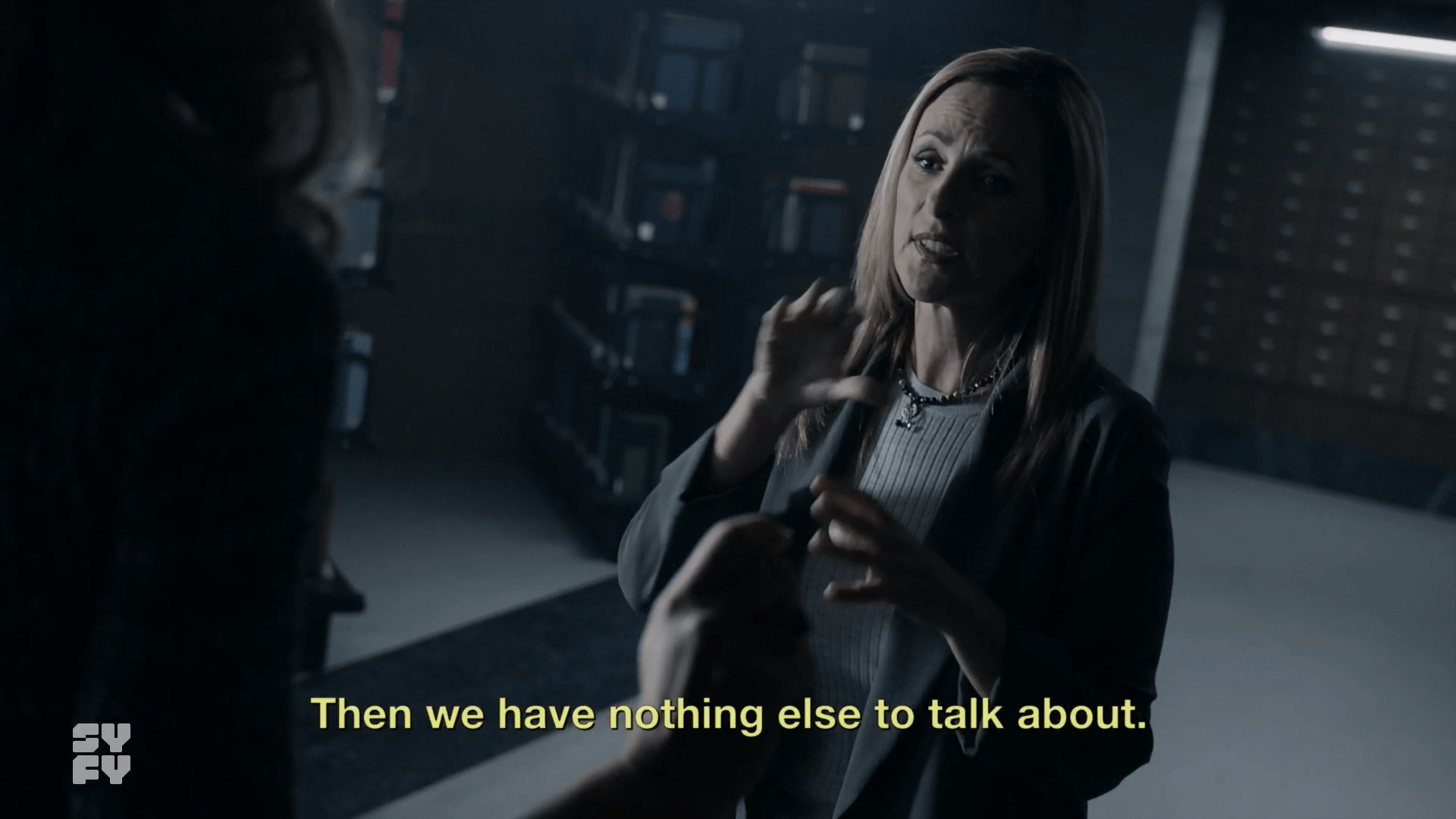
In the standout segment, we learned of Harriet’s background from her perspective. The sound was completely dropped out, with only a faint rumbling heard sporadically on the track. Any dialogue was handled via sign language and subtitles. We follow Harriet as a young girl chastised by Zelda for staying outside of the library, where time moves normally (inside a day could be years), for far too long. Then, she’s an angsty teenager who decided to leave the library for good. Each time jump is heartbreaking as you witness the strained relationship between mother-daughter. It’s all the more poignant with the stripped down (or nonexistent) sound design. There’s nothing to distract you from the emotion at play and the performances of the actors on display.

I actually got a bit misty eyed as it all played out. Harriet isn’t a character we’ve seen that much of. She’s been in the periphery up until now, and this episode proved how important it is to see different representations of the human experience on film and TV. It’s powerful to be placed within someone else’s shoes. It was a risk to let a large portion of a popular television show play out in complete silence, but it’s a risk that paid off. The story ends with the explosive sound of shattering glass and a punch to the gut that I won’t dare spoil. “The Magicians” isn’t afraid of trying new things or being labeled as “jumping the shark.” They are the shark, and next week’s musical episode is sure to be another delightful, stylistic departure.
