


Almost nothing is more fatal than the nuclear bomb. Just two of them killed an estimated 225,000 people between Hiroshima and Nagasaki, Japan, and we live our lives with the threat of thousands of them being unleashed over our heads at any given moment.
In The Divide – now available on DVD and Blu-ray – Michael Biehn and others are subject to the fury of a massive nuclear bomb attack on the outskirts of New York City. As brutal an example of degenerating humanity as the film is, The Divide still circumvents the mind shattering reality that gets implied for Manhattan Island. The walls of fire, the collapsing skyscrapers. The atomic force blasts that would have rocked the flesh right off the population’s bones.
Outside that New York City basement shelter, its easy to say that ten million would have perished. Those not crushed like gnats by the falling debris of a thousand steel and brick buildings would have been baked alive in the fire, or sickened to fatality from radiation poisoning. In this Closer to Death, we take a look at when man becomes victim to one the deadliest forces in human history: The Atomic Bomb.
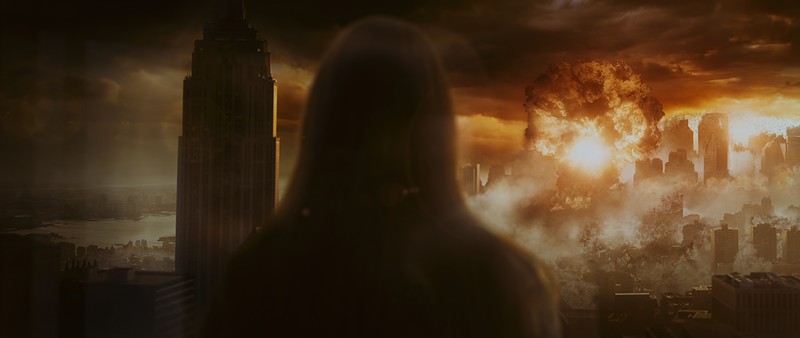
THE BLAST
In The Divide, several atomic bombs fall. Back in 1945, the US dropped two nuclear bombs on Japan, one each in the cities of Hiroshima and Nagasaki. It ended the second World War like a shotgun blast at a house party.
The use of those bombs still ignites debate today. Before the nukes fell, Japan and the United States had lost 2 million soldiers. An American invasion of Japan was being planned that would have doubled, or even tripled those casualty numbers. The shock and awe of nuclear weaponry ended a war that would have claimed millions of more casualties, for the price of 225,000 Japanese civilians. President Truman offered the chance to surrender before the bombs dropped. Its hard to admit but perhaps these blows did save lives down the line, and deter nations from such scales of war for decades to follow.
The harsh incendiary death only implied in The Divide had unfortunately been experienced in reality in Hiroshima and Nagasaki, Japan. A fire that burns hotter than the surface of the sun was opened up, searing anything and anyone near ground zero. It melted steel, and turned sand to glass.
After the blazing infrared and incendiary death, further damage is caused in the form of blast force and winds.
Most of the material damage caused by a nuclear air burst is caused by a combination of the high static overpressures and the blast winds. The long compression of the blast wave weakens structures, which are then torn apart by the blast winds. The compression, vacuum and drag phases together may last several seconds or longer, and exert forces many times greater than the strongest hurricane.
Acting on the human body, the shock waves cause pressure waves through the tissues. These waves mostly damage junctions between tissues of different densities (bone and muscle) or the interface between tissue and air. Lungs and the abdominal cavity, which contain air, are particularly injured. The damage causes severe hemorrhaging or air embolisms, either of which can be rapidly fatal. – Wikipedia
One jaw-dropping documentary on the nuclear explosions of WWII is called Hiroshima, and it can be found on Netflix instant. Some of the stories it told from first hand witnesses were harrowing. Scores of people, burnt black with flesh hanging from their bones, staggered (some for miles) away from the blast only to die once reaching other survivors.
Countless skeletons, seared of their flesh, were found in the debris and ashes of Hiroshima, up to a mile away from the blast. And worst of them all, the tale of a mother who could not free her 5 year old child from the collapsed debris – who had to listen to her child burn alive, unable to free her from the wreckage.
There are thousands of stories that never get told in the wake of such disaster. Even still, The Reaper would not be finished with survivors. In The Divide, Michael Biehn was deadly adamant about not going outside the taped door and letting the nuclear ash in.
He had good reason.

RADIATION POISONING – LINGERING DEATH
In the weeks after the nuclear bombs were dropped in Japan, large numbers of people died from radiation burns and sickness. “Lucky” survivors clinging to life suffered from chronic weakness, bloody diarrhea, vomiting, open sores, and dehydration. Low white blood cell count and almost complete absence of the platelets necessary to prevent bleeding. Radiation and its after-effects claimed the most lives – victims flesh swiss-cheesing with ulcers, hair and teeth falling from their roots, anemia – for even years after – bone marrow syndromes and babies being still born.
RECOMMENDED FILMS:
THE DAY AFTER: When I was in high school, this film came out and played on TV. Its basically an example of what would have happened had the Cuban Missle Crisis not been averted. Scares the hell out of me to this day – because it can happen, and probably will one day.
DAMNATION ALLEY: A bit cheesy and throwback on the FX, its still a cool 70’s style, no holds barred look at nuclear war and its post/apocalyptic world.
TERMINATOR II: Although not really a horror film, and more a post-apocalyptic tale than an straight-up nuclear war film, it served up one of the most frightening sequences of my lifetime when we saw what it would look like to be nuked out of LA
Other films circa the topic (nuclear waste horror) that should not be missed: C.H.U.D., CLASS OF NUKE EM HIGH, EMPIRE OF THE ANTS, and worthy mention WARGAMES – it isnt exactly horror, but the threat of a computer launching the world’s nuclear arsenal and starting World War III isnt far from it.
Documentaries:
HIROSHIMA (1945) – Nuclear Bombing of Japan Ends WWII
CUBAN MISSLE CRISIS (1962) – USA and USSR Nearly Unleash Their Nuclear Arsenals
Fact: The largest atomic bomb ever detonated by the United States is around 15 megatons. The largest nuke ever exploded was 57 megatons – nicknamed Tsar Bomba – and set off by Russia. The explosion was so immense that people got third degree burns 65 miles away.
Remember in Escape From New York when Snake Plisskin went “walkin around down there” after Cabbie told him not to – under the theater where they were singing New York, New York. A woman was being raped and beaten by a couple of degenerates? The Divide plays out like a long look into that five-second sequence. The devolution of humanity once all hell breaks loose, and the horror of being trapped in a closed area with them.
While its implied that the lucky ones burn up in the blast, and that the real Hell would be having to survive amidst such vermin, the real draw to The Divide is equal to that which is the actual horror that the budget couldn’t focus on – Manhattan’s blast damage outside that shelter door. Its a horror you can’t help but try to imagine and dwell on fictionally, because of the level of carnage and Hades-on-Earth-like factors. As you watch the news tonight and go about your lives from here, always remember that which we so easily forget – that the reality of this gun’s barrel is actually pointed at our heads at every given moment.
~ John Marrone – Closer to Death
