Editorials
Mr. Disgusting Picks the Best Horror Films of 2017!
*Keep up with our ongoing end of the year coverage here*
Other Year’s Lists: 2008 | 2009 | 2010 | 2011 | 2012 | 2013 | 2014 | 2015 | 2016 | 2017 | 2018 | 2019 | 2020
There is no question that 2017 was one of the best years ever for horror. Just a few years ago I was unhappy that The Babadook topped my best of the year list. It perfectly represented where horror was at the time, being that none of the films deserved the honor of “best of the year”. But then something happened – in 2015, there was an overload of independent films that made choosing a top ten immensely difficult. The momentum continued through 2016, setting the stage for what could easily be horror’s ultimate mic drop.
There’s panic across the board about getting people into theaters. The box office is shrinking. Studio tentpoles are failing. Yet, there stood several horror films that annihilated everything in their path. From Split to Get Out, Annabelle: Creation, and then IT, horror film after horror film continued to take the top spot at the box office, taking in hundreds of millions worldwide. Our genre is quite literally unstoppable right now.
They say when the world is in flames and there’s political turmoil, entertainment has the most to gain, especially horror. It’s pure and unadulterated escapism. People aren’t looking for superheroes to save them, they’re looking for the final girl to stab that bad mother fucker in the back. It’s the fantasy of self-induced power and the fight for survival. Horror movies give us the illusion of control when the world is coming for you, and there’s nothing more satisfying than standing up to life and kicking it right in the balls.
Horror does not discriminate. Horror is unity. Horror is for everyone. Horror is 2017.
Honorable Mention: Downrange (D. Ryuhei Kitamura; Eleven Arts)

Ryuhei Kitamura’s Downrange is quite simple, stranding a carpool of teenagers on the side of the road as an enigmatic sniper targets them one-by-one. The film is 100% pure rage, leaving brains splattered across the hot pavement, and murdering innocent children who accidentally end up at the wrong place at the wrong time. It’s about as mean-spirited as horror can get…and it’s glorious. While typically turned off by films this dark and unforgiving, Downrange is an uncomfortable and unapologetic breath of fresh air. It feels necessary. Horror has gone soft.
It’s also loaded with nonstop thrills that will have audiences on the edge of their seats until the shocking conclusion. It’s been awhile since we’ve seen anything with this much grit and guts, with Kitamura digging down deep to deliver a punch that’s going to knock audiences right on their asses.
Other Honorable Mentions:
- mother! (D. Darren Aronofsky)
- Split (D. M. Night Shyamalan)
- Happy Death Day (D. Christopher Landon)
- Wish Upon (D. John R. Leonetti)
- Annabelle: Creation (D. David Sandberg)
10. The Killing of a Sacred Deer (D. Yorgos Lanthimos; A24)

Director Yorgos Lanthimos (The Lobster) reunites with Colin Farrell (In Bruges) in this frightening thriller about the sacrifices one man has to make in order to protect his family. While Farrell is always entertaining to watch, Barry Keoghan carries this Shakespearean nightmare on his shoulders. Keoghan plays a young boy who befriends a doctor (Farrell) who may or may not have killed his father in the operating room. He’s plotted his revenge. His performance is seductive, manipulative, and even more so unnerving when you find yourself wondering if a young boy is capable of such horrors. The movie is a high-strung slow burn that terrorizes the audience with agonizing tension that’s never released.
9. Pyewacket (D. Adam MacDonald; IFC Midnight)
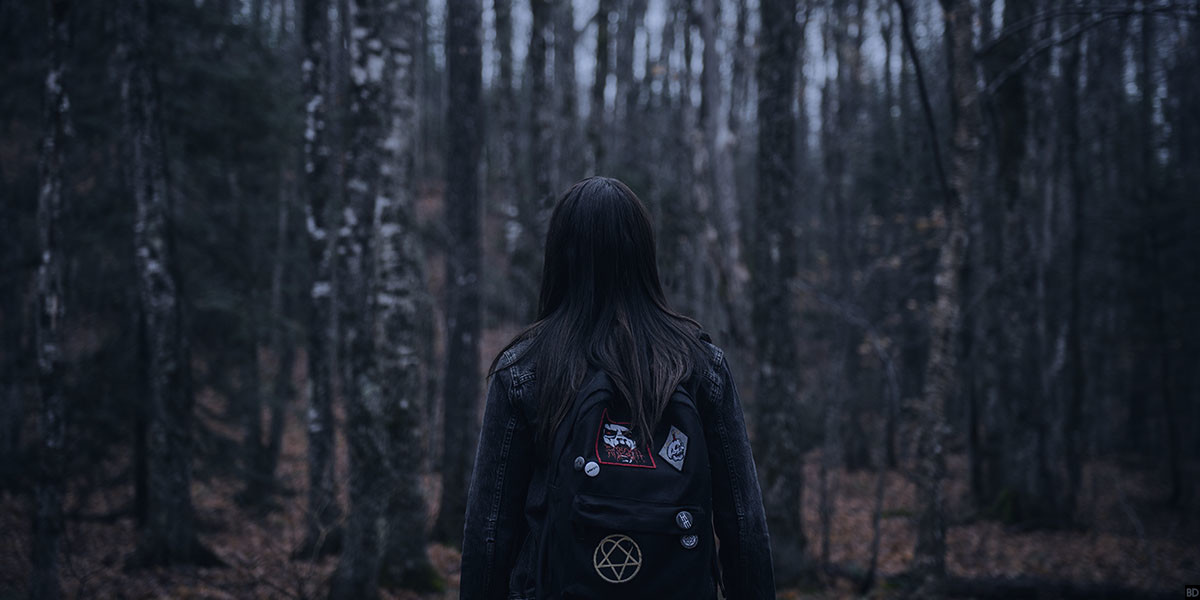
One of the biggest surprises of the year was the Adam MacDonald‘s under-the-radar Pyewacket, a frightening coming-of-age slow burn that delivers brooding heavy metal horror. Beautifully shot with impressive performances all around, what’s great about Pyewacket is that it never overplays its hand. MacDonald is never trying too hard to shock the audience and is more determined to make his film believable than anything else. In that regard, he still delivers on his promise and offers up a shocking finale that’s equally crushing as it’s mortifying. Pyewacket is a surprisingly simple movie, but it’s incredibly well made and entertains with the best of them. It’s brooding tension will get under your skin and leave you thinking about it for days after.
8. Tragedy Girls (D. Tyler MacIntyre; Gunpowder & Sky)

Tyler MacIntyre’s Tragedy Girls, powered by Alexandra Shipp and Brianna Hildebrand‘s performances, is fiercely entertaining. Boasted as a “new spin on the slasher genre,” the film delivers on this promise, approaching the killing from a different perspective. While the film is lightning fun, the deaths within it are brutal, Final Destination brutal, directed and edited with precision for maximum impact that surely will have audiences roaring in delight. Tragedy Girls is sweet and salty, the perfect mix of horror and comedy that surely will have you clicking the “heart” button over and over.
7. Brawl in Cell Block 99 (D. S. Craig Zahler; RLJE)
While this isn’t the best genre film of the year, it may very well be my favorite. I couldn’t tell you the last time I obsessed over a movie as much as Brawl in Cell Block 99, which stars a badass Vince Vaughn as a man who must fight his way through several prisons in order to save his wife (Jennifer Carpenter), and the baby inside her. The stakes are off-the-charts high as director S. Craig Zahler threatens the life of an unborn baby, setting the stage for Vaughn to go full Wolverine, brutally annihilating everyone in his path. The best way to describe the film is “Tarantino-lite”, told in a pulp-y, over-the-top manner that results in excessive (unrealistic) gore and ultra-violence. The practical special effects are weird and unnerving, tapping into old-school horror, turning Cell Block 99 into a massive bloodbath. I’m obsessed with this authentic cult midnight movie that’s more fun than anything else you’ll see all year.
6. Raw (D. Julia Ducournau; Focus World)
Garance Marillier delivers a powerhouse of a performance, playing a young vegan girl entering her first year of veterinarian school. There, she reconnects with her older sister, while battling new feelings, emotions, and urges in this coming-of-age horror film that can only be likened to Ginger Snaps.
Julia Ducournau’s film is as riveting as it is tense, chewing on complex issues while also hammering the audience with fucked up sequences (one in particular nearly made me vomit). And as gross as Raw can get, the camerawork and cinematography together are masterful, delivering one of the most gorgeous horror films in years.
Up Next: My Top 5 Horror Films of the Year
Editorials
Steven Spielberg Just Directed the Scariest Scene of His Career in ‘Disclosure Day’
Steven Spielberg has always been conversant in the cinematic language of the horror genre, despite relatively few credits in the genre. His contributions as a writer and producer on things like Poltergeist are legendary, and films like Duel and Jaws certainly wield the horror genre in remarkable, often chilling ways. He may not be a horror filmmaker, but he knows when he needs to scare us, and he has the tools to make that happen.
I didn’t go into Disclosure Day, Spielberg’s alien epic, expecting outright horror, and indeed the film leans much more into thrilling than frightening. This is not a horror film, but for a few minutes in the middle, much to my surprise, it became one.
Spielberg has filmed more than his fair share of scary scenes over the years, but with Disclosure Day, he directed a new contender for the scariest scene of his entire career.
SPOILERS AHEAD for Disclosure Day!

Josh O’Connor in DISCLOSURE DAY, directed by Steven Spielberg.
Among the various alien secrets laced throughout Disclosure Day are a trio of palm-sized rods, the color of pencil graphite. These rods, originating from another planet, can be used for a number of things, but for the purposes of this scene, the most important is “diving,” gripping the rod in one bare hand and using its power to “dive” into the mind of another person.
The person holding the rod in this scene is Noah Scanlon (Colin Firth), head of shadowy cybersecurity firm Wordex, who is hellbent on keeping human knowledge of extraterrestrials secret from the general public. Scanlon’s trying to find whistleblower Daniel Kellner (Josh O’Connor), who’s got all of those alien secrets tucked in a backpack while he’s on the run, and while Daniel’s more experienced mind is protected from diving, his girlfriend Jane’s (Eve Hewson) is not. So, monitored by medical personnel at Wordex headquarters (diving is dangerous), Scanlon pushes his way into Jane’s mind to find the location of Daniel’s safe house.
A telepathic invasion is scary enough on its own, but Spielberg doesn’t stop there. When Scanlon dives into Eve’s mind, he appears to her to be sitting across the kitchen table, like he’s in the room. Her bright blue eyes turn Scanlon’s dark brown, and she loses much of her control over her own body, not to mention her mind. Moments before, Daniel finally shared with her the secrets in his backpack, so Jane is shocked, conflicted, deeply vulnerable when Scanlon slips inside her head. This is not just telepathy. This is possession.
Spielberg underscores this not just through the visual language of the scene, as Jane breaks out in a sweat and struggles to sit upright as Scanlon invades her mind, but through Jane’s background. As she revealed to Daniel earlier in the film, Jane is a former novitiate nun who left her convent when she began to question her calling. She still believes firmly in God and, more importantly, believes that perhaps proof of alien life should be kept secret from the public because, in her eyes, it would upset the entire balance of faith in the world. God is a defining factor for humankind, Jane argues, and showing humanity proof of creatures from the stars would undercut that in dangerous ways.

This context, combined with the crucifix necklace Jane’s holding in her hand at the time of the dive, makes this scene the closest thing Spielberg will ever shoot to something out of The Exorcist. It’s not just a battle of wills, but a battle of faith. As an amoral technocrat worms his way into her memories, her beliefs, her faith, Jane turns the crucifix into a weapon, squeezing it until her hand bleeds when she discovers that a pain response can momentarily push Scanlon out of her head.
Of course, when you put a crucifix and a bloody hand together, it conjures images of stigmata. Screenwriter David Koepp pushes the allusion further by having Scanlon quote Christ on the cross to Jane by way of convincing her that she must be the one to stop Daniel by any means necessary.
It’s easy to see why this is scary, right?
On a very basic level, you have a powerful, wealthy man subduing and assaulting an innocent young woman, which is frightening enough. Then, the layers of the scene kick in. Scanlon doesn’t just assault Jane, but possesses her, seizes her memories, her knowledge, and finally her own free will, all while Jane literally clings to her faith in an effort to fight back. Disclosure Day is, among other things, a story about who has a right to the truth, and Scanlon believes that he should be the arbiter of that truth. Not just the truth as he sees it, but the truth as Jane sees it as well. If they don’t see eye to eye, he’ll make her.
But the possession, as it turns out, cuts both ways. Using the rod to dive is, for a normal human being, an intensely strenuous process. Scanlon admits that previous attempts almost killed him, and for some members of his time, so much as touching the rod results in a near-death experience. Even accessing an unprepared mind like Jane’s takes a lot of Scanlon, and when she kicks him out by squeezing the crucifix – again, so much meaning embedded in the details here – his team holds him back and tries to offer medical intervention. But Scanlon persists, pushing them away, and keeps diving back in.
This means that Jane can’t escape him because he just won’t stop pushing back through her defenses, but it also means that each time Scanlon enters her mind, and thus the safe house, he looks more monstrous. By the end, through a combination of lighting and makeup, Firth barely looks human, conjuring up images of the possessed Father Karras at the end of The Exorcist.

Colin Firth (center, standing) in DISCLOSURE DAY, directed by Steven Spielberg.
On a pure, visceral craft level, all of this is quite frightening, but the real trick to making this scene into Spielberg’s most terrifying lies in the more existential horror surrounding all of this. Disclosure Day is a film about the battle for the truth over extraterrestrials, but it’s also about a fight against an impossibly powerful surveillance state, the devaluing of human and alien lives in favor of some nebulous collection of assets, and the value of the individual in a world that increasingly lumps people into demographic boxes and writes them off.
In this scene, the surveillance state becomes supernatural, a human life is worth less than a piece of information, and an extragovernmental technocrat would rather sacrifice his own humanity than see reason. In 2026, few things could be more terrifying than that. Spielberg knows this and wields it mightily, proving once again that, while he’s not a strictly horror filmmaker, he can direct horror with the best of them.
Disclosure Day is in theaters now.

Eve Hewson (second from left) in DISCLOSURE DAY, directed by Steven Spielberg.

You must be logged in to post a comment.